


Most among the long faces of the UK's Labour Party was this fact: a party which had never won two full terms in government won a third.
That is not to be dismissed. There was a time, back in the 1980s, when such a feat seemed to be the remotest fantasy.
Even the midnight rumors of a Labour parliamentary majority of 50, later revised, would once have thrilled, rather than crushed, the party's supporters. In 1974, for example, that kind of margin would have felt like a landslide. And, lest we forget, Margaret Thatcher started a revolution in 1979 with a majority of just 44. A sober view would say that Thursday was no disaster, merely a sign that, as David Blunkett declared, "normal politics has returned" -- that the rhythms of the 1960s and 1970s had been restored.
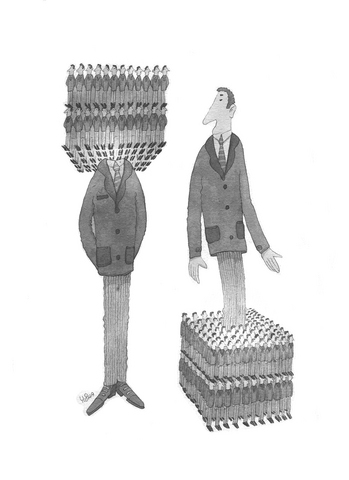
ILLUSTRATION: YU SHA
But that's not how it felt for a few jittery hours as Thursday turned into Friday. For among "New Labour's" many rewritings of the political rule book was its alteration of our sense of scale. The triple-digit wins of 1997 and 2001 made landslides seem normal, so that anything less looked like failure. And in the small hours of Friday, as result after result showed a sharp plunge in the Labour vote, the fear of failure was palpable.
There were important Labour holds -- the party fended off strong challenges in the totemic New Labour seat of Birmingham Edgbaston as well as in Hove and Ynys Mon -- but also some painful defeats. A giant swing to the Liberal Democrats in the middle-class north London seat of Wood Green and Hornsey toppled former minister Barbara Roche -- one of the clearest proofs that the war on Iraq cost Labour dear.
But it was more than seats which fell: some of "New Labour's" defining myths tumbled, too.
First and most obvious to go was the legend of Prime Minister Tony Blair's infallibility. As soon as he was elected Labour leader in 1994, he had seemed to have a magic touch: cartoonists showed him walking on water. Last night the magician fell to earth. He won a viable, working majority -- the achievement of a mortal, rather than a sorcerer. And what few Labourites would deny is that the leader who was once his party's shiniest electoral asset became, in 2005, an obstacle to be overcome. The Lib Dem surge was caused by antipathy to the Iraq war, of course, but it was also a function of the new Blair factor -- the sentiment among many former Labour voters that they would rather switch parties than endorse "that man."
The second New Labour belief to take a hit was the strategy of the big tent. The original Blair triumph was to make his party a coalition so capacious it had room for the left and right, stretching from unreconstructed socialist Tony Benn to former Tories.
On Thursday the coalition came under strain from both directions. Its left flank peeled off, dismayed by the Iraq war, by tuition fees for university students, by the assault on civil liberties, by the erosion of trust in the prime minister. Those voters wandered out of the tent into the arms of the Lib Dems and others.
But there was pressure from the right, too. The Conservatives blew their dog whistle on immigration and asylum and, in parts of the country, voters who had moved from Conservative to Labour in 1997 pricked up their ears and ran back home. Peterborough, Putney and Ilford North slipped from red to blue.
For the Tories, it seemed like a decent night's work. The party was flat on the floor in 2001. On Thursday it picked itself up and started to fight. Michael Howard will be credited for taking the first step towards a Tory revival.
For some Conservative modernizers, that will count as a disappointment -- not that they would dare say such a thing out loud.
For they needed the party either to win or be conclusively defeated, so that they might begin the wholesale transformation that Labour underwent in the 1990s. Now, the modernizers fear, Tories will think they need do no more than give one more heave next time. Worse, Conservatives may conclude that playing to Britons' demons, rather than their better angels, is what pays dividends.
Liberal Democrats found it hard to know what kind of night they were having. Even at 2:30am Friday morning, no national picture was emerging. Some gains here, as in Birmingham Yardley, but losses there, as in Newbury. It was spotty and patchy.
Still, the larger point was that in the election of 2005, they were finally on the map. In the last week of the campaign, they became the chief objects of Labour fire. This is a mark of their achievement, the arrival, perhaps, of three-party politics. This represents a real change in the British landscape. The Lib Dems are no longer on the margins, dismissed as an irritant by the other parties -- but now a real player that can turn elections.
So what is the outcome? When Blair spoke to the people of Sedgefield, looking pained and drawn rather than elated, he said Britons had wanted a Labour government with a reduced majority. Most pundits had said that outcome was impossible to achieve; the vote was too blunt an instrument to effect so calibrated a consequence.
And yet that is what seems to have happened. Now there will be a House of Commons with more Lib Dems, a couple more independents and, yes, more Conservatives. The house of poodles, the rubber stamp, is gone.
That might have a taming effect on Labour. Now the party will simply not have the votes to drive through another tuition fees, another ID cards, another Iraq. The Labour rebels will have the power of veto.
But it may also be good for parliamentary democracy itself. After years dismissed as a pliant echo chamber for the government, the House of Commons will suddenly matter. The people of Britain spoke -- and they may have got exactly what they wanted.
Recently, China launched another diplomatic offensive against Taiwan, improperly linking its “one China principle” with UN General Assembly Resolution 2758 to constrain Taiwan’s diplomatic space. After Taiwan’s presidential election on Jan. 13, China persuaded Nauru to sever diplomatic ties with Taiwan. Nauru cited Resolution 2758 in its declaration of the diplomatic break. Subsequently, during the WHO Executive Board meeting that month, Beijing rallied countries including Venezuela, Zimbabwe, Belarus, Egypt, Nicaragua, Sri Lanka, Laos, Russia, Syria and Pakistan to reiterate the “one China principle” in their statements, and assert that “Resolution 2758 has settled the status of Taiwan” to hinder Taiwan’s
Singaporean Prime Minister Lee Hsien Loong’s (李顯龍) decision to step down after 19 years and hand power to his deputy, Lawrence Wong (黃循財), on May 15 was expected — though, perhaps, not so soon. Most political analysts had been eyeing an end-of-year handover, to ensure more time for Wong to study and shadow the role, ahead of general elections that must be called by November next year. Wong — who is currently both deputy prime minister and minister of finance — would need a combination of fresh ideas, wisdom and experience as he writes the nation’s next chapter. The world that
Can US dialogue and cooperation with the communist dictatorship in Beijing help avert a Taiwan Strait crisis? Or is US President Joe Biden playing into Chinese President Xi Jinping’s (習近平) hands? With America preoccupied with the wars in Europe and the Middle East, Biden is seeking better relations with Xi’s regime. The goal is to responsibly manage US-China competition and prevent unintended conflict, thereby hoping to create greater space for the two countries to work together in areas where their interests align. The existing wars have already stretched US military resources thin, and the last thing Biden wants is yet another war.
Since the Russian invasion of Ukraine in February 2022, people have been asking if Taiwan is the next Ukraine. At a G7 meeting of national leaders in January, Japanese Prime Minister Fumio Kishida warned that Taiwan “could be the next Ukraine” if Chinese aggression is not checked. NATO Secretary-General Jens Stoltenberg has said that if Russia is not defeated, then “today, it’s Ukraine, tomorrow it can be Taiwan.” China does not like this rhetoric. Its diplomats ask people to stop saying “Ukraine today, Taiwan tomorrow.” However, the rhetoric and stated ambition of Chinese President Xi Jinping (習近平) on Taiwan shows strong parallels with


 RSS
RSS