


A contest for China's soul is now underway in that giant country, pitting two powerful forces and two very different stances toward the outside world against each other. The outcome will have a major impact on whether China succeeds in becoming a nation capable of having truly constructive and durable relations with the outside world.
On one hand, China's economic revolution has helped position it in the world as a confidant powerhouse of trade, a more responsible global powerbroker, and even as a reassuring military presence. On the other hand, China remains trapped by a past and a mindset steeped in a sense of victimization, which tempts it to export blame for internal problems.
The main question is whether China can escape the pull of this old psychological syndrome -- which kept it preoccupied throughout the 20th century with debilitating sentiments of weakness, insecurity, and humiliation -- and allow itself to be guided by a new outlook on the world, and even on old enemies.
The anti-Japanese demonstrations are a symptom of the old syndrome, fueled by grievances born at a time when China was, indeed, aggrieved and humiliated. With China's growing economic clout, rising standard of living and increasingly respected place in the world, one would hope that the Chinese and their leaders would find a way to let go of the dead. Yet, even as the luster of the "China miracle" dazzles the world, the Chinese seem loath leave behind their dark feelings of victimization.
Instead of assuming a new national paradigm based on the reality of their accomplishments -- national unity, robust international trade, and growing global influence, China's leaders cling to the old paradigm of their country as victim, the "sick man of Asia" being "cut up like a melon" by predatory imperial and colonial powers like Japan. That bitter memory of oppression and exploitation lingers in the minds of too many Chinese like the afterimage of a bright light long after it has been turned off.
The Japanese occupation of China was a particularly galling and humiliating period because Japan was an Asian, not a Western, power. Moreover, like China, Japan was a society steeped in Confucian culture, which many Chinese reformers in the 19th and 20th centuries blamed as a critical impediment to their own country's development and modernization.
Of course, Japan did occupy China, committed unimaginable savagery, and has since paid no reparations or apologized in a convincing way. Nevertheless, what benefit does China gain by continuing to raise these issues 60 years later? What is worth the risk of alienating the world's second largest economy and one of China's most important trade partners?
First, aiding and inciting the expression of popular anger against Japan gives China's Communist Party leaders a powerful and readily available vehicle for rallying domestic support, thereby legitimizing their own power. At the same time, the demonstrations represent China's experience of the world as an unequal place where the weak are inevitably bullied, exploited and humiliated. This mindset suggests that, despite the panoramic city skylines, the billboards and the flashy five-star hotels, China has a long way to go before it truly comes to understand and appreciate its actual accomplishments and status.
Indeed, surges of organized anger when China is attacked or insulted are hardly new. The reaction of China's leaders after the US' accidental attack on China's embassy in Belgrade in 1998, and to the collision of an American spy plane with a Chinese plane over the Pacific in 2001, was to permit, if not foment, large anti-foreign demonstrations. In keeping with this syndrome, Foreign Minister Li Zhaoxing (李肇星) has accused Japan of having "hurt the feelings of the Chinese people" by not apologizing for their crimes, as if he were minister of psychology, rather than foreign affairs.
Of course, China's wounded psyche and the desire for restitution from its former tormentors deserve sympathy. In this sense, China, like many countries, could be said to have something of a bi-polar personality. Much of the emotional force of Mao Zedong's (毛澤東) revolution derived from the widespread sense of unequal treatment and humiliation by foreign powers, and this revolutionary fervor has never been properly interred.
Just as Mao's portrait has never been taken down from The Gate of Heavenly Peace, so whole elements of his revolution continue to survive in China's institutions, ways of thinking, and modes of interacting with the world. Like recessive genes, they sometimes suddenly re-express themselves.
The role of victim is all too familiar to the Chinese, perhaps even somewhat comforting, for it provides a way to explain -- and explain away -- China's problems. But it is also dangerous, because it derives from China's old weaknesses rather than its new strengths. The era of Japanese militaristic and imperialist power has long gone, and the world is beating a path to China's door. The last thing the country needs is to remain trapped in the past.
Orville Schell, the author of many acclaimed books on China, is a dean at the University of California at Berkeley.
Copyright: Project Syndicate
Taiwanese pragmatism has long been praised when it comes to addressing Chinese attempts to erase Taiwan from the international stage. “Taipei” and the even more inaccurate and degrading “Chinese Taipei,” imposed titles required to participate in international events, are loathed by Taiwanese. That is why there was huge applause in Taiwan when Japanese public broadcaster NHK referred to the Taiwanese Olympic team as “Taiwan,” instead of “Chinese Taipei” during the opening ceremony of the Tokyo Olympics. What is standard protocol for most nations — calling a national team by the name their country is commonly known by — is impossible for
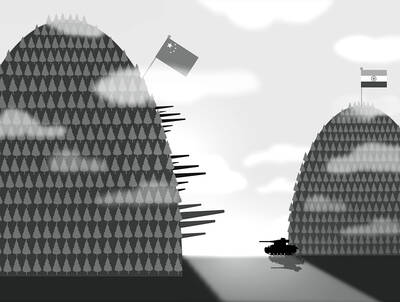
India is not China, and many of its residents fear it never will be. It is hard to imagine a future in which the subcontinent’s manufacturing dominates the world, its foreign investment shapes nations’ destinies, and the challenge of its economic system forces the West to reshape its own policies and principles. However, that is, apparently, what the US administration fears. Speaking in New Delhi last week, US Deputy Secretary of State Christopher Landau warned that “we will not make the same mistakes with India that we did with China 20 years ago.” Although he claimed the recently agreed framework
China’s supreme objective in a war across the Taiwan Strait is to incorporate Taiwan as a province of the People’s Republic. It follows, therefore, that international recognition of Taiwan’s de jure independence is a consummation that China’s leaders devoutly wish to avoid. By the same token, an American strategy to deny China that objective would complicate Beijing’s calculus and deter large-scale hostilities. For decades, China has cautioned “independence means war.” The opposite is also true: “war means independence.” A comprehensive strategy of denial would guarantee an outcome of de jure independence for Taiwan in the event of Chinese invasion or
The Office of the US Trade Representative (USTR) on Wednesday last week announced it is launching investigations into 16 US trading partners, including Taiwan, under Section 301 of the Trade Act of 1974 to determine whether they have engaged in unfair trade practices, such as overproduction. A day later, the agency announced a separate Section 301 investigation into 60 economies based on the implementation of measures to prohibit the importation of goods produced with forced labor. Several of Taiwan’s main trading rivals — including China, Japan, South Korea and the EU — also made the US’ investigation list. The announcements come


 RSS
RSS