


India is not China, and many of its residents fear it never will be. It is hard to imagine a future in which the subcontinent’s manufacturing dominates the world, its foreign investment shapes nations’ destinies, and the challenge of its economic system forces the West to reshape its own policies and principles.
However, that is, apparently, what the US administration fears. Speaking in New Delhi last week, US Deputy Secretary of State Christopher Landau warned that “we will not make the same mistakes with India that we did with China 20 years ago.” Although he claimed the recently agreed framework for Indo-US trade would be a win-win, Washington did not intend to let India develop new markets just in case “the next thing we know, you are beating us at many commercial things.”
Landau’s statement blended confrontation and insecurity the way only America-Firsters can. Even so, it is worth taking it seriously. Not least because a milder version of his claim might be true: The rush to invest and build up China after it entered the global trading system in 2001 would not be replicated for any other developing country. A unique set of factors — the explosion of intercontinental trade, and a ubiquitous end-of-history confidence — made that possible. The stars would not align so favorably with anyone else.
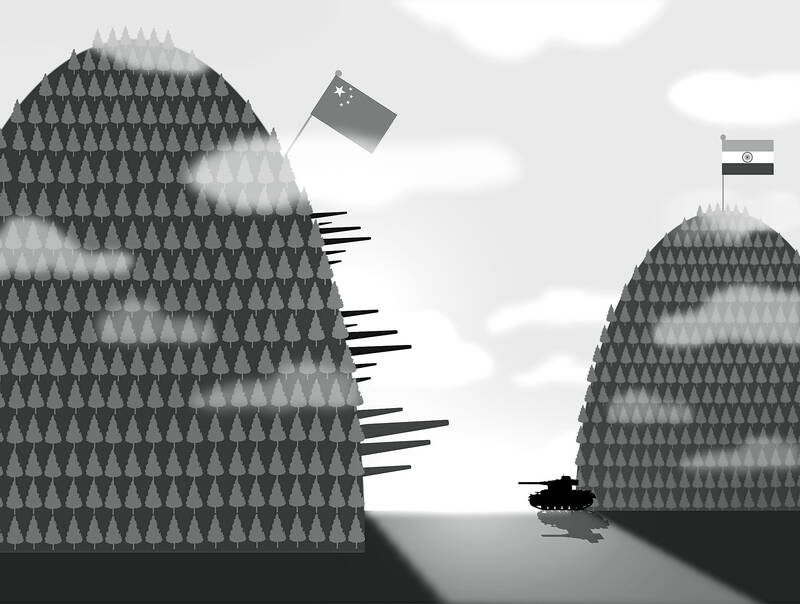
Illustration: Yusha
Even if you are willing to buy the Landau view that the West’s interest in China was a mistake, his complete failure to diagnose what went wrong is still dangerous. The problem was not that an emerging economy drew interest and investment. The problem was that the world over-invested in an explicitly mercantilist, state-directed model that had the incentive and ability to pivot swiftly into expanding its own economic power at everyone else’s expense.
India’s political economy is messy and frustrating — but it is driven by the private sector, not by the state. Companies make their own choices about how to borrow, what to make, and where to sell. They operate in the pursuit of profits, not control. Such a nation has neither the ability to, nor any interest in, dominating supply networks. It wants to fit into value chains, not own them.
Nor is India’s commercial culture the same as China’s, as foreign investors both enthusiastic and depressed would agree. You might lose your money in India, but not your intellectual property. Those fearful of investing usually worry their local partners could miss targets, not that they could become globe-spanning rivals.
What India produces and how it expands are also substantially different. Growth is driven by domestic consumption and dominated by services, rather than living off investment and exports. New Delhi has spent more than a decade focusing on domestic production and subsidizing factories — and, after all that, manufacturing has stayed the same proportion of gross domestic product as it was to begin with. Momentum alone would drive its output toward being a sixth and then a fifth of the global total, but it would grow alongside the West, rather than substitute it. These are complementary economies.
The West could invest twice as much in India as it did in China two decades ago, and it still would not produce a systemic rival. In fact, isolating the nation — starving its markets, technology, and financing — is much more likely to produce a geopolitical and geo-economic challenger. Even at the best of times, India tends to turn inward, to believe that its growth could happen despite the outside world and not because of it. The US should be careful not to feed this instinct.
What people used to call “engagement” with China might not have turned it into a constructive participant in the post-War global order; but active disengagement with the Global South, and with India in particular, could certainly create opponents and disruptors of that system.
The most potent threat India poses to the US and the West is the same as it always was: underperformance. Even a Make America Great Again (MAGA)-driven Washington should worry not that its patronage could cause another China to emerge, but that, despite its trickles of support, neither India nor any other country or grouping, would be able to balance China.
Mihir Sharma is a Bloomberg Opinion columnist. A senior fellow at the Observer Research Foundation in New Delhi, he is the author of The Last Chance for the Indian Economy.This column reflects the personal views of the author and does not necessarily reflect the opinion of the editorial board or Bloomberg LP and its owners.
The conflict in the Middle East has been disrupting financial markets, raising concerns about rising inflationary pressures and global economic growth. One market that some investors are particularly worried about has not been heavily covered in the news: the private credit market. Even before the joint US-Israeli attacks on Iran on Feb. 28, global capital markets had faced growing structural pressure — the deteriorating funding conditions in the private credit market. The private credit market is where companies borrow funds directly from nonbank financial institutions such as asset management companies, insurance companies and private lending platforms. Its popularity has risen since

On March 22, 2023, at the close of their meeting in Moscow, media microphones were allowed to record Chinese Communist Party (CCP) dictator Xi Jinping (習近平) telling Russia’s dictator Vladimir Putin, “Right now there are changes — the likes of which we haven’t seen for 100 years — and we are the ones driving these changes together.” Widely read as Xi’s oath to create a China-Russia-dominated world order, it can be considered a high point for the China-Russia-Iran-North Korea (CRINK) informal alliance, which also included the dictatorships of Venezuela and Cuba. China enables and assists Russia’s war against Ukraine and North Korea’s
After thousands of Taiwanese fans poured into the Tokyo Dome to cheer for Taiwan’s national team in the World Baseball Classic’s (WBC) Pool C games, an image of food and drink waste left at the stadium said to have been left by Taiwanese fans began spreading on social media. The image sparked wide debate, only later to be revealed as an artificially generated image. The image caption claimed that “Taiwanese left trash everywhere after watching the game in Tokyo Dome,” and said that one of the “three bad habits” of Taiwanese is littering. However, a reporter from a Japanese media outlet
An article published in the Dec. 12, 1949, edition of the Central Daily News (中央日報) bore a headline with the intimidating phrase: “You Cannot Escape.” The article was about the execution of seven “communist spies,” some say on the basis of forced confessions, at the end of the 713 Penghu Incident. Those were different times, born of political paranoia shortly after the Chinese Nationalist Party (KMT) relocated to Taiwan following defeat in China by the Chinese Communist Party (CCP). The phrase was a warning by the KMT regime to the local populace not to challenge its power or threaten national unity. The


 RSS
RSS