


After thousands of Taiwanese fans poured into the Tokyo Dome to cheer for Taiwan’s national team in the World Baseball Classic’s (WBC) Pool C games, an image of food and drink waste left at the stadium said to have been left by Taiwanese fans began spreading on social media. The image sparked wide debate, only later to be revealed as an artificially generated image.
The image caption claimed that “Taiwanese left trash everywhere after watching the game in Tokyo Dome,” and said that one of the “three bad habits” of Taiwanese is littering. However, a reporter from a Japanese media outlet who had visited the site observed several inconsistencies with the image.
The reporter said that the seats at the Tokyo Dome are tip-up seats that automatically fold up when not in use, unlike the seats in the image, which were fixed. The reporter also pointed out that a left field foul pole was missing from the image, and that the lettering on the signage was also different.
Many Taiwanese fans at the Tokyo Dome that day also said that the image was not consistent with what they had seen, and Japanese users posted clips of fans, who they said were Taiwanese, picking up trash as they left the stadium.
The Taiwan FactCheck Center said that the controversy stemmed from a post which criticized Taiwanese fans’ poor manners at the Tokyo Dome.
The story was picked up by media outlets, including one which generated an image using artificial intelligence (AI) and posted it on social media. Although originally marked as “AI-generated,” the label was later intentionally removed and spread across multiple social media platforms, including by an account which had been listed by Taiwan’s Investigation Bureau as a foreign user who previously spread malicious rumors about Taiwan.
Democratic Progressive Party legislator Michelle Lin (林楚茵) called the controversy a classic example of the Chinese Communist Party’s (CCP) cognitive warfare, and said that some of the online media accounts which spread the image were revealed to be content farms hosting local Facebook groups — “I am a XX resident” (我是XX人, with “XX” being counties or towns in Taiwan) — often reposting news from pro-China media or sharing unsubstantiated AI-generated content.
Lin has speculated that the Tokyo Dome case might also be part of the CPP’s cyberoperations aimed at sullying Taiwan’s international image and driving a wedge between Taiwanese and Japanese.
The speculations are based on cybersecurity reports from recent years which have shown that China has been operating a massive network of cybergroups to conduct intelligence gathering, surveillance and cyberwarfare around the world.
Taiwanese officials and international researchers have consistently warned about CCP cognitive warfare aimed at undermining Taiwan’s democracy and eroding public trust in the government.
A report published by OpenAI last month showed multiple covert influence operations and malicious cyberactivities linked to China using ChatGPT targeting the US, Japan and their allies. Vanderbilt University’s Institute of National Security last year released a report that showed a Chinese state-affiliated AI company was conducting AI-driven propaganda campaigns in Hong Kong and Taiwan, with the aim of shaping public opinion during election campaigns.
Taiwanese Facebook users have reported several cases of AI-generated content which were posted online through the “I am a XX resident” groups. The content was allegedly posted by CPP cybergroups, with the posts containing AI prompts which were used to make the content, such as “remove sensitive wording, enhance Taiwan local colloquial nuance,” or “re-edit for Taiwanese users, using Traditional Chinese characters.” The posters had reportedly forgotten to remove the AI prompts from the post.
Even if the Tokyo Dome image was evidence of CCP cyberwarfare tactics, due to swift cross-border fact-checking debunking the disinformation, it did not succeed in triggering widespread anger among Taiwanese and Japanese, but prompted them to unite in raising caution against a common threat.
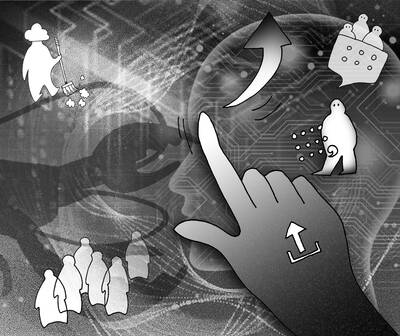
The case serves as a warning to Taiwan of how AI has changed the speed, scale and impact of information manipulation and propaganda operations, allowing disinformation to be created and spread at a very low cost.
As well as implementing stronger regulatory responses to combat AI-generated disinformation, the government should promote updated media literacy from an early age, now crucial for building societal resilience in a new AI era.
Weeks into the craze, nobody quite knows what to make of the OpenClaw mania sweeping China, marked by viral photos of retirees lining up for installation events and users gathering in red claw hats. The queues and cosplay inspired by the “raising a lobster” trend make for irresistible China clickbait. However, the West is fixating on the least important part of the story. As a consumer craze, OpenClaw — the AI agent designed to do tasks on a user’s behalf — would likely burn out. Without some developer background, it is too glitchy and technically awkward for true mainstream adoption,
Out of 64 participating universities in this year’s Stars Program — through which schools directly recommend their top students to universities for admission — only 19 filled their admissions quotas. There were 922 vacancies, down more than 200 from last year; top universities had 37 unfilled places, 40 fewer than last year. The original purpose of the Stars Program was to expand admissions to a wider range of students. However, certain departments at elite universities that failed to meet their admissions quotas are not improving. Vacancies at top universities are linked to students’ program preferences on their applications, but inappropriate admission
On Monday, a group of bipartisan US senators arrived in Taiwan to support the nation’s special defense bill to counter Chinese threats. At the same time, Beijing announced that Chinese President Xi Jinping (習近平) had invited Chinese Nationalist Party (KMT) Chairwoman Cheng Li-wun (鄭麗文) to visit China, a move to make the KMT a pawn in its proxy warfare against Taiwan and the US. Since her inauguration as KMT chair last year, Cheng, widely seen as a pro-China figure, has made no secret of her desire to interact with the Chinese Communist Party (CCP) and meet with Xi, naming it a
Taiwan People’s Party (TPP) Chairman Huang Kuo-chang (黃國昌) took the stage at a protest rally on Sunday in front of the Presidential Office Building in Taipei in support of former TPP chairman Ko Wen-je (柯文哲), who has been sentenced to 17 years in jail for corruption and embezzlement. Huang told the crowd that Chinese Nationalist Party (KMT) Chairwoman Cheng Li-wun (鄭麗文) had sent a message of support the previous day, saying she would be traveling from the south to Taipei: If the protest continued into the evening, she had said, she would show up. The rally was due to end


 RSS
RSS