


An article published in the Dec. 12, 1949, edition of the Central Daily News (中央日報) bore a headline with the intimidating phrase: “You Cannot Escape.” The article was about the execution of seven “communist spies,” some say on the basis of forced confessions, at the end of the 713 Penghu Incident.
Those were different times, born of political paranoia shortly after the Chinese Nationalist Party (KMT) relocated to Taiwan following defeat in China by the Chinese Communist Party (CCP). The phrase was a warning by the KMT regime to the local populace not to challenge its power or threaten national unity.
The Penghu Incident does not have the notoriety or historical profile of the 228 Incident that occurred two years earlier. However, both are symptomatic of the historical trauma that continues to plague attempts at national unity in Taiwan.
The CCP, too, continues to seek national unity in its own country, but very differently from how the problem is being addressed in Taiwan. While Taiwan is trying to seek unity through transparency, China is trying to eradicate differences to construct a unity of its own liking, through the suppression of history, culture and differences of opinion.
Today’s Opinion page is all about reconciliation with the past. Arthur Chang (張崇廉), a lieutenant colonel in the navy reserve, writes about transitional justice and the need to avoid seeking retribution, even though closure relies on accountability of the protagonist. He believes that the KMT is yet to allow this closure to happen. Political commentator Shen Yan (沈言) in “History points in one direction,” writes about the ethnic, cultural and linguistic complexity of Taiwanese society that occurred as a result of immigration in the post-war chaos, stretching over three generations of the same family: his grandfather heavily influenced by the Japanese colonial period, his father-in-law who spoke in a heavy Shandong accent and had experienced the 713 Penghu Incident as a student, and he himself, who grew up in the democratic era.
Finally, writer Liu Che-ting (劉哲廷) writes about the recent launch of an online resource by the Ministry of Education on transitional justice, and the absurdity of having this resource promoting transitional justice in a country in which a huge expanse of capital city real estate is taken up by the Chiang Kai-shek Memorial Hall, an “enormous monument to an authoritarian past.” The juxtaposition is absurd, although explicable with an understanding of the historical, national and ethnic complexity of a nation yet to emerge from the contradictions of the post-war period.
Official attempts at transitional justice, coupled with the vibrant debate around it, are testament to the messy but organic process that demonstrates the strengths of the democratic system: a search for unity and understanding with society-wide participation. The criticisms are valid, but that they can be levied at all is proof that expression in a democracy is not limited to a single vote every four years. It is a bottom-up process that embraces historical and ethnic diversity, where the populace is warning the former authoritarian regime that it “cannot escape” its actions.
In China, the CCP is pushing for a manufactured unity. The Chinese National People’s Congress passed the Act on the Promotion of Ethnic Unity and Progress on Thursday, which Mainland Affairs Council Deputy Minister Liang Wen-chieh (梁文傑) has said is essentially a law representing Chinese President Xi Jinping’s (習近平) vision of governing different ethnic groups in China, “to establish what the CCP perceives as ‘correct’ views on the nation, history, ethnicity, culture, education and religion.”
As Khedroob Thondup, a former member of the Tibetan parliament in exile, wrote in “Legislative unity, erasing difference” (page 8, March 14), the law recasts “unity in diversity” as “unity through uniformity” and “reframes diversity as a threat, turning legal protections into instruments of erasure.”
The law also provides a legal basis to prosecute parents who want to instill “detrimental” views in children that would “affect ethnic harmony.”
It is one man, Xi, telling individuals in the world’s second-most populous nation how to conceptualize their identity, and not to challenge the party or threaten national unity; it is a warning to any dissenters that “you cannot escape,” that there is nowhere to hide.
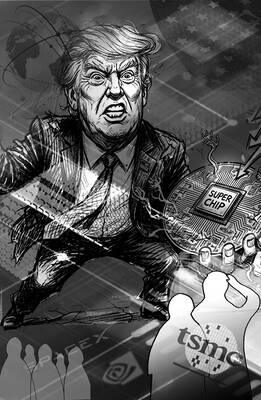
The White House’s decision to take a 9.9 percent stake in Intel Corp is looking like very shrewd business indeed. Since the government bought in at US$20.47 a share last August, the US chipmaker’s surging stock price has delivered the US a US$43 billion return. One of the reasons the investment has so far proved so sound is that the White House has made sure of it. According to The Wall Street Journal, Howard personally pushed deals on Intel’s behalf with some of the most lucrative clients imaginable. They include Nvidia Corp, the company at the heart of the AI
The Ministry of the Interior, working with the navy and coast guard, is organizing Taiwan’s first joint exercise simulating escort tankers carrying liquefied natural gas (LNG) and oil through a Chinese blockade. The drills simulate fuel transport along three maritime corridors leading toward Japan, the Philippines and the US. Deputy Minister of the Interior Sawyer Mars (馬士元) said that a blockade of the Taiwan Strait would amount to “almost a 100 percent blockade of the regional energy supply.” Minister of National Defense Wellington Koo said planning to counter a blockade is standard practice in Taipei. While the exercise is limited in
A single photograph can cut through a lot of noise, but it can also be used to misrepresent the truth. At the very least, it can concentrate the mind on something that requires further investigation. On Monday last week, Ma Ying-jeou Foundation CEO Tai Hsia-ling (戴遐齡) and former National Security Council secretary-general King Pu-tsung (金溥聰) held a news conference in which they showed a photograph of former foundation CEO Hsiao Hsu-tsen (蕭旭岑), now Chinese Nationalist Party (KMT) deputy chairman. In the image Hsiao is seated next to Xiamen Taiwan Businessmen Association chairman Han Ying-huan (韓螢煥). The two men were holding
I first met Professor Ray Jiing (井迎瑞) as a film and documentary student at Shih Hsin University’s (SHU) Department of Radio Television and Film in 1988. The following year, he went on to become the director of the Chinese Taipei Film Archive — forerunner of the Taiwan Film and Audiovisual Institute (TFAI). Over his eight-year tenure, Jiing rescued and restored over 200 classic Taiwanese films. In 1997, he established the Graduate Institute of Studies in Documentary and Film Archiving at Tainan National University of the Arts (TNNUA), and I joined the program in his third cohort of students. Beyond a


 RSS
RSS