


This is an article I have long wanted to write, but I could never find the appropriate time. And then work would intervene, causing me to put the project aside. When SARS was rampant, my thoughts constantly returned to this idea, and how I wished that someone among the epidemiologists appearing on television would raise the point. But they always focused on SARS prevention and urging people to "cultivate good habits of hygiene." Virtually no one mentioned "conceptual change," which was regrettable.
If the recent spread of SARS can teach the people of Taiwan something or act as a catalyst for conceptual change, I believe "emulating the neurotic passion for cleanliness and nervosity of the Japanese" might be the most valuable and important thing for us to learn. But this must start with basic education aimed at a "conceptual awakening."
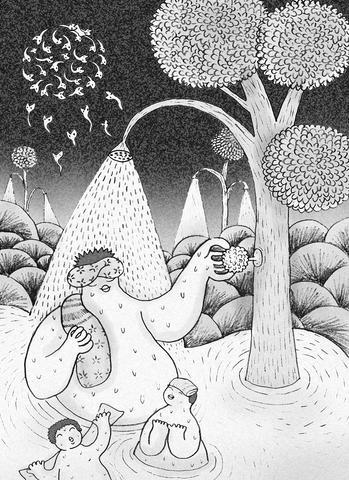
ILLUSTRATION: MOUNTAIN PEOPLE
In the Chinese-speaking world and in the perceptions of Chinese people, the "neurotic" aspect of a passion for cleanliness has always been regarded as a kind of illness -- something abnormal, irrational and unhealthy.
Since the term nervosity implies reference to nerves, it is frequently equated with hypersensitivity. Although this is not considered as serious a condition as full-blown neurosis, in the perceptions of most Chinese, there isn't all that much difference between the two.
Like the neurotic, those people characterized by nervosity are not considered normal or rational in the Chinese view. Apart from mistaken perceptions created by linguistic idiosyncrasies, there are also cultural and ethnic characteristics involved here.
In the perception of Japanese people, there is nothing at all negative about a neurotic passion for cleanliness or nervosity. On the contrary, these qualities are considered signs of assiduousness and punctiliousness. They reflect a spirit of giving consistent effort and getting to the bottom of problems. Most Japanese even believe that a neurotic passion for cleanliness and nervosity are basic virtues.
Because of such differences of culture and perception, virtually no one in the Chinese world would dare openly admit to being neurotic about cleanliness or characterized by nervosity. Having publicly made such a declaration, one would inevitably be looked upon as a freak or lunatic by others, and one would be ostracized by the collective.
But are those characterized by a neurotic passion for cleanliness and nervosity wrong? Not necessarily. As long as one's own anxiety or the demands made on oneself don't impose on others or make others unhappy, then there is no question of right and wrong. These are personality characteristics involving the placement of greater than average demands on oneself. There is nothing wrong with holding oneself to a higher standard. The ones who are wrong are those common ignoramuses who are always content just to muddle along and have been known to Chinese since the May Fourth Movement as "Mr. Close Enough." People characterized by a neurotic passion for cleanliness and nervosity will not tolerate a careless, perfunctory or "close enough" attitude.
That people in the Chinese-speaking world consider a neurotic passion for cleanliness an illness reveals something about their lackadaisical tendency to gloss over problems and get by with a minimum of effort. This is also a primary reason why China has not developed and remains a backward country today. The recent case of China deceiving the world about the SARS epidemic and thereby causing it to spread to Hong Kong and Taiwan once again demonstrated the depravity of this people lacking a neurotic passion for cleanliness.
A decade ago, I wrote an article to share with everyone the success story of a Korean who had a neurotic passion for cleanliness. He was Park Tae-joon, the founder of South Korea's state-run Pohang Steel Corp (comparable to Taiwan's China Steel, but three times larger -- it is the world's largest single steel refinery).
As a boy, Park traveled to Japan with his father, who was doing business there, and in Japan he finished high school and later graduated from the department of mechanical engineering at Waseda University. During the time he pursued his studies in Japan, his meticulous nature took shape.
In those years, he was evacuated for a period to the countryside to escape from US military air raids, and while there, he witnessed country women returning from the fields and bathing to wash the grime from their bodies before entering the kitchen to cook dinner. This was a valuable experience for him, and it served as the impetus for the "Quality Control by Bathing" theory he later promoted. When Park was laying plans for the Pohang Steel Corporation, he was able to give full play to his personal qualities of perfectionism, meticulousness and a neurotic passion for cleanliness.
In the late 1970s, when South Korean textile exports were reaching a peak, Park once walked around a department store in the course of a trip to the US. Searching every floor of the store, he was unable to find a single garment made in South Korea. Only later did he discover that they were all piled in the basement where discount goods were sold. An employee of the store told him that since South Korean garments were of low quality, either coming apart at the seams and losing buttons or else poorly stitched, they could only be sold as discount goods. Hearing these words, Park was filled with a sense of shame.
After returning to South Korea, Park sought out the boss of an export-oriented garment factory and requested that he let female employees bathe regularly and frequently change into fresh undergarments on the theory that only by maintaining bodily cleanliness and a light carefree mood would they be able to take great care in their work and produce a high quality, defect-free product.
Since South Korea is bitterly cold in the winter and energy resources were in extremely short supply, bathing was a great luxury there. Any child in the family who loved to bathe would definitely be considered "prodigal." Thus Koreans developed a countervailing "National Decline by Bathing" theory to defend not bathing. But Park would not bow to this consensus and vigorously promoted his own "Quality Control by Bathing" theory with the intent of eradicating the Korean people's bad habit of not bathing.
When Park made the rounds of a worker's dormitory or visited the home of an employee, he would always inspect the bathroom first. He even ignored the opposition of those around him and allocated funds then worth NT$400 million to build bathroom facilities meeting international standards in the Pohang Steel Corp so that the 16,000 plus workers could work at maximum efficiency in a clean environment.
Park believed that a person who is proper in mind and body would naturally organize his surroundings in a clean and orderly manner. On the other hand, someone unclean would certainly be oblivious to filth and disorder in the environment. Once such attitudes and indolence became ingrained, a person would lose any sense of discipline and become perfunctory in discharging his responsibilities. The love of cleanliness that Park learned from country women in Japan became the fundamental management principle of his giant steel refinery and the motivating force behind its success.
Having read the story of Koreans being influenced by the neurotic passion for cleanliness of the Japanese, now take a look at an article that circulated on the Internet after the recent incident of a sick doctor from Mackay Memorial Hospital traveling in Japan, a passage from which is quoted below.
"Look at how Japan handled it. A day after news emerged that a doctor from the Mackay Memorial Hospital had traveled in Japan while suffering from SARS, the headline news on Japan's NHK evening broadcast included a government announcement of the Taiwanese doctor's itinerary in Japan. It made public details of what transportation he took each day, what tourist spots he visited, what restaurants he ate at, and what hotels he slept in. It also added that this announcement already had the consent of all the businesses involved, and the current conditions at each hotel the doctor had visited were briefly described by the owners themselves. Altogether he stayed in four hotels, of which three had already closed of their own accord for sterilization ... All transportation he took and all spots he visited were being thoroughly cleaned and sterilized by the government."
These actions by the Japanese government and the tourism industry inevitably look like an overreaction to Chinese people, and there is a tendency to ridicule the Japanese for being hypersensitive. But this is the tangible manifestation of the nervosity the Japanese consider a virtue. In the Japanese view, this is neither hypersensitive nor an overreaction. Instead it is basic morality in the form of assiduous efforts to safeguard the lives and security of individuals and the collective. No Japanese person would regard this manner of checking by the map and going after the source of infection as something only a disturbed person would attempt.
Sure enough, there were no cases of SARS in Japan. Could the Chinese-speaking world call Japanese nervosity mistaken with regard to this record? The Japanese love to bathe and have made a habit of their neurotic passion for cleanliness. They have even developed a unique "bathing culture," which has become part of their daily lives. Only by making a neurotic passion for cleanliness and nervosity part of every person's own basic standards will the spirit of conscientiousness and persistence exist in our work and study.
After the recent experience of SARS, what Taiwanese most need are the habits and personal characteristics of a neurotic passion for cleanliness and nervosity. One hopes that Taiwanese who have these characteristics will hereafter no longer shrink and hide but instead bravely step forward and speak resoundingly to tell those slobs or Chinese, "Listen, a neurotic passion for cleanliness and nervosity aren't symptoms of illness. These are true virtues!" Taiwanese need not be entrapped by the idiosyncrasies of the Chinese language. Change of outmoded and incorrect concepts is overdue.
Rick Chu
Translated by Ethan Harkness
Minister of Labor Hung Sun-han (洪申翰) on April 9 said that the first group of Indian workers could arrive as early as this year as part of a memorandum of understanding (MOU) between the Taipei Economic and Cultural Center in India and the India Taipei Association. Signed in February 2024, the MOU stipulates that Taipei would decide the number of migrant workers and which industries would employ them, while New Delhi would manage recruitment and training. Employment would be governed by the laws of both countries. Months after its signing, the two sides agreed that 1,000 migrant workers from India would
In recent weeks, Taiwan has witnessed a surge of public anxiety over the possible introduction of Indian migrant workers. What began as a policy signal from the Ministry of Labor quickly escalated into a broader controversy. Petitions gathered thousands of signatures within days, political figures issued strong warnings, and social media became saturated with concerns about public safety and social stability. At first glance, this appears to be a straightforward policy question: Should Taiwan introduce Indian migrant workers or not? However, this framing is misleading. The current debate is not fundamentally about India. It is about Taiwan’s labor system, its
On March 31, the South Korean Ministry of Foreign Affairs released declassified diplomatic records from 1995 that drew wide domestic media attention. One revelation stood out: North Korea had once raised the possibility of diplomatic relations with Taiwan. In a meeting with visiting Chinese officials in May 1995, as then-Chinese president Jiang Zemin (江澤民) prepared for a visit to South Korea, North Korean officials objected to Beijing’s growing ties with Seoul and raised Taiwan directly. According to the newly released records, North Korean officials asked why Pyongyang should refrain from developing relations with Taiwan while China and South Korea were expanding high-level
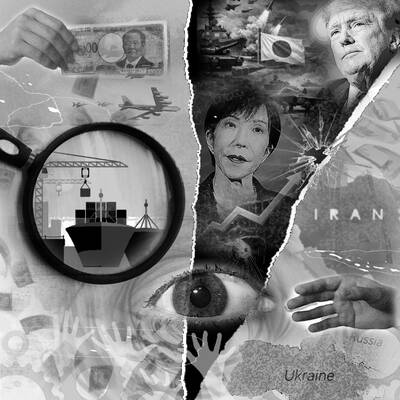
Japan’s imminent easing of arms export rules has sparked strong interest from Warsaw to Manila, Reuters reporting found, as US President Donald Trump wavers on security commitments to allies, and the wars in Iran and Ukraine strain US weapons supplies. Japanese Prime Minister Sanae Takaichi’s ruling party approved the changes this week as she tries to invigorate the pacifist country’s military industrial base. Her government would formally adopt the new rules as soon as this month, three Japanese government officials told Reuters. Despite largely isolating itself from global arms markets since World War II, Japan spends enough on its own


 RSS
RSS