


South Korea’s newest batch of university graduates lives in fear of being trapped at the bottom of the pay scale in a group of workers dubbed the “880,000 Won Generation.”
The figure, equal to about US$650, represents about what a temporary staff or contract worker makes a month in net pay and is also a sign of the crushed dreams of the country’s youth who bet an elite education would lead to a rewarding career.
The current global crisis may cause South Korea to create its first generation of chronically underemployed and unemployed among the highly educated since the country emerged as a global economic power over the past few decades, experts said.
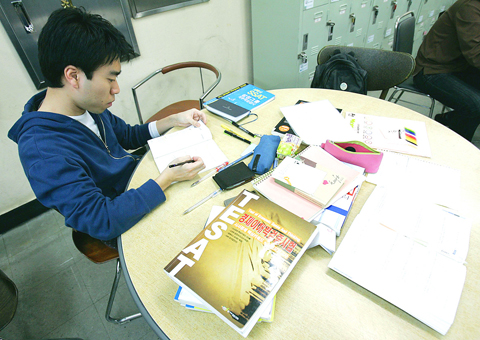
PHOTO: REUTERS
“Years ago, a diploma from a good university was a blank check for career success in Korea, but now it’s merely a certificate of unemployment,” said Cho, a university senior who asked only to be identified by her family name.
There are few places in the world where youth invest as much time and parents spend as large of a percentage of their income on education as South Korea, where cram schools are required to shut down by midnight so that students can have some sleep after studying for between 12 and 14 hours a day.
The goal has been entry to an elite university, which usually means a high-paying job, being considered a more desirable candidate for marriage and a level of prestige in the highly competitive society.
For many like Cho, the answer to the tough job market is even more education but experts are wondering if the current job crunch may be more than temporary and could signal an unraveling of social structures.
“There is a low empowerment level among people in their 20s,” said Woo Suk-hoon, an economics professor who coined the term 800,000 Won Generation in a recent book. “There is a much weaker social safety net in South Korea compared to what is offered in many OECD countries. This makes it easier for the country to sacrifice younger South Koreans in the labor market.”
A growing number of the young South Koreans have only been able to find temporary work. They see these posts as quicksand because the longer they stay, the more difficult it becomes for them to escape to join the regimented work force of regular workers who traditionally stay with one company for life.
The situation will likely get worse as the government predicts about 200,000 jobs will disappear this year while many private-sector economists warn of as many as 500,000 job losses.
Above a third of a million South Koreans aged between 20 and 29 were jobless in February, bringing the unemployment rate for the age group to 8.5 percent, more than double the nationwide jobless rate, the National Statistical Office said.
The government is aiming to ease the employment pinch through job-sharing and internship programs but Chu Duk-han, an activist who runs an online community for job seekers, sees this as nothing but a stop-gap measure.
“There are so many hopeless people who cannot even get those irregular jobs. The unemployment rate of the highly educated young people doesn’t tell the whole story. High school graduates are totally being excluded and ignored,” Chu said.
Kang Myung-koo, a 31-year-old high school graduate, said that he has not even been able to find a part-time job since last June when he lost a post at an online shopping mall in shipping.
“I am competing with college students for simple jobs with no age limits or academic requirements. I have nowhere to go. It’s hopeless. My bank account has dried up and the unemployment insurance benefits will stop soon,” Kang said.
Major employers such as Korea National Oil Corp, Hyundai Motor and the National Pension Service have said they plan to cut the wages of new hires.
In addition, many have said they will hire fewer regular employees and more contractors through internship programs.
“More and more companies are closing their doors for new full-time workers and hiring cheap interns instead,” said Park Young-ryeol, a professor of business administration at Yonsei University.
“I’m afraid this type of hiring is turning into a common practice,” Park said.

Taiwan has arranged for about 8 million barrels of crude oil, or about one-third of its monthly needs, to be shipped from the Red Sea this month to bypass the Strait of Hormuz and ease domestic supply pressures, CPC Corp, Taiwan (CPC, 台灣中油) said yesterday. The state-run oil company has worked with Middle Eastern suppliers to secure routes other than the Strait of Hormuz, through which about 20 percent of the world’s oil and liquefied natural gas typically passes, CPC chairman Fang Jeng-zen (方振仁) said at a meeting of the legislature’s Economics Committee in Taipei. Suppliers in Saudi Arabia have indicated they
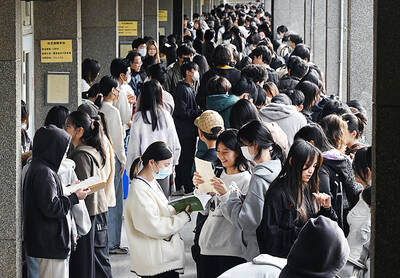
A global survey showed that 60 percent of Taiwanese had attained higher education, second only to Canada, the Ministry of the Interior said. Taiwan easily surpassed the global average of 43 percent and ranked ahead of major economies, including Japan, South Korea and the US, data from the Organisation for Economic Co-operation and Development (OECD) for 2024 showed. Taiwan has a high literacy rate, data released by the ministry showed. As of the end of last year, Taiwan had 20.617 million people aged 15 or older, accounting for 88.5 percent of the total population, with a literacy rate of 99.4 percent, the data

CCP ‘PAWN’? Beijing could use the KMT chairwoman’s visit to signal to the world that many people in Taiwan support the ‘one China’ principle, an academic said Chinese Nationalist Party (KMT) Chairwoman Cheng Li-wun (鄭麗文) yesterday arrived in China for a “peace” mission and potential meeting with Chinese President Xi Jinping (習近平), while a Taiwanese minister detailed the number of Chinese warships currently deployed around the nation. Cheng is visiting at a time of increased Chinese military pressure on Taiwan, as the opposition-dominated Legislative Yuan stalls a government plan for US$40 billion in extra defense spending. Speaking to reporters before going to the airport, Cheng said she was going on a “historic journey for peace,” but added that some people felt uneasy about her trip. “If you truly love Taiwan,

NEW LOW: The council in 2024 based predictions on a pessimistic estimate for the nation’s total fertility rate of 0.84, but last year that rate was 0.69, 17 percent lower An expected National Development Council (NDC) report expects the nation’s population to drop below 12 million by 2065, with the old-age dependency ratio to top 100 percent sooner than 2070, sources said yesterday. The council is slated to release its latest population projections in August, using an ultra-low fertility model, the sources said. The previous report projected that Taiwan’s population would fall to 14.37 million by 2070, but based on a new estimate of the total fertility rate (TFR) — the average number of children born to a woman over her lifetime — the population is expected to reach 12 million by


 RSS
RSS