


Consumers walking into an electronics store looking for a big-screen high-definition TV (HDTV) may find that the place looks and feels different than it did last Christmas.
They will see more name-brand models along the wall and a lot fewer of the second-tier brands that also happen to carry lower price tags. They may also find themselves accosted by sales staff pushing expensive but nonessential services like extended warranties and professional installation. Liberal return policies are getting tougher at some stores.
"We're abandoning the entry-level price point," said Joe McGuire, the chief executive of the regional electronics chain Tweeter Home Entertainment Group until stepping down this week. "Compared to last year, we'll be very much focused on models with superior picture quality and large sizes."
To boost profits, the company will also push customers to purchase its US$399 professional installation package and its US$79 picture calibration service.
Electronics retailers are doing this because, although they are selling more HDTVs than ever before, they are making less money on them. As consumers inexorably move toward buying ever-larger screens, revenues climb, and competition among the retailers forces price cuts. And as the low-price high-volume mass merchants like Wal-Mart or Costco become major vendors of big-screen HDTVs, all retailers are forced to keep their prices -- and their profit margins -- as low as possible.
Prices have continued to drop dramatically this year. According to the research firm iSuppli, the average retail price of 42-inch HDTVs -- one of the most popular sizes this year -- has declined to US$1,655 from US$2,140 last Christmas, representing a 23 percent drop.
Prices will continue to fall, industry analysts say, because the retailers are powerless to prevent the declines. Not only is retail competition fierce, but flat panel TV manufacturers, especially the Taiwanese contract manufacturers, continue to build new plants and expand production, creating a glut in panels.
Price promotions by the minor makers propelled Vizio from the No.4 LCD TV maker in the US market in the first quarter of this year to the best-selling maker in the second quarter.
"Half the reason that consumers buy our sets is because of lower prices," said William Wang, Vizio's chief executive. "But our goal was never to compete on price only. We have a great product."
While this is great news for consumers, it is not what retailers want to hear. The impact of the low, sometimes negative, profit margins has been devastating to many of them.
For example, Tweeter increased its unit sales of televisions during last year's Christmas selling season by 15 percent over the previous Christmas. Profit margin in the video category, McGuire said, was "down substantially on a year over year basis due to the intense competition in the category" and in June, the company sought protection from creditors in bankruptcy court. It was sold last month to Schultze Asset Management, an equity buyout firm.
Other chains were affected as well. Circuit City saw its video sales drop from 42 percent of its overall sales last year to 39 percent in its first quarter ending May 31. It fired some higher-paid veteran sales people to reduce costs.
"In some cases those people were not any more productive than lower-paid people," said Bill Cimino, a Circuit City spokesman.
During Best Buy's quarter ended June 2, its gross profit rate declined 6 percent to 23.9 percent of revenue compared with 25.4 percent in the year-earlier period. The company attributed the decline partially to the "promotional environment in home video."
RETURN POLICY
Even Costco, which operates on a 9 percent profit markup on televisions -- about half of what big box retailers manage -- has been negatively affected by plummeting flat panel TV prices. Due to its liberal return policy -- almost anything can be returned at any time, no questions asked -- its effective profit margin on TVs was more than halved, according to Richard Galanti, Costco's chief financial officer. Customers would buy a large flat panel TV, use it for a year, then return it for a larger, less-expensive one.
"I spoke to one customer who had bought four TVs and returned three of them for lower prices," Galanti said.
The company often got stuck with used TVs, or had to sell them to salvage companies for a fraction of their price.
Costco wants to make sure that does not happen again. It has changed its generous return policy to permit televisions to be returned only within 90 days, as it does with computer purchases. The company has doubled the manufacturer's warranty to two years.
Perhaps as worrisome to retailers are signs that growth is slowing, said Greg Melich, a retail-sector analyst at Morgan Stanley.
NEGATIVE GROWTH
"For the past few months, growth in the total TV market has been zero or negative, because demand is not there at these price points," he said.
Morgan Stanley research indicates that two-thirds of US households will not buy an HDTV until the price of a 37-inch or larger set drops below US$600. The price of a 37-inch LCD TV averaged about US$1,200 in June, iSuppli said.
"When the price goes to US$800, 17 million more Americans will consider buying one," Melich said.
Retailers would also like to see them buy a new high-definition DVD player that makes movies on an HDTV especially vibrant -- though the format war between companies making Blu-ray and HD DVD players has stymied sales, said James McQuivey, principal analyst at Forrester.
"The high-definition DVD format war must end by 2008 if retailers are going to sell movie discs and players," he said.
Sales of surround-sound systems have also been disappointing, McQuivey said, because TV makers have been touting their own high-quality sound built into the TV sets. And many consumers do not understand that to get true surround sound requires the addition of external rear speakers.
"The first thing customers want is picture quality, and the next is good sound," McQuivey said. "But the average consumer is not that sophisticated. To most people, that means a big, loud TV."
Extended warranties, another high-profit service, are selling less well. As TV prices drop, consumers are less inclined to buy it.
One thing is certain: HDTV prices will continue to drop.
For consumers looking to buy a new HDTV, McQuivey advises them to "wait until January."
"You'll get great deals. The retailers will always take on more product than they need," he said.

The Ministry of Foreign Affairs (MOFA) yesterday said it is closely monitoring developments in Venezuela, and would continue to cooperate with democratic allies and work together for regional and global security, stability, and prosperity. The remarks came after the US on Saturday launched a series of airstrikes in Venezuela and kidnapped Venezuelan President Nicolas Maduro, who was later flown to New York along with his wife. The pair face US charges related to drug trafficking and alleged cooperation with gangs designated as terrorist organizations. Maduro has denied the allegations. The ministry said that it is closely monitoring the political and economic situation

Conflict with Taiwan could leave China with “massive economic disruption, catastrophic military losses, significant social unrest, and devastating sanctions,” a US think tank said in a report released on Monday. The German Marshall Fund released a report titled If China Attacks Taiwan: The Consequences for China of “Minor Conflict” and “Major War” Scenarios. The report details the “massive” economic, military, social and international costs to China in the event of a minor conflict or major war with Taiwan, estimating that the Chinese People’s Liberation Army (PLA) could sustain losses of more than half of its active-duty ground forces, including 100,000 troops. Understanding Chinese

UNRELENTING: China attempted cyberattacks on Taiwan’s critical infrastructure 2.63 million times per day last year, up from 1.23 million in 2023, the NSB said China’s cyberarmy has long engaged in cyberattacks against Taiwan’s critical infrastructure, employing diverse and evolving tactics, the National Security Bureau (NSB) said yesterday, adding that cyberattacks on critical energy infrastructure last year increased 10-fold compared with the previous year. The NSB yesterday released a report titled Analysis on China’s Cyber Threats to Taiwan’s Critical Infrastructure in 2025, outlining the number of cyberattacks, major tactics and hacker groups. Taiwan’s national intelligence community identified a large number of cybersecurity incidents last year, the bureau said in a statement. China’s cyberarmy last year launched an average of 2.63 million intrusion attempts per day targeting Taiwan’s critical
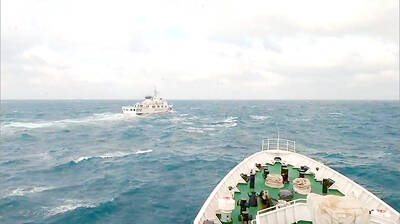
‘SLICING METHOD’: In the event of a blockade, the China Coast Guard would intercept Taiwanese ships while its navy would seek to deter foreign intervention China’s military drills around Taiwan this week signaled potential strategies to cut the nation off from energy supplies and foreign military assistance, a US think tank report said. The Chinese People’s Liberation Army (PLA) conducted what it called “Justice Mission 2025” exercises from Monday to Tuesday in five maritime zones and airspace around Taiwan, calling them a warning to “Taiwanese independence” forces. In a report released on Wednesday, the Institute for the Study of War said the exercises effectively simulated blocking shipping routes to major port cities, including Kaohsiung, Keelung and Hualien. Taiwan would be highly vulnerable under such a blockade, because it


 RSS
RSS