


Leofoo Tourism Group (六福旅遊集團) yesterday said that it would close its 48-year-old Leofoo Hotel (六福客棧) in Taipei’s Zhongshan District (中山) on May 31 to pave the way for a regeneration project and curb losses caused by the COVID-19 outbreak.
The group said it previously planned to close the facility at the end of this year, but decided to move up the schedule to cope with a sharp decline in business.
Hotels and restaurants have been hit hard by the outbreak, which has kept people at home to avoid infection.
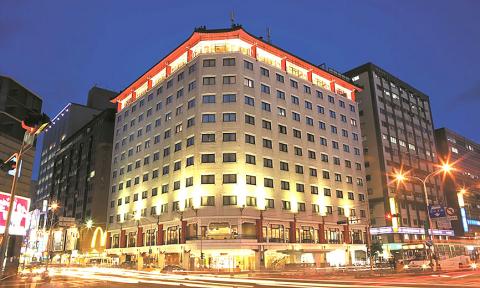
Photo: Wang Yi-hung, Taipei Times
The hotel’s Chinese Golden Phoenix Restaurant (金鳳廳) would close on March 31 and the guestrooms would follow on May 31, the group said.
The group — which also owns the Courtyard by Marriott Taipei (六福萬怡) in Taipei’s Nangang District (南港) as well as Leofoo Resort (六福莊), Leofoo Village Theme Park (六福村) and other recreational facilities — last year gained the Taipei City Government’s approval to regenerate Leofoo Hotel.
The closure would not affect guests who have purchased hotel or restaurant vouchers, the group said, adding that they can receive full refunds or use the vouchers at affiliated facilities.
The group said it would help its employees find work at affiliated facilities or other hotels and restaurants, adding that it would disclose layoff details next month.
It is the second hotel the Hsinchu-based conglomerate closed in three years, after Westin Taipei in December 2018.
However, Leofoo Tourism Group said it would stay in the industry with a focus on the maintenance and cleaning of high-end properties, using the know-how it has gathered over the past 50 years.
Leofoo Hotel sits on a 380 ping (1,256m2) lot and is qualified for favorable development terms to encourage the regeneration of old and dangerous buildings.
The regeneration project might have a floor area ratio of 620 percent, allowing the construction of a 20-story building valued at up to NT$7 billion (US$232.33 million), REPro Knight Frank researcher Andy Huang (黃舒衛) has said.
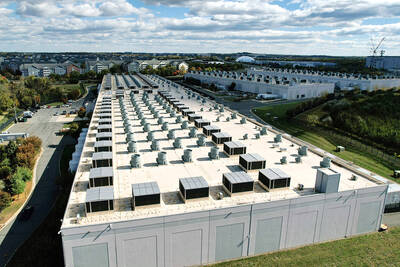
The demise of the coal industry left the US’ Appalachian region in tatters, with lost jobs, spoiled water and countless kilometers of abandoned underground mines. Now entrepreneurs are eyeing the rural region with ambitious visions to rebuild its economy by converting old mines into solar power systems and data centers that could help fuel the increasing power demands of the artificial intelligence (AI) boom. One such project is underway by a non-profit team calling itself Energy DELTA (Discovery, Education, Learning and Technology Accelerator) Lab, which is looking to develop energy sources on about 26,305 hectares of old coal land in
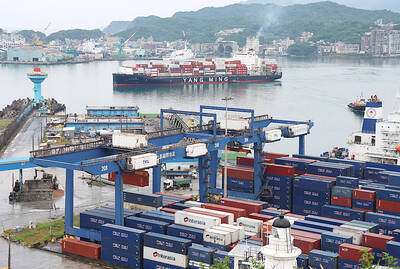
Taiwan’s exports soared 56 percent year-on-year to an all-time high of US$64.05 billion last month, propelled by surging global demand for artificial intelligence (AI), high-performance computing and cloud service infrastructure, the Ministry of Finance said yesterday. Department of Statistics Director-General Beatrice Tsai (蔡美娜) called the figure an unexpected upside surprise, citing a wave of technology orders from overseas customers alongside the usual year-end shopping season for technology products. Growth is likely to remain strong this month, she said, projecting a 40 percent to 45 percent expansion on an annual basis. The outperformance could prompt the Directorate-General of Budget, Accounting and

Netflix on Friday faced fierce criticism over its blockbuster deal to acquire Warner Bros Discovery. The streaming giant is already viewed as a pariah in some Hollywood circles, largely due to its reluctance to release content in theaters and its disruption of traditional industry practices. As Netflix emerged as the likely winning bidder for Warner Bros — the studio behind Casablanca, the Harry Potter movies and Friends — Hollywood’s elite launched an aggressive campaign against the acquisition. Titanic director James Cameron called the buyout a “disaster,” while a group of prominent producers are lobbying US Congress to oppose the deal,

Two Chinese chipmakers are attracting strong retail investor demand, buoyed by industry peer Moore Threads Technology Co’s (摩爾線程) stellar debut. The retail portion of MetaX Integrated Circuits (Shanghai) Co’s (上海沐曦) upcoming initial public offering (IPO) was 2,986 times oversubscribed on Friday, according to a filing. Meanwhile, Beijing Onmicro Electronics Co (北京昂瑞微), which makes radio frequency chips, was 2,899 times oversubscribed on Friday, its filing showed. The bids coincided with Moore Threads’ trading debut, which surged 425 percent on Friday after raising 8 billion yuan (US$1.13 billion) on bets that the company could emerge as a viable local competitor to Nvidia


 RSS
RSS