


Chicony Power Technology Co (群光電能), which makes a variety of computer peripherals, on Monday reported that earnings for last quarter declined from a quarter earlier due to higher operating expenses, and said that it expected the COVID-19 epidemic to affect its Chinese operations in the short term.
Net income fell 41.8 percent to NT$389 million (US$12.93 million), from NT$668 million in the previous quarter, while revenue declined 11.1 percent to NT$8.88 billion, the company said on its Web site.
Earnings per share were NT$1.02 last quarter, it said.
However, for last year as a whole, net income rose 67 percent annually to NT$1.72 billion and operating income increased 54.7 percent annually to NT$2.2 billion, with earnings per share rising from NT$2.72 to NT$4.51, Chicony said.
Revenue also increased 10 percent to NT$34.42 billion, from NT$31.29 billion a year earlier, while gross margin was 16.4 percent, an increase of 2.4 percentage points, and operating margin 6.4 percent, up 1.9 percentage points, the company said.
Chicony mainly focuses on manufacturing keyboards, switches, power supplies, smart and green solutions, camera modules and adapters for notebook computers.
The company operates four manufacturing sites in Dongguan, Chongqing, Wujiang and Nanchang in China and is expanding production capacity in Thailand.
In a conference call, Chicony said that it was utilizing factories in other places to fill the gap due to curtailed production in China and that it expected revenue to still grow steadily this year.
Local media cited Chicony president Peter Tseng (曾國華) as telling investors at an earnings conference that the New Taipei City-headquartered company hopes to increase factory production in China to 70 to 80 percent by the end of this month, up from 60 to 65 percent last month, which would help boost shipments above last month’s levels.
Revenue for this quarter would drop by 8 to 10 percent annually and gross margin would decline by 1 to 1.5 percentage points, the company said.
Chicony’s revenue might reach NT$6.59 billion this quarter, down 8.86 percent year-on-year and 25.83 percent quarter-on-quarter, Jih Sun Securities Investment Consulting Co (日盛投顧) said in a note yesterday.
Given the short-term effects of the epidemic, Jih Sun revised down its earnings per share forecast to NT$4.54 for this year, from a previous estimate of NT$5.18.
Chicony’s board of directors has approved plans to distribute a cash dividend of NT$3.2 per share, representing a payout ratio of 70.95 percent, and suggesting a dividend yield of 5.4 percent based on the share’s closing price of NT$59.3 on the Taiwan Stock Exchange yesterday.

The demise of the coal industry left the US’ Appalachian region in tatters, with lost jobs, spoiled water and countless kilometers of abandoned underground mines. Now entrepreneurs are eyeing the rural region with ambitious visions to rebuild its economy by converting old mines into solar power systems and data centers that could help fuel the increasing power demands of the artificial intelligence (AI) boom. One such project is underway by a non-profit team calling itself Energy DELTA (Discovery, Education, Learning and Technology Accelerator) Lab, which is looking to develop energy sources on about 26,305 hectares of old coal land in

Taiwan’s exports soared 56 percent year-on-year to an all-time high of US$64.05 billion last month, propelled by surging global demand for artificial intelligence (AI), high-performance computing and cloud service infrastructure, the Ministry of Finance said yesterday. Department of Statistics Director-General Beatrice Tsai (蔡美娜) called the figure an unexpected upside surprise, citing a wave of technology orders from overseas customers alongside the usual year-end shopping season for technology products. Growth is likely to remain strong this month, she said, projecting a 40 percent to 45 percent expansion on an annual basis. The outperformance could prompt the Directorate-General of Budget, Accounting and

Netflix on Friday faced fierce criticism over its blockbuster deal to acquire Warner Bros Discovery. The streaming giant is already viewed as a pariah in some Hollywood circles, largely due to its reluctance to release content in theaters and its disruption of traditional industry practices. As Netflix emerged as the likely winning bidder for Warner Bros — the studio behind Casablanca, the Harry Potter movies and Friends — Hollywood’s elite launched an aggressive campaign against the acquisition. Titanic director James Cameron called the buyout a “disaster,” while a group of prominent producers are lobbying US Congress to oppose the deal,
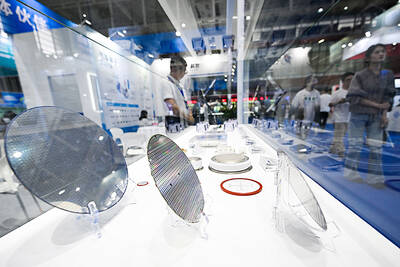
Two Chinese chipmakers are attracting strong retail investor demand, buoyed by industry peer Moore Threads Technology Co’s (摩爾線程) stellar debut. The retail portion of MetaX Integrated Circuits (Shanghai) Co’s (上海沐曦) upcoming initial public offering (IPO) was 2,986 times oversubscribed on Friday, according to a filing. Meanwhile, Beijing Onmicro Electronics Co (北京昂瑞微), which makes radio frequency chips, was 2,899 times oversubscribed on Friday, its filing showed. The bids coincided with Moore Threads’ trading debut, which surged 425 percent on Friday after raising 8 billion yuan (US$1.13 billion) on bets that the company could emerge as a viable local competitor to Nvidia


 RSS
RSS