


Standard Chartered Bank Taiwan Ltd (渣打台灣銀行) yesterday trimmed its forecast for the nation’s GDP growth this year to 1.9 percent, from 2.2 percent it predicted in December last year, due to the COVID-19 outbreak.
That was a comparatively smaller reduction than those for neighboring markets, with the bank predicting that South Korea’s economic growth would slow from 2.1 percent to 1.8 percent, Singapore’s would dip from 1.4 percent to 0.8 percent and Hong Kong would decline from minus-1.5 percent to minus-2.4 percent.
“It seems that Taiwan’s economy would still outperform neighboring countries amid the virus fears, thanks to the nation’s vibrant manufacturing activity and relief measures,” Standard Chartered Taipei-based senior economist for Northeast Asia Tony Phoo (符銘財) told the Taipei Times by telephone.
The outbreak has caused supply-chain disruptions in Asia, especially Chinese semi-finished goods, but Taiwan, being a major player in the original equipment manufacturing business, is expected to better handle the situation, as local companies find alternative suppliers and even gain new orders, Phoo said.
As NT$40 billion (US$1.33 billion) of a government-proposed NT$60 billion special relief budget has been earmarked to aid affected sectors, such as tourism and restaurants, it is expected to help reduce the negative effects to the economy, he added.
“We think it would be similar to the situation during the US-China trade tensions. Due to a deep connection with China, Taiwan was once predicted to suffer badly amid the trade dispute, but it turned out to be a major beneficiary,” Phoo said.
South Korea, which also has strong manufacturing activity, is likely to face mixed effects from the outbreak, as companies might gain new orders transferred from Chinese firms, but also face weaker consumer demand, he said.
By comparison, Singapore and Hong Kong, whose economies are mainly concentrated on service sectors such as finance, shipping, aviation and tourism, are likely to suffer more from the outbreak, as companies cannot simply find new customers, he added.
If the outbreak in China could be contained by the end of this month, Asian economies could improve slightly in the second quarter and see a V-shaped rebound in the third quarter, when consumers would be willing to make big-ticket purchases, Phoo said.
However, if the outbreak lasts longer, its effects would be more serious, he said.
“There is no substitute for consumer demand in China and the semi-finished goods made there. If they continue to be weak due to the virus crisis, we would all be affected negatively,” Phoo said.
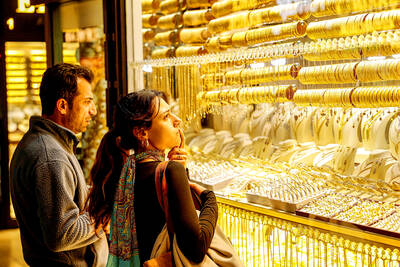
In Italy’s storied gold-making hubs, jewelers are reworking their designs to trim gold content as they race to blunt the effect of record prices and appeal to shoppers watching their budgets. Gold prices hit a record high on Thursday, surging near US$5,600 an ounce, more than double a year ago as geopolitical concerns and jitters over trade pushed investors toward the safe-haven asset. The rally is putting undue pressure on small artisans as they face mounting demands from customers, including international brands, to produce cheaper items, from signature pieces to wedding rings, according to interviews with four independent jewelers in Italy’s main

Japanese Prime Minister Sanae Takaichi has talked up the benefits of a weaker yen in a campaign speech, adopting a tone at odds with her finance ministry, which has refused to rule out any options to counter excessive foreign exchange volatility. Takaichi later softened her stance, saying she did not have a preference for the yen’s direction. “People say the weak yen is bad right now, but for export industries, it’s a major opportunity,” Takaichi said on Saturday at a rally for Liberal Democratic Party candidate Daishiro Yamagiwa in Kanagawa Prefecture ahead of a snap election on Sunday. “Whether it’s selling food or

CONCERNS: Tech companies investing in AI businesses that purchase their products have raised questions among investors that they are artificially propping up demand Nvidia Corp chief executive officer Jensen Huang (黃仁勳) on Saturday said that the company would be participating in OpenAI’s latest funding round, describing it as potentially “the largest investment we’ve ever made.” “We will invest a great deal of money,” Huang told reporters while visiting Taipei. “I believe in OpenAI. The work that they do is incredible. They’re one of the most consequential companies of our time.” Huang did not say exactly how much Nvidia might contribute, but described the investment as “huge.” “Let Sam announce how much he’s going to raise — it’s for him to decide,” Huang said, referring to OpenAI

The global server market is expected to grow 12.8 percent annually this year, with artificial intelligence (AI) servers projected to account for 16.5 percent, driven by continued investment in AI infrastructure by major cloud service providers (CSPs), market researcher TrendForce Corp (集邦科技) said yesterday. Global AI server shipments this year are expected to increase 28 percent year-on-year to more than 2.7 million units, driven by sustained demand from CSPs and government sovereign cloud projects, TrendForce analyst Frank Kung (龔明德) told the Taipei Times. Demand for GPU-based AI servers, including Nvidia Corp’s GB and Vera Rubin rack systems, is expected to remain high,


 RSS
RSS