


In the suburbs of Dublin on a windy, overcast day in January, several alumni of Airbus SE and the British Royal Air Force watched as a flying object, shaped a bit like a crouching frog, hovered about 10m up in the air.
The craft, called MNA-1090, opened its cargo bay door and lowered a package — about the size of a shoebox — to the ground on a string. The robotics engineers who had helped design the vehicle opened the carton, looked inside and smiled: the dozen-or-so pots of Ben & Jerry’s Homemade Holdings Inc ice cream were still perfectly frozen.
Late this month, customers on the outskirts of Dublin, far from the dense metropolises that make the food delivery services of firms like Uber Technologies Inc and Roofoods Ltd viable in terms of revenue, are to get to try ordering food and drink the same way.
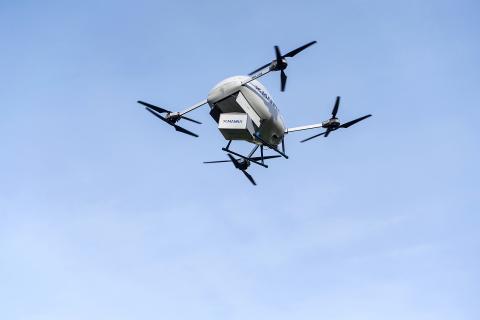
Photo: Bloomberg
Manna Aero built the MNA-1090 to be an airborne replacement for the human-and-bicycle formula used the world over by food delivery platforms and is preparing to run a couple of hundred test flights per day over several weeks to lay the groundwork for a permanent service for small Irish towns.
Ben & Jerry’s, UK food delivery firm Just Eat PLC and local Irish restaurant chain Camile Thai are signed up to participate in the pilot, which is to take place at the University College Dublin campus.
“In five years, it’s going to be the most normal thing you can imagine,” Manna CEO Bobby Healy said.
If you live in a city, having a hot meal delivered to your doorstep in less than an hour has never been easier or cheaper. For about the price of a small coffee, a human being will cycle to a restaurant, collect your freshly baked pizza and take it to your apartment.
Innovations in smartphones, mapping and gig-economy logistics have catalyzed growth of the sector, which research firm Frost & Sullivan has estimated will be worth US$200 billion by 2025.
However, the margins are tiny for the companies handling the delivery and the competition is fierce.
In October last year, Grubhub Inc executives told shareholders that they did not believe it was even possible to generate significant profit from food delivery.
The cost of paying people to drive food around was just too much, they said.
Companies are looking for an alternative and a roster of investors believe that Healy might have a model that could work: a drones-as-a-service for restaurants and delivery apps.
Here is how Healy said it will work: Manna would partner with restaurants or food courts that have a high throughput of orders and a small outdoor space to house a drone-loading team.
The Manna craft itself is about the size of a computer printer and would carry meals weighing about 2kg more than 2km in less than three minutes, even in wind and rain.
Upon arriving at its destination, the drone will hover and wait for the customer to accept delivery using an app, having indicated when ordering exactly where they want their food to land — on the lawn, an outdoor dining table or just in the driveway.
The drone will descend and lower the food parcel, which Healy said would still be “piping hot.”
Manna’s vehicle has been designed to travel for 100 million hours without a problem, Healy said in an interview.
However, in addition to space for three 10-inch pizzas, it also has a backup battery and two parachutes, just in case.
The 51-year-old Irish entrepreneur is a mobility veteran. In 2003, he sold off travel software firm Eland Technologies to industry titan SITA. He then helped build CarTrawler into a transportation platform used by more than 100 international airlines.
Healy has got some well-known names putting US$5.2 million behind Manna, including billionaire Peter Thiel’s Founders Fund, Dynamo venture capital and FF Venture Capital.
For food platforms, Manna said that the service is more than just a gimmick — it will redue delivery costs and allow them to scale to currently underserved suburban areas in a profitable way.
Healy said that Manna’s drone delivery would cost platforms US$3 to US$5 per delivery.
Fabricio Bloisi, CEO of online delivery platform iFood in Brazil, said that the use of drones is a “great breakthrough” for the industry because of their efficiency and ability to travel relatively large distances.
He said that his company is working with Sao Paulo-based Speedbird Aero to reduce delivery time by combining the use of drones with bicycles and motorbikes.
Uber is testing a drone for food delivery in San Diego, California, and Alphabet Inc’s Wing is already delivering coffee, food, medicine and household items directly to homes in Finland, Australia and the US state of Virginia.
Amazon.com Inc is also developing its Prime Air service, with a view to delivering parcels, not necessarily food, of up to 2.3kg via drone. The company is bidding for a stake in the UK’s Roofoods.
Healy is not worried. He is pitching Manna as a business-to-business company, where its drones are used by food delivery companies, not end consumers. To the entrepreneur, Wing is not his rival.
“We’re arming their competitors,” Healy said.
Still, not everyone is so rosy about the drone delivery trend.
In a sign of how divided views are on the technology, Dutch food delivery firm Takeaway.com NV — which has bought Just Eat, one of Manna’s partners for the pilot — said that it thinks drone delivery for food is a “fantasy.”
“We just don’t see any way how it can work currently from a technical perspective,” Takeaway spokesman Joris Wilton said. “We will not be investing in developing it in-house.”
Miki Kuusi, co-founder and CEO of Helsinki-based food delivery company Wolt, said that his company has tested drone deliveries, but added that “it’s been more PR [public relations] than actually about a business case.”
That partly has to do with complexities around picking up the food orders, he said.
Drone services have to be deeply integrated with the restaurants to ensure that drones are loaded in the right way, something “most restaurants in a hectic environment are not equipped to do,” he added.
Then there is the tricky issue of regulation. Airspace authorities have tightened restrictions on drone usage as their popularity with consumers and troublemakers has grown.
People have also expressed discomfort at the idea of machinery whizzing above their homes — both for privacy and safety reasons.
Add to that the complexity of hauling hot food in the sky over several kilometers and it is an uphill battle for any start-up to launch a service.
Healy recognizes that changing the industry would not happen overnight, given the need to safely test the technology and get approvals from regulators, as well as from local communities, at each new stage.
Still, he expects to have completed between 20,000 and 50,000 successful deliveries by year-end.
“With this industry it’s ‘crawl, walk, run,’” Healy said. “We want to crawl for a little while, we want everyone to feel good about it.”

The demise of the coal industry left the US’ Appalachian region in tatters, with lost jobs, spoiled water and countless kilometers of abandoned underground mines. Now entrepreneurs are eyeing the rural region with ambitious visions to rebuild its economy by converting old mines into solar power systems and data centers that could help fuel the increasing power demands of the artificial intelligence (AI) boom. One such project is underway by a non-profit team calling itself Energy DELTA (Discovery, Education, Learning and Technology Accelerator) Lab, which is looking to develop energy sources on about 26,305 hectares of old coal land in

Taiwan’s exports soared 56 percent year-on-year to an all-time high of US$64.05 billion last month, propelled by surging global demand for artificial intelligence (AI), high-performance computing and cloud service infrastructure, the Ministry of Finance said yesterday. Department of Statistics Director-General Beatrice Tsai (蔡美娜) called the figure an unexpected upside surprise, citing a wave of technology orders from overseas customers alongside the usual year-end shopping season for technology products. Growth is likely to remain strong this month, she said, projecting a 40 percent to 45 percent expansion on an annual basis. The outperformance could prompt the Directorate-General of Budget, Accounting and

Netflix on Friday faced fierce criticism over its blockbuster deal to acquire Warner Bros Discovery. The streaming giant is already viewed as a pariah in some Hollywood circles, largely due to its reluctance to release content in theaters and its disruption of traditional industry practices. As Netflix emerged as the likely winning bidder for Warner Bros — the studio behind Casablanca, the Harry Potter movies and Friends — Hollywood’s elite launched an aggressive campaign against the acquisition. Titanic director James Cameron called the buyout a “disaster,” while a group of prominent producers are lobbying US Congress to oppose the deal,

Two Chinese chipmakers are attracting strong retail investor demand, buoyed by industry peer Moore Threads Technology Co’s (摩爾線程) stellar debut. The retail portion of MetaX Integrated Circuits (Shanghai) Co’s (上海沐曦) upcoming initial public offering (IPO) was 2,986 times oversubscribed on Friday, according to a filing. Meanwhile, Beijing Onmicro Electronics Co (北京昂瑞微), which makes radio frequency chips, was 2,899 times oversubscribed on Friday, its filing showed. The bids coincided with Moore Threads’ trading debut, which surged 425 percent on Friday after raising 8 billion yuan (US$1.13 billion) on bets that the company could emerge as a viable local competitor to Nvidia


 RSS
RSS