


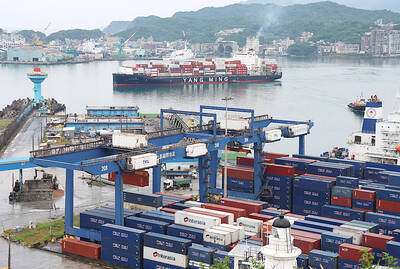
Sea freight transport, the lifeblood of trade and a bellwether of the global economy, has been blown off course by the COVID-19 outbreak, sparking general alarm.
As analysts pore over charts to gauge just how badly Chinese megafactories have been hit, figures provided by cargo ship traffic paint a gloomy picture.
The Baltic Dry Index (BDI) reflects the daily price of moving goods such as coal, rice and wheat along routes deemed representative of the global market.
The BDI has now reached lows last seen in early 2016, when the shipping sector was suffering a supply and demand imbalance in the wake of the global economic crisis of 2008 and 2009.
Its “capesize” index for the largest category of ships — ones that cannot even squeeze through the Suez or Panama canals — is at historic lows.
“The latest slump is directly related to the coronavirus epidemic in China and the subsequent restrictions on activity,” London-based Capital Economics Ltd said in a research note.
“Given that China accounts for about 40 percent of global seaborne trade, it is not so surprising that freight rates have tanked,” it added.
Arctic Securities AS analyst Lars Bastian Ostereng said that the outbreak “basically led to full stops in many ports in China.”
Louis Dreyfus Armateurs SAS, a global merchant based in France, is one of many shipping giants approaching China with caution.
The 169-year-old company has banned its sailors from going onshore and stopped relieving its crews at Chinese ports, resulting in considerable disruptions.
“The coronavirus epidemic is a very serious event for the market,” Antoine Person, a top executive at the firm, said.
China does not just produce goods, it is also a major consumer with a booming middle class and the world’s largest population.
It accounts for “about 35 percent of all seaborne dry bulk imports in the world,” Ostereng said.
With more than 2,400 death reported from COVID-19 and swathes of the country under effective lockdown for a second month, Chinese demand might suffer for months to come, he said.
This would impact exports to China from around the world, including the US and Europe, with accompanying political repercussions.
“Power generation in China has dropped and steel mills are reportedly cutting capacity utilization which, respectively, point to lower demand for coal and iron ore,” research firm Capital Economics wrote.
That in turn reduces Chinese imports of coal and steel produced in places such as Australia and Brazil, impacting their economies.
The price of shipping both commodities is reflected in the BDI index, which is in “free fall,” Capital Economics said.
In addition to importing raw materials — Chinese factories consume nearly 40 percent of metals produced in the world — the factory slowdown has forced the world’s largest shipper to brace for the year ahead.
Denmark’s AP Moller-Maersk AS on Thursday said that the outbreak has “significantly lowered visibility on what to expect in 2020.”
“We expect a weak start to the year,” it warned.
Daily Telegraph international business editor Ambrose Evans-Pritchard on Thursday wrote that the shipping collapse was “threatening weeks of chaos for manufacturing supply lines and the broader structure of global trade.”
He said that optimists expect Chinese demand and factory output to explode once the restrictions end and businesses try to make up for lost ground.
No one can be sure when that would be — or if the outbreak would spread.
Chinese factories are still experiencing severe worker shortages and Evans-Pritchard said that he is unconvinced.
"Fiscal stimulus is coming, but the transmission channels will remain blocked as long as the lockdown measures stay in place," he wrote. "But to lift the curfew risks losing control of the virus."

The demise of the coal industry left the US’ Appalachian region in tatters, with lost jobs, spoiled water and countless kilometers of abandoned underground mines. Now entrepreneurs are eyeing the rural region with ambitious visions to rebuild its economy by converting old mines into solar power systems and data centers that could help fuel the increasing power demands of the artificial intelligence (AI) boom. One such project is underway by a non-profit team calling itself Energy DELTA (Discovery, Education, Learning and Technology Accelerator) Lab, which is looking to develop energy sources on about 26,305 hectares of old coal land in
Taiwan’s exports soared 56 percent year-on-year to an all-time high of US$64.05 billion last month, propelled by surging global demand for artificial intelligence (AI), high-performance computing and cloud service infrastructure, the Ministry of Finance said yesterday. Department of Statistics Director-General Beatrice Tsai (蔡美娜) called the figure an unexpected upside surprise, citing a wave of technology orders from overseas customers alongside the usual year-end shopping season for technology products. Growth is likely to remain strong this month, she said, projecting a 40 percent to 45 percent expansion on an annual basis. The outperformance could prompt the Directorate-General of Budget, Accounting and

Netflix on Friday faced fierce criticism over its blockbuster deal to acquire Warner Bros Discovery. The streaming giant is already viewed as a pariah in some Hollywood circles, largely due to its reluctance to release content in theaters and its disruption of traditional industry practices. As Netflix emerged as the likely winning bidder for Warner Bros — the studio behind Casablanca, the Harry Potter movies and Friends — Hollywood’s elite launched an aggressive campaign against the acquisition. Titanic director James Cameron called the buyout a “disaster,” while a group of prominent producers are lobbying US Congress to oppose the deal,

Two Chinese chipmakers are attracting strong retail investor demand, buoyed by industry peer Moore Threads Technology Co’s (摩爾線程) stellar debut. The retail portion of MetaX Integrated Circuits (Shanghai) Co’s (上海沐曦) upcoming initial public offering (IPO) was 2,986 times oversubscribed on Friday, according to a filing. Meanwhile, Beijing Onmicro Electronics Co (北京昂瑞微), which makes radio frequency chips, was 2,899 times oversubscribed on Friday, its filing showed. The bids coincided with Moore Threads’ trading debut, which surged 425 percent on Friday after raising 8 billion yuan (US$1.13 billion) on bets that the company could emerge as a viable local competitor to Nvidia


 RSS
RSS