


Japan’s factory activity suffered its steepest contraction in seven years this month, as the widening fallout from the COVID-19 outbreak in China reinforced the risk of a recession in the world’s third-largest economy.
The manufacturing downturn offers the clearest evidence yet of the outbreak’s damaging effects on global growth and businesses, and is likely to ramp up pressure on Japanese policymakers to increase stimulus.
The Jibun Bank Flash Japan Services Manufacturing Purchasing Managers’ Index (PMI) fell to a seasonally adjusted 47.6 from a final 48.8 last month, its lowest since late 2012.
The index stayed below the 50.0 threshold that separates contraction from expansion for a 10th month. If the final reading confirms the shrinking, it would mark the longest such stretch since a 16-month run to June 2009 following the 2008 global financial crisis.
The PMI survey, compiled by IHS Markit, showed that new orders declining at the fastest pace in more than seven years, while other indicators such as overall output and backlogs of work also dropped.
“Latest PMI data... significantly raise the prospect of a technical recession in the world’s third largest economy,” IHS Markit economist Joe Hayes said.
“New business at services companies fell at the strongest rate since June 2016, with survey evidence implying that the coronavirus outbreak has hit tourism particularly hard in Japan, a key source of demand for services,” he said.
Data last week showed the economy shrank at its fastest pace in nearly six years in the December quarter last year, stoking talk of a recession, as the virus added to the impact of a sales tax hike on consumer and business spending.
The Jibun Bank Flash Japan Services PMI index shrank at its fastest pace in nearly six years, again due to the virus’ debilitating impact across the sector.
The index came in at a seasonally adjusted 46.7 from the previous month’s 51.0, its lowest reading since April 2014 when Japan also implemented a nationwide tax hike.
It slumped to 47.0 this month, also hitting its lowest since April 2014 and down from the previous month’s final of 50.1.
“February flash PMI data stack the odds heavily against Q1 growth, despite [Japanese Prime Minister Shinzo] Abe’s best efforts to stimulate the economy after the sales tax hike,” Hayes said.

The demise of the coal industry left the US’ Appalachian region in tatters, with lost jobs, spoiled water and countless kilometers of abandoned underground mines. Now entrepreneurs are eyeing the rural region with ambitious visions to rebuild its economy by converting old mines into solar power systems and data centers that could help fuel the increasing power demands of the artificial intelligence (AI) boom. One such project is underway by a non-profit team calling itself Energy DELTA (Discovery, Education, Learning and Technology Accelerator) Lab, which is looking to develop energy sources on about 26,305 hectares of old coal land in

Taiwan’s exports soared 56 percent year-on-year to an all-time high of US$64.05 billion last month, propelled by surging global demand for artificial intelligence (AI), high-performance computing and cloud service infrastructure, the Ministry of Finance said yesterday. Department of Statistics Director-General Beatrice Tsai (蔡美娜) called the figure an unexpected upside surprise, citing a wave of technology orders from overseas customers alongside the usual year-end shopping season for technology products. Growth is likely to remain strong this month, she said, projecting a 40 percent to 45 percent expansion on an annual basis. The outperformance could prompt the Directorate-General of Budget, Accounting and

Netflix on Friday faced fierce criticism over its blockbuster deal to acquire Warner Bros Discovery. The streaming giant is already viewed as a pariah in some Hollywood circles, largely due to its reluctance to release content in theaters and its disruption of traditional industry practices. As Netflix emerged as the likely winning bidder for Warner Bros — the studio behind Casablanca, the Harry Potter movies and Friends — Hollywood’s elite launched an aggressive campaign against the acquisition. Titanic director James Cameron called the buyout a “disaster,” while a group of prominent producers are lobbying US Congress to oppose the deal,
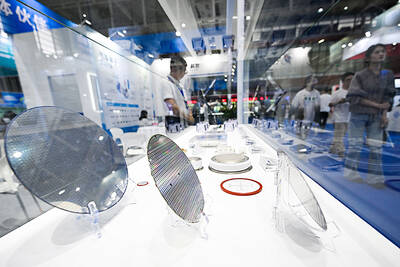
Two Chinese chipmakers are attracting strong retail investor demand, buoyed by industry peer Moore Threads Technology Co’s (摩爾線程) stellar debut. The retail portion of MetaX Integrated Circuits (Shanghai) Co’s (上海沐曦) upcoming initial public offering (IPO) was 2,986 times oversubscribed on Friday, according to a filing. Meanwhile, Beijing Onmicro Electronics Co (北京昂瑞微), which makes radio frequency chips, was 2,899 times oversubscribed on Friday, its filing showed. The bids coincided with Moore Threads’ trading debut, which surged 425 percent on Friday after raising 8 billion yuan (US$1.13 billion) on bets that the company could emerge as a viable local competitor to Nvidia


 RSS
RSS