


Asia-focused banking giant HSBC Holdings PLC yesterday axed 35,000 jobs, far more than expected, and posted slumping annual profits, as it warned over the financial impact of COVID-19.
Pre-tax profits tumbled by a third to US$13.3 billion last year from a year earlier, largely owing to a US$7.3 billion write-off related to its investment and commercial banking businesses in Europe.
The London-based lender added in a results statement that it hopes to cut its global workforce by 15 percent to 200,000 staff over the next three years.
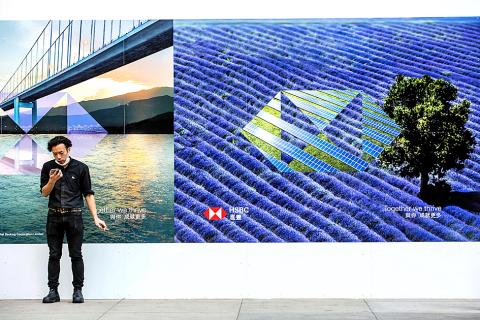
Photo: AFP
Commentators had expected 10,000 job cuts.
The radical overhaul comes as HSBC streamlines operations in the US and Europe, although no details were given on where the axe would fall.
HSBC has been trying to lower costs as it faces a multitude of uncertainties caused by the grinding US-China trade dispute, the UK’s departure from the EU and now COVID-19 in China.
“The group’s 2019 performance was resilient. However, parts of our business are not delivering acceptable returns,” interim chief executive Noel Quinn said.
“We are therefore outlining a revised plan to increase returns for investors, create the capacity for future investment and build a platform for sustainable growth,” he said.
“We have already begun to implement this plan, which my management team and I are committed to executing at pace,” Quinn added.
While its Asia business has done well in the past few years — fueled primarily by China — Europe and the US have disappointed.
Quinn, who took over as acting CEO after the shock ousting in August last year of John Flint, has been tasked with transforming the sprawling international bank, which spans more than 50 countries, but makes the vast majority of its profit in Asia.
Turning to COVID-19, HSBC said the outbreak in China had impacted its outlook.
“We continue to monitor the recent coronavirus outbreak, which is causing economic disruption in Hong Kong and mainland China and may impact performance in 2020,” the bank said.
The restructuring plans are the biggest shake-up since 2012, when HSBC was caught up in a Mexican money-laundering scandal.
The bank said it was targeting US$4.5 billion in cost cuts by 2022, with restructuring costs of about US$6 billion.
Many of the cutbacks will be in the European and US investment banking sectors, while units in more profitable Asia and the Middle East would be bolstered.
In the US, the bank said it planned to reduce its branch network by about 30 percent, consolidate back and middle-office activities, and lower operating expenses by 10 to 15 percent.
For its non-UK Europe sector, the bank said it would “reduce our sales and trading and equity research in Europe and transition our structured products capabilities from the UK to Asia.”
Riskier assets would be reduced by 35 percent in Europe and 45 percent in the US.
Overall, the bank said it hoped to achieve a lower adjusted cost base of US$31 billion or below in 2022.
The disappointing results sent HSBC’s shares sliding 5 percent in London and by 2.2 percent in Hong Kong, as it also reported a loss before tax of US$3.9 billion in the fourth quarter.
The bright spot for HSBC remains Asia, which has accounted for half of its revenue and 90 percent of the group’s profit in the past few years.
Adjusted profit before tax in Asia last year was up 6 percent to US$18.6 billion.
Even in Hong Kong, which was battered by months of seething pro-democracy protests last year, the banking giant posted a 5 percent increase in adjusted pretax profit to US$12.1 billion.
Yesterday’s statement gave little clarity on whether Quinn would get the CEO job full time, saying a permanent CEO would be appointed within six to 12 months.
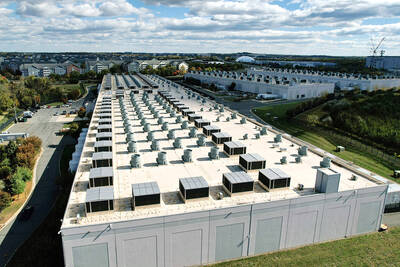
The demise of the coal industry left the US’ Appalachian region in tatters, with lost jobs, spoiled water and countless kilometers of abandoned underground mines. Now entrepreneurs are eyeing the rural region with ambitious visions to rebuild its economy by converting old mines into solar power systems and data centers that could help fuel the increasing power demands of the artificial intelligence (AI) boom. One such project is underway by a non-profit team calling itself Energy DELTA (Discovery, Education, Learning and Technology Accelerator) Lab, which is looking to develop energy sources on about 26,305 hectares of old coal land in
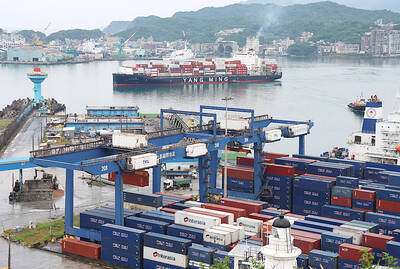
Taiwan’s exports soared 56 percent year-on-year to an all-time high of US$64.05 billion last month, propelled by surging global demand for artificial intelligence (AI), high-performance computing and cloud service infrastructure, the Ministry of Finance said yesterday. Department of Statistics Director-General Beatrice Tsai (蔡美娜) called the figure an unexpected upside surprise, citing a wave of technology orders from overseas customers alongside the usual year-end shopping season for technology products. Growth is likely to remain strong this month, she said, projecting a 40 percent to 45 percent expansion on an annual basis. The outperformance could prompt the Directorate-General of Budget, Accounting and

Netflix on Friday faced fierce criticism over its blockbuster deal to acquire Warner Bros Discovery. The streaming giant is already viewed as a pariah in some Hollywood circles, largely due to its reluctance to release content in theaters and its disruption of traditional industry practices. As Netflix emerged as the likely winning bidder for Warner Bros — the studio behind Casablanca, the Harry Potter movies and Friends — Hollywood’s elite launched an aggressive campaign against the acquisition. Titanic director James Cameron called the buyout a “disaster,” while a group of prominent producers are lobbying US Congress to oppose the deal,

Two Chinese chipmakers are attracting strong retail investor demand, buoyed by industry peer Moore Threads Technology Co’s (摩爾線程) stellar debut. The retail portion of MetaX Integrated Circuits (Shanghai) Co’s (上海沐曦) upcoming initial public offering (IPO) was 2,986 times oversubscribed on Friday, according to a filing. Meanwhile, Beijing Onmicro Electronics Co (北京昂瑞微), which makes radio frequency chips, was 2,899 times oversubscribed on Friday, its filing showed. The bids coincided with Moore Threads’ trading debut, which surged 425 percent on Friday after raising 8 billion yuan (US$1.13 billion) on bets that the company could emerge as a viable local competitor to Nvidia


 RSS
RSS