


Organizers of the world’s biggest mobile technology fair are pulling the plug over worries about the COVID-19 outbreak from China.
The annual Mobile World Congress is to no longer be held as planned in Barcelona, Spain, from Feb. 24 to 27.
“Global concern regarding the coronavirus outbreak, travel concern and other circumstances, make it impossible for the GSMA to hold the event,” GSMA chief executive John Hoffman said in a statement on Wednesday.
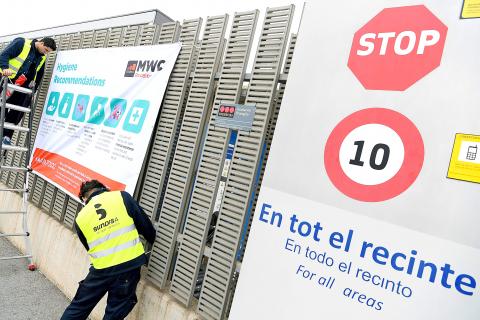
Photo: AFP
The decision comes after dozens of tech companies and wireless carriers dropped out, with the latest cancelations by Nokia Oyj, Vodafone Group PLC, Deutsche Telekom AG and Britain’s BT PLC.
Organizers and government officials had sought to hold out against growing pressure to cancel the annual tech extravaganza, which had been expected to draw more than 100,000 visitors from about 200 countries, including 5,000 to 6,000 from China.
The show normally represents a huge source of revenue for hotels, restaurants and taxi companies. Authorities have estimated the show was to generate 473 million euros (US$513 million) and more than 14,000 part-time jobs for the local economy.
Spanish Vice President Carmen Calvo said there was “no public health reason” to call off the show. She said Spain had a good health response system and was following all of the recommendations from the WHO.
Spanish labor unions said that the show was called off due to the panic of the major technological companies. The CCOO union’s regional leader, Javier Pacheco, denounced “the alarmist attitude of the technological companies that from their position of global supremacy don’t care about the local impact.”
However, Creative Strategies president Tim Bajarin said the cancelation was prudent with all the unknowns surrounding how the virus is spread and as many companies had already pulled out.

The demise of the coal industry left the US’ Appalachian region in tatters, with lost jobs, spoiled water and countless kilometers of abandoned underground mines. Now entrepreneurs are eyeing the rural region with ambitious visions to rebuild its economy by converting old mines into solar power systems and data centers that could help fuel the increasing power demands of the artificial intelligence (AI) boom. One such project is underway by a non-profit team calling itself Energy DELTA (Discovery, Education, Learning and Technology Accelerator) Lab, which is looking to develop energy sources on about 26,305 hectares of old coal land in

Taiwan’s exports soared 56 percent year-on-year to an all-time high of US$64.05 billion last month, propelled by surging global demand for artificial intelligence (AI), high-performance computing and cloud service infrastructure, the Ministry of Finance said yesterday. Department of Statistics Director-General Beatrice Tsai (蔡美娜) called the figure an unexpected upside surprise, citing a wave of technology orders from overseas customers alongside the usual year-end shopping season for technology products. Growth is likely to remain strong this month, she said, projecting a 40 percent to 45 percent expansion on an annual basis. The outperformance could prompt the Directorate-General of Budget, Accounting and

Netflix on Friday faced fierce criticism over its blockbuster deal to acquire Warner Bros Discovery. The streaming giant is already viewed as a pariah in some Hollywood circles, largely due to its reluctance to release content in theaters and its disruption of traditional industry practices. As Netflix emerged as the likely winning bidder for Warner Bros — the studio behind Casablanca, the Harry Potter movies and Friends — Hollywood’s elite launched an aggressive campaign against the acquisition. Titanic director James Cameron called the buyout a “disaster,” while a group of prominent producers are lobbying US Congress to oppose the deal,

Two Chinese chipmakers are attracting strong retail investor demand, buoyed by industry peer Moore Threads Technology Co’s (摩爾線程) stellar debut. The retail portion of MetaX Integrated Circuits (Shanghai) Co’s (上海沐曦) upcoming initial public offering (IPO) was 2,986 times oversubscribed on Friday, according to a filing. Meanwhile, Beijing Onmicro Electronics Co (北京昂瑞微), which makes radio frequency chips, was 2,899 times oversubscribed on Friday, its filing showed. The bids coincided with Moore Threads’ trading debut, which surged 425 percent on Friday after raising 8 billion yuan (US$1.13 billion) on bets that the company could emerge as a viable local competitor to Nvidia


 RSS
RSS