


In a career spanning more than three decades, Canadian fashion mogul Lawrence Stroll has relied on a simple formula: Take over a brand that is either niche, or in trouble, or both, and beef it up for half a dozen years. Then exit with a tidy profit.
It is a skill he honed in the 1980s bringing Ralph Lauren Corp’s preppy New England look to Europe, before buying Tommy Hilfiger in 1989 with long-term business partner Silas Chou — another clothing brand that celebrated Americana with its blue-red-white emblem and country-club attire.
Add to that list Michael Kors, teetering on the brink of collapse when the duo picked it up in 2003. By the time Stroll and Chou sold out in 2011, Kors was the king of affordable luxury with a sky-high valuation.
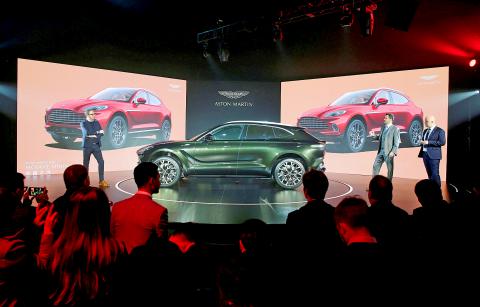
Photo: Reuters
Now Stroll wants to prove he can replicate that approach in a very different field, one where investments are higher, regulation is fiercer and competition is more unforgiving.
Last week, UK sports-car maker Aston Martin Lagonda Global Holdings PLC secured a £500 million (US$656 million) lifeline from a group that included Stroll, who is set to become executive chairman of the brand best known as the vehicle of choice for James Bond.
Aston Martin badly needs a savior. At the time of its initial public offering late in 2018, the business was pitched as a peer to Ferrari NV, which had pulled off a highly successful listing three years earlier.
However, the comparison quickly evaporated, with a string of profit warnings, lackluster sales and dwindling financial reserves weighing on Aston Martin’s stock, which has lost 75 percent of its value.
“Perhaps a touch of irrational mad passion with a large wallet isn’t as crazy as it sounds,” said Matthias Schmidt, an independent automotive analyst in Berlin.
While Stroll has not laid out his plan for Aston Martin in public, the stakes could not be higher. The company has huge financial outlays, having pinned its turnaround on the success of its first sports utility vehicle (SUV), the US$189,000 DBX.
The DBX is Aston Martin’s bet that it can broaden its clientele from buyers of sleek sports cars, such as the entry-level US$150,000 Vantage, which has turned out to be a tough sell.
Aston Martin is also different from Stroll’s previous investments because the company is listed, meaning any turnaround happens under the glare of public ownership and the reporting requirements this brings.
“Stroll brings a number of important benefits, namely he has removed the urgent cash need of the business, allowing it to focus on building its brand rather than selling units to fund working capital,” said Angus Tweedie, an analyst at Citigroup Global Markets in London.
Even though the DBX pushes into a crowded niche of luxury SUVs, early orders for the model have been encouraging.
That success gives Stroll and the team some breathing space to relieve pressure from other models, said Giulio Pescatore, an analyst at HSBC Holdings PLC in London.
At the same time, Aston Martin would be wise not to pursue a single-model strategy, he said.
“The DBX on its own cannot carry the weight of the company,” Pescatore said.
Deliveries of the model are to begin in May, Aston Martin has said.
Stroll wasted little time resetting Aston Martin’s priorities.
The automaker said it is paring back big-ticket investments in new models to focus instead on easier-to-achieve projects such as the DBX and special editions that tend to cost millions.
Aston Martin also put on hold its plans for an electric model, a counter-intuitive move in an environment where most other automakers are going all-in with battery-powered vehicles.
Unlike the world of fashion, the auto industry has years-long research and development cycles that require extensive investments, and Aston Martin’s decision to jettison its electric ambitions might put it at a technological disadvantage.
Stroll’s successes in fashion relied in no small part on dramatically extending the product portfolio to make the brands more widely accessible.
In the case of Michael Kors, that meant adding popular accessories like sunglasses or handbags to the core range of clothing.
Investors have speculated that Stroll might also take Aston Martin from being an auto company to a luxury consumer brand, an extension whose profit contribution remains untested beyond small items such as key rings or T-shirts.
Even before Stroll showed up, Aston Martin chief executive officer Andy Palmer sought to create a lifestyle offering that includes cashmere scarves and leather bags, as well as partnerships ranging from the luxurious (a real-estate development in Miami) to the ludicrous (a mini submarine called Project Neptune).
The positive impact on the bottom line is questionable, at best: Aston Martin sunglasses and T-shirts can be purchased for 75 percent off their sticker price at discount chains.
Stroll’s arrival would reinforce Aston Martin’s luxury pedigree, Palmer said in an interview last week.
“I think the dialogue will change from automotive to luxury,” he added.
Fans of the brand can look forward to not just the latest Bond movie this year, but can hope for a new investor who will display a more lasting commitment than the live-and-let-die approach of Stroll’s predecessors.
With assistance from Christopher Jasper, Tom Metcalf and Pei Yi Mak

The demise of the coal industry left the US’ Appalachian region in tatters, with lost jobs, spoiled water and countless kilometers of abandoned underground mines. Now entrepreneurs are eyeing the rural region with ambitious visions to rebuild its economy by converting old mines into solar power systems and data centers that could help fuel the increasing power demands of the artificial intelligence (AI) boom. One such project is underway by a non-profit team calling itself Energy DELTA (Discovery, Education, Learning and Technology Accelerator) Lab, which is looking to develop energy sources on about 26,305 hectares of old coal land in
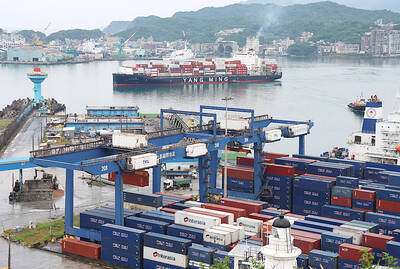
Taiwan’s exports soared 56 percent year-on-year to an all-time high of US$64.05 billion last month, propelled by surging global demand for artificial intelligence (AI), high-performance computing and cloud service infrastructure, the Ministry of Finance said yesterday. Department of Statistics Director-General Beatrice Tsai (蔡美娜) called the figure an unexpected upside surprise, citing a wave of technology orders from overseas customers alongside the usual year-end shopping season for technology products. Growth is likely to remain strong this month, she said, projecting a 40 percent to 45 percent expansion on an annual basis. The outperformance could prompt the Directorate-General of Budget, Accounting and
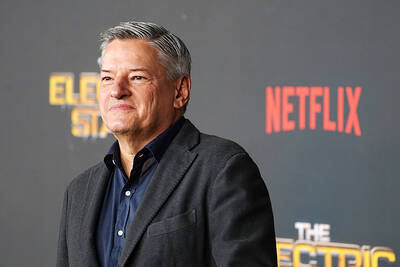
Netflix on Friday faced fierce criticism over its blockbuster deal to acquire Warner Bros Discovery. The streaming giant is already viewed as a pariah in some Hollywood circles, largely due to its reluctance to release content in theaters and its disruption of traditional industry practices. As Netflix emerged as the likely winning bidder for Warner Bros — the studio behind Casablanca, the Harry Potter movies and Friends — Hollywood’s elite launched an aggressive campaign against the acquisition. Titanic director James Cameron called the buyout a “disaster,” while a group of prominent producers are lobbying US Congress to oppose the deal,
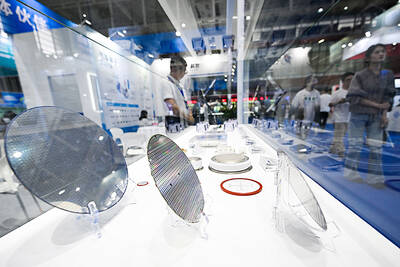
Two Chinese chipmakers are attracting strong retail investor demand, buoyed by industry peer Moore Threads Technology Co’s (摩爾線程) stellar debut. The retail portion of MetaX Integrated Circuits (Shanghai) Co’s (上海沐曦) upcoming initial public offering (IPO) was 2,986 times oversubscribed on Friday, according to a filing. Meanwhile, Beijing Onmicro Electronics Co (北京昂瑞微), which makes radio frequency chips, was 2,899 times oversubscribed on Friday, its filing showed. The bids coincided with Moore Threads’ trading debut, which surged 425 percent on Friday after raising 8 billion yuan (US$1.13 billion) on bets that the company could emerge as a viable local competitor to Nvidia


 RSS
RSS