


Uber Technologies Inc on Thursday said that it would deliver a first-ever quarterly profit by the end of the year, signaling that cost-cutting measures are exceeding even the company’s own expectations.
The company would become profitable, on an adjusted basis, by the fourth quarter of this year, chief executive officer Dara Khosrowshahi said on a conference call to discuss financial results.
A previous plan set this goal for next year. The company’s stock was up about 5 percent in extended trading.
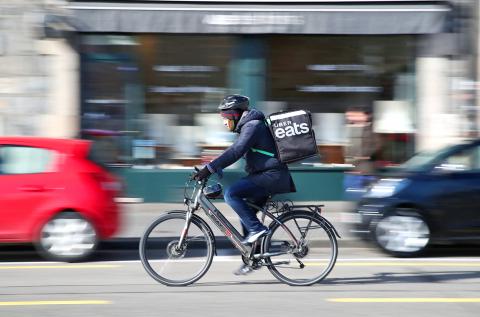
Photo: Reuters
The drive toward profitability is likely to take a toll on growth.
Gross bookings would decline slightly in this quarter from the fourth quarter of last year, chief financial officer Nelson Chai said.
For the fourth quarter, Uber edged out Wall Street’s expectations, with bookings up 28 percent and a loss that was narrower than analysts’ estimates.
Gross bookings for the fourth quarter were US$18.1 billion, showing that demand for transportation and food delivery orders remains strong. The measure, which represents the total value of rides, food orders and other businesses, is closely watched by investors.
Efforts to rein in spending are proving to be especially effective. The San Francisco-based company reported an adjusted loss of US$615 million, compared with a US$713 million average of analysts’ estimates compiled by Bloomberg.
The loss, which excludes interest, taxes and other expenses, was US$817 million in the same quarter a year earlier.
Uber is trying to more closely connect its various services and increase usage among the more than 100 million customers who open the app each month. The company is investing in electric bicycle and scooter rentals, and experimenting with helicopter rides and temporary staffing.
However, the new businesses are pricey and investors have punished the company for burning cash to fuel growth. The stock, which went public in May last year, trades below its initial public offering (IPO) price.
Uber on Thursday said that its loss for the year using generally accepted accounting principles was US$8.51 billion.
The startling figure was driven primarily by stock compensation and one-time costs associated with the IPO.
In the past year, Uber has taken steps to check its spending habit. It reduced marketing expenses, cut more than 1,000 employees and abandoned some unprofitable food delivery units. It ended delivery in South Korea and last month sold the delivery operation in India.
The company would consider abandoning delivery in other countries or acquiring businesses with the goal of only competing in markets where Uber Eats would be the biggest or second-biggest option, Khosrowshahi said.
Eventually, Uber Eats expects to reduce discounts for customers, which would drive a decline in spending by next quarter. The strategy is similar to what the company did in ride-hailing.
“The Eats team is running the same exact play,” Khosrowshahi said. “It’s just running a year behind.”
The ride-hailing business was profitable on a standalone basis in the fourth quarter, Uber said.
The company lost US$130 million on its “other technology programs,” including the autonomous driving division, which is funded by Uber, SoftBank Group Corp, Toyota Motor Corp and others.

The demise of the coal industry left the US’ Appalachian region in tatters, with lost jobs, spoiled water and countless kilometers of abandoned underground mines. Now entrepreneurs are eyeing the rural region with ambitious visions to rebuild its economy by converting old mines into solar power systems and data centers that could help fuel the increasing power demands of the artificial intelligence (AI) boom. One such project is underway by a non-profit team calling itself Energy DELTA (Discovery, Education, Learning and Technology Accelerator) Lab, which is looking to develop energy sources on about 26,305 hectares of old coal land in

Taiwan’s exports soared 56 percent year-on-year to an all-time high of US$64.05 billion last month, propelled by surging global demand for artificial intelligence (AI), high-performance computing and cloud service infrastructure, the Ministry of Finance said yesterday. Department of Statistics Director-General Beatrice Tsai (蔡美娜) called the figure an unexpected upside surprise, citing a wave of technology orders from overseas customers alongside the usual year-end shopping season for technology products. Growth is likely to remain strong this month, she said, projecting a 40 percent to 45 percent expansion on an annual basis. The outperformance could prompt the Directorate-General of Budget, Accounting and

Netflix on Friday faced fierce criticism over its blockbuster deal to acquire Warner Bros Discovery. The streaming giant is already viewed as a pariah in some Hollywood circles, largely due to its reluctance to release content in theaters and its disruption of traditional industry practices. As Netflix emerged as the likely winning bidder for Warner Bros — the studio behind Casablanca, the Harry Potter movies and Friends — Hollywood’s elite launched an aggressive campaign against the acquisition. Titanic director James Cameron called the buyout a “disaster,” while a group of prominent producers are lobbying US Congress to oppose the deal,

Two Chinese chipmakers are attracting strong retail investor demand, buoyed by industry peer Moore Threads Technology Co’s (摩爾線程) stellar debut. The retail portion of MetaX Integrated Circuits (Shanghai) Co’s (上海沐曦) upcoming initial public offering (IPO) was 2,986 times oversubscribed on Friday, according to a filing. Meanwhile, Beijing Onmicro Electronics Co (北京昂瑞微), which makes radio frequency chips, was 2,899 times oversubscribed on Friday, its filing showed. The bids coincided with Moore Threads’ trading debut, which surged 425 percent on Friday after raising 8 billion yuan (US$1.13 billion) on bets that the company could emerge as a viable local competitor to Nvidia


 RSS
RSS