


Chinese telecom giant Huawei Technologies Co (華為) on Tuesday said that it would set up manufacturing hubs in Europe, as it tries to fight off US pressure on EU nations to stop it from operating.
“Huawei is more committed to Europe than ever before,” the company’s top executive for Europe, Abraham Liu (劉康), said during a Lunar New Year reception in Brussels. “That’s why we have decided we want to set up manufacturing bases in Europe — so that we can truly have 5G for Europe made in Europe.”
The announcement came just days after the EU recommended that member states could ban telecoms operators deemed a security risk from critical parts of 5G infrastructure.
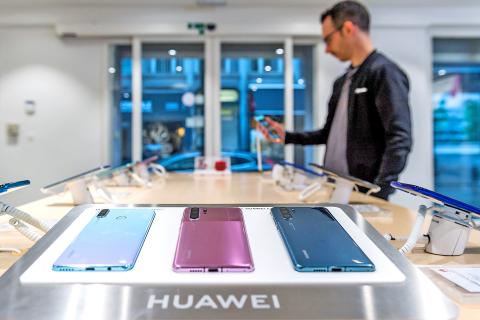
Photo: Bloomberg
However, the EU plan, which closely mirrored rules set out by Britain allowing a limited role for Huawei, stopped short of barring the firm from the next-generation communications network designed for near-instantaneous data transfers.
Those guidelines were the fruit of months of agonizing within the EU, which has struggled to find a middle way to balance Huawei’s huge dominance in the 5G sector with security concerns pressed by Washington.
Liu in his speech acknowledged that the tech world “is increasingly entangled with geopolitical issues, trade negotiations and diplomatic dialogue between nations.”
“Politically motivated suspicion does not address the challenges ahead,” he added, in a veiled admonishment to Washington.
He also urged Europe, the US and China to “invest more, in political discussion, to talk about collaboration and common rules.”
In Europe, a ban on Huawei will now ultimately be up to member states, but the European Commission’s middle-road recommendations give cover to European capitals to resist US pleas.
Building factories in Europe would also help persuade EU nations to turn away from tough measures against Huawei, with all eyes on Germany, which has delayed its decision on a possible ban.
Huawei said it employs more than 13,000 staff, and runs two regional centers and 23 research centers in 12 EU nations.
Huawei is one of the world’s leading network technology suppliers, and one of the few — along with European telecom companies Nokia Oyj and Ericsson AB — capable of building 5G networks.
The US sees the company as a potential threat to cybersecurity and fears it would facilitate cyberespionage by the Chinese government, to which it is said to have close links.
US President Donald Trump administration plans to meet this month to discuss further curbing exports to China and Huawei, two sources said, in a bid to resolve differences within the government over the possible crackdown.
The gathering, scheduled for Feb. 28, is to bring together high-level officials for talks after the US Department of Commerce withdrew a rule aimed at further reducing foreign shipments to Huawei amid pushback from the US Department of Defense, one of the people said.
The meeting, which is expected to include Cabinet-level officials, including Secretary of Commerce Wilbur Ross, Secretary of Defense Mark Esper and Secretary of State Mike Pompeo, is aimed at addressing how best to approach the blacklisted Chinese company and the broader war with China over technological dominance.
“The administration has to decide how to match its rhetoric on China with policies to deny China key technology and industry,” said Tim Morrison, a former senior director at the White House’s National Security Council under Trump, who favors tougher rules.
“Too many tools have not been brought to the president, because the entire administration isn’t yet in the fight. That must end,” he added.
US companies have said the measures that have been floated would harm US business by driving customers to foreign competitors, while doing little to thwart Huawei.
The agencies did not immediately respond to a request for comment.
Additional reporting by Reuters
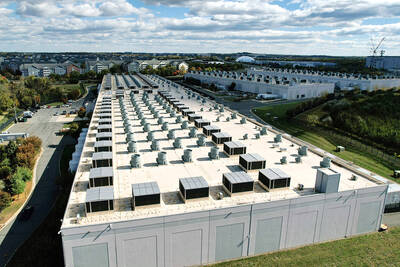
The demise of the coal industry left the US’ Appalachian region in tatters, with lost jobs, spoiled water and countless kilometers of abandoned underground mines. Now entrepreneurs are eyeing the rural region with ambitious visions to rebuild its economy by converting old mines into solar power systems and data centers that could help fuel the increasing power demands of the artificial intelligence (AI) boom. One such project is underway by a non-profit team calling itself Energy DELTA (Discovery, Education, Learning and Technology Accelerator) Lab, which is looking to develop energy sources on about 26,305 hectares of old coal land in

Taiwan’s exports soared 56 percent year-on-year to an all-time high of US$64.05 billion last month, propelled by surging global demand for artificial intelligence (AI), high-performance computing and cloud service infrastructure, the Ministry of Finance said yesterday. Department of Statistics Director-General Beatrice Tsai (蔡美娜) called the figure an unexpected upside surprise, citing a wave of technology orders from overseas customers alongside the usual year-end shopping season for technology products. Growth is likely to remain strong this month, she said, projecting a 40 percent to 45 percent expansion on an annual basis. The outperformance could prompt the Directorate-General of Budget, Accounting and

Netflix on Friday faced fierce criticism over its blockbuster deal to acquire Warner Bros Discovery. The streaming giant is already viewed as a pariah in some Hollywood circles, largely due to its reluctance to release content in theaters and its disruption of traditional industry practices. As Netflix emerged as the likely winning bidder for Warner Bros — the studio behind Casablanca, the Harry Potter movies and Friends — Hollywood’s elite launched an aggressive campaign against the acquisition. Titanic director James Cameron called the buyout a “disaster,” while a group of prominent producers are lobbying US Congress to oppose the deal,
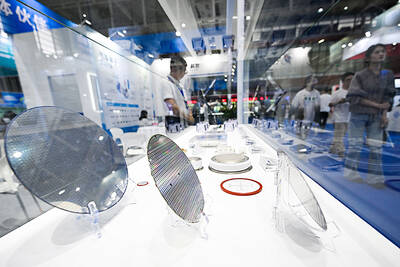
Two Chinese chipmakers are attracting strong retail investor demand, buoyed by industry peer Moore Threads Technology Co’s (摩爾線程) stellar debut. The retail portion of MetaX Integrated Circuits (Shanghai) Co’s (上海沐曦) upcoming initial public offering (IPO) was 2,986 times oversubscribed on Friday, according to a filing. Meanwhile, Beijing Onmicro Electronics Co (北京昂瑞微), which makes radio frequency chips, was 2,899 times oversubscribed on Friday, its filing showed. The bids coincided with Moore Threads’ trading debut, which surged 425 percent on Friday after raising 8 billion yuan (US$1.13 billion) on bets that the company could emerge as a viable local competitor to Nvidia


 RSS
RSS