


Hong Kong’s flagship carrier Cathay Pacific Airways Ltd (國泰航空) is asking its entire workforce to take up to three weeks of unpaid leave, chief executive officer Augustus Tang (鄧健榮) announced yesterday, as the airline faces a crisis in the wake of a new coronavirus outbreak in China.
The request lays bare desperate times at Cathay, which was hammered last year by months of political chaos and protests in Hong Kong, and is now being further hurt by the fallout from the virus outbreak.
In a video message to the company’s 27,000 employees, Tang said they were being asked to take up to three weeks leave with no pay between next month and June.
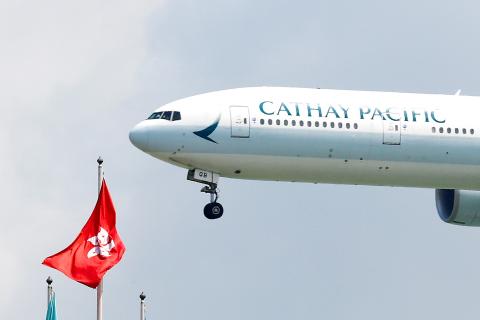
Photo: Reuters
“I am hoping all of you will participate, from our frontline employees to our senior leaders, and share in our current challenges,” Tang said.
Cathay has 500 to 600 employees in Taiwan, local Chinese-language media reported.
The 2019 novel coronavirus, which was first detected in Wuhan, China, late last year, spread over the Lunar New Year holiday, which would normally be one of the busiest times for regional airlines. Instead, dozens of international carriers have reduced or suspended flights to China in a bid to halt the pathogen’s spread and as passenger numbers plummet.
Tang said that Cathay was experiencing “one of the most difficult Chinese New Year holidays we have ever had” because of the outbreak.
“And we don’t know how long it will last,” he said. “With such an uncertain outlook, preserving our cash is now the key to protecting our business.”
He announced a series of measures to tackle the crisis, including asking staff to voluntarily take unpaid leave.
“I realize this is difficult to hear, and we may need to take further steps ahead, but by supporting the special leave scheme you will be helping at our time of need,” he told staff.
He also asked suppliers to reduce their prices, and said that the airline would make short-term adjustments to its capacity — including an already announced move to cut flights 30 percent worldwide for two months, including a 90 percent reduction to China.
The last time Cathay asked staff to take unpaid leave was in 2009 in the wake of the global financial crash.
“The situation now is just as grave,” Tang said.
Cathay’s passenger capacity would probably drop 7.5 percent this year, Andrew Lee (李錦榮), an analyst at Jefferies Hong Kong Ltd, said in a report on Tuesday.
That compares with the airline’s forecast for a 1.4 percent decline.
The carrier will probably report a loss for the second half of last year and the first half of this year, before rebounding to profit in the second half of this year, Lee said.
Additional reporting by Bloomberg and staff writer

The demise of the coal industry left the US’ Appalachian region in tatters, with lost jobs, spoiled water and countless kilometers of abandoned underground mines. Now entrepreneurs are eyeing the rural region with ambitious visions to rebuild its economy by converting old mines into solar power systems and data centers that could help fuel the increasing power demands of the artificial intelligence (AI) boom. One such project is underway by a non-profit team calling itself Energy DELTA (Discovery, Education, Learning and Technology Accelerator) Lab, which is looking to develop energy sources on about 26,305 hectares of old coal land in

Taiwan’s exports soared 56 percent year-on-year to an all-time high of US$64.05 billion last month, propelled by surging global demand for artificial intelligence (AI), high-performance computing and cloud service infrastructure, the Ministry of Finance said yesterday. Department of Statistics Director-General Beatrice Tsai (蔡美娜) called the figure an unexpected upside surprise, citing a wave of technology orders from overseas customers alongside the usual year-end shopping season for technology products. Growth is likely to remain strong this month, she said, projecting a 40 percent to 45 percent expansion on an annual basis. The outperformance could prompt the Directorate-General of Budget, Accounting and

Netflix on Friday faced fierce criticism over its blockbuster deal to acquire Warner Bros Discovery. The streaming giant is already viewed as a pariah in some Hollywood circles, largely due to its reluctance to release content in theaters and its disruption of traditional industry practices. As Netflix emerged as the likely winning bidder for Warner Bros — the studio behind Casablanca, the Harry Potter movies and Friends — Hollywood’s elite launched an aggressive campaign against the acquisition. Titanic director James Cameron called the buyout a “disaster,” while a group of prominent producers are lobbying US Congress to oppose the deal,

Two Chinese chipmakers are attracting strong retail investor demand, buoyed by industry peer Moore Threads Technology Co’s (摩爾線程) stellar debut. The retail portion of MetaX Integrated Circuits (Shanghai) Co’s (上海沐曦) upcoming initial public offering (IPO) was 2,986 times oversubscribed on Friday, according to a filing. Meanwhile, Beijing Onmicro Electronics Co (北京昂瑞微), which makes radio frequency chips, was 2,899 times oversubscribed on Friday, its filing showed. The bids coincided with Moore Threads’ trading debut, which surged 425 percent on Friday after raising 8 billion yuan (US$1.13 billion) on bets that the company could emerge as a viable local competitor to Nvidia


 RSS
RSS