


Toyota Motor Corp’s luxury Lexus brand posted a double-digit sales gain last year, taking its 30th anniversary in stride as strength in China and Europe offset stalled demand in North America.
The brand, which debuted in 1989, grew 10 percent to 765,330 vehicles worldwide, Toyota said in a statement yesterday, powered by strong sales of its UX subcompact crossover and best-selling RX sports utility vehicle.
China sales soared 25 percent to 202,000 vehicles last year and deliveries in Europe climbed 14 percent to 87,000 vehicles.
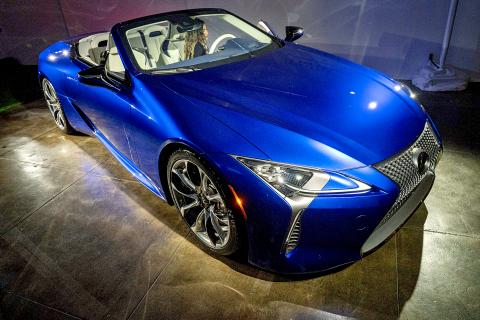
Photo: Bloomberg
However, in North America, the brand’s largest market, sales came to 325,000 vehicles — which Toyota said were “level with prior year.“
Lexus’ shift toward smaller and more fuel-efficient vehicles, such as ones with hybrid gas-electric motors, has proved popular in China and Europe, but an aging product lineup in the US — where larger vehicles rule the road — has cost it market share and momentum.
Toyota has long sought to make Lexus a global brand, and its rapid growth in China and Europe after years of sluggishness is helping realize that goal.
Company officials say they have not forgotten about the US market — which it once dominated — and have a series of newer vehicles in the offing.
Sales in the US fell 0.1 percent last year to 298,114 vehicles.
That marked a fourth straight year of declines and the lowest level since 2013.
Lexus sold its 10 millionth vehicle last year, a testament to its success over other Japanese luxury brands such as Nissan Motor Co’s Infiniti and Honda Motor Co’s Acura, whose cumulative worldwide sales total 2.6 million and 5.4 million respectively.
Yet the Toyota premium brand still trails behind German rivals.
Daimler AG’s Mercedes-Benz saw sales last year rise 1.3 percent to 2.34 million vehicles, besting No. 2 BMW AG’s 2 percent gain to 2.17 million vehicles.

The demise of the coal industry left the US’ Appalachian region in tatters, with lost jobs, spoiled water and countless kilometers of abandoned underground mines. Now entrepreneurs are eyeing the rural region with ambitious visions to rebuild its economy by converting old mines into solar power systems and data centers that could help fuel the increasing power demands of the artificial intelligence (AI) boom. One such project is underway by a non-profit team calling itself Energy DELTA (Discovery, Education, Learning and Technology Accelerator) Lab, which is looking to develop energy sources on about 26,305 hectares of old coal land in

Taiwan’s exports soared 56 percent year-on-year to an all-time high of US$64.05 billion last month, propelled by surging global demand for artificial intelligence (AI), high-performance computing and cloud service infrastructure, the Ministry of Finance said yesterday. Department of Statistics Director-General Beatrice Tsai (蔡美娜) called the figure an unexpected upside surprise, citing a wave of technology orders from overseas customers alongside the usual year-end shopping season for technology products. Growth is likely to remain strong this month, she said, projecting a 40 percent to 45 percent expansion on an annual basis. The outperformance could prompt the Directorate-General of Budget, Accounting and

Netflix on Friday faced fierce criticism over its blockbuster deal to acquire Warner Bros Discovery. The streaming giant is already viewed as a pariah in some Hollywood circles, largely due to its reluctance to release content in theaters and its disruption of traditional industry practices. As Netflix emerged as the likely winning bidder for Warner Bros — the studio behind Casablanca, the Harry Potter movies and Friends — Hollywood’s elite launched an aggressive campaign against the acquisition. Titanic director James Cameron called the buyout a “disaster,” while a group of prominent producers are lobbying US Congress to oppose the deal,
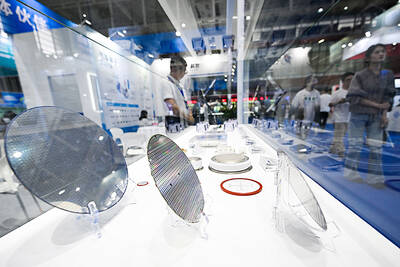
Two Chinese chipmakers are attracting strong retail investor demand, buoyed by industry peer Moore Threads Technology Co’s (摩爾線程) stellar debut. The retail portion of MetaX Integrated Circuits (Shanghai) Co’s (上海沐曦) upcoming initial public offering (IPO) was 2,986 times oversubscribed on Friday, according to a filing. Meanwhile, Beijing Onmicro Electronics Co (北京昂瑞微), which makes radio frequency chips, was 2,899 times oversubscribed on Friday, its filing showed. The bids coincided with Moore Threads’ trading debut, which surged 425 percent on Friday after raising 8 billion yuan (US$1.13 billion) on bets that the company could emerge as a viable local competitor to Nvidia


 RSS
RSS