


Apple Inc was the world’s top smartphone seller in the final quarter of last year, seizing the crown from Samsung Electronics Co, market trackers said.
Apple shipped an estimated 73.8 million iPhones during the fourth quarter, driven by the popularity of its newest models in the US and Europe and lower-priced handsets in other parts of the world, International Data Corp (IDC) reported on Thursday last week.
Apple, which has been below Samsung for some time, “is recovering, due to cheaper iPhone 11 pricing and healthier demand in Asia and North America,” said Neil Mawston, executive director of wireless device strategies at Strategy Analytics, whose separate survey also showed Apple on top in the past quarter.
South Korean consumer electronics giant Samsung delivered about 69.4 million handsets as it slipped to the No. 2 position, IDC said.
Chinese smartphone powerhouse Huawei Technologies Co (華為) remained a strong player in its home market, but saw sales of premium models take a hit in Western Europe in the wake of US sanctions, IDC associate research director Melissa Chau sid.
“Things will continue to look challenging for Huawei given that the trade war is still not yet resolved, while new uncertainty raised around the Wuhan coronavirus could potentially have adverse effects on not just Huawei, but all players reliant on the China smartphone supply chain,” Chau said.
Huawei shipped 56.2 million smartphones during the quarter, a decline of about 7 percent from the same period a year earlier, IDC reported.
Huawei faces headwinds because of US sanctions that have prevented it from receiving key components and software, IHS Markit senior analyst Anna Ahrens said.
“In markets like Western Europe, the lack of Google services will make Huawei phones a hard sell for consumers, especially considering that the company’s Mate series is positioned squarely in the premium price segment,” Ahrens said.
Samsung remained the top smartphone seller overall last year, and the broader market is expected to receive a boost as 5G telecom networks are established and new smartphones synched to them are launched.
For the full year, overall smartphone sales were down about 1 percent despite an improving trend in the fourth quarter, IDC and Strategy Analytics surveys showed.
IDC reported shipments of 368 million handsets last year compared with 373 million a year earlier — a third consecutive yearly decline.
Separately, Apple is temporarily closing its 42 stores in mainland China, the company’s third-biggest market in terms of sales behind the US and Europe. China is also where most iPhones and other devices are made.
The iPhone maker said in a statement that it was closing stores, corporate offices and contact centers in China until Sunday “out of an abundance of caution and based on the latest advice from leading health experts.”
“Our thoughts are with the people most immediately affected by the coronavirus and with those working around the clock to study and contain it,” the statement said.
Apple’s online store is to remain open.
In a note on Saturday, Wedbush Securities Inc analyst Daniel Ives predicted the store closures would have a “negligible” effect on Apple, largely because consumers in mainland China would still be able to buy iPhones and other products through online channels.
Even if the shutdown of the brick-and-mortar stores extends throughout the whole of this month, Ives said it would only lower Apple’s annual iPhone sales in that region by about 3 percent.
Additional reporting by AP

The demise of the coal industry left the US’ Appalachian region in tatters, with lost jobs, spoiled water and countless kilometers of abandoned underground mines. Now entrepreneurs are eyeing the rural region with ambitious visions to rebuild its economy by converting old mines into solar power systems and data centers that could help fuel the increasing power demands of the artificial intelligence (AI) boom. One such project is underway by a non-profit team calling itself Energy DELTA (Discovery, Education, Learning and Technology Accelerator) Lab, which is looking to develop energy sources on about 26,305 hectares of old coal land in

Taiwan’s exports soared 56 percent year-on-year to an all-time high of US$64.05 billion last month, propelled by surging global demand for artificial intelligence (AI), high-performance computing and cloud service infrastructure, the Ministry of Finance said yesterday. Department of Statistics Director-General Beatrice Tsai (蔡美娜) called the figure an unexpected upside surprise, citing a wave of technology orders from overseas customers alongside the usual year-end shopping season for technology products. Growth is likely to remain strong this month, she said, projecting a 40 percent to 45 percent expansion on an annual basis. The outperformance could prompt the Directorate-General of Budget, Accounting and

Netflix on Friday faced fierce criticism over its blockbuster deal to acquire Warner Bros Discovery. The streaming giant is already viewed as a pariah in some Hollywood circles, largely due to its reluctance to release content in theaters and its disruption of traditional industry practices. As Netflix emerged as the likely winning bidder for Warner Bros — the studio behind Casablanca, the Harry Potter movies and Friends — Hollywood’s elite launched an aggressive campaign against the acquisition. Titanic director James Cameron called the buyout a “disaster,” while a group of prominent producers are lobbying US Congress to oppose the deal,
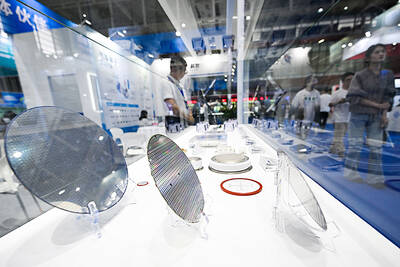
Two Chinese chipmakers are attracting strong retail investor demand, buoyed by industry peer Moore Threads Technology Co’s (摩爾線程) stellar debut. The retail portion of MetaX Integrated Circuits (Shanghai) Co’s (上海沐曦) upcoming initial public offering (IPO) was 2,986 times oversubscribed on Friday, according to a filing. Meanwhile, Beijing Onmicro Electronics Co (北京昂瑞微), which makes radio frequency chips, was 2,899 times oversubscribed on Friday, its filing showed. The bids coincided with Moore Threads’ trading debut, which surged 425 percent on Friday after raising 8 billion yuan (US$1.13 billion) on bets that the company could emerge as a viable local competitor to Nvidia


 RSS
RSS