


It is a problem that Davos cannot solve.
The World Economic Forum (WEF) tried to mitigate the environmental impact of all those private jets traveling to and from this year’s conference in the Swiss town by giving them the option to fill up on so-called sustainable aviation fuel, which is designed to lower carbon emissions compared with normal flights. Many attendees who left the conference after the last session on Friday will nevertheless have had to take commercial planes that use conventional fuel.
Given the WEF’s effort this week to tackle the risks facing the world economy from climate change — environmental issues topped its agenda for the first time in the event’s 50-year history — it is an uncomfortable situation on its own doorstep. It is also a high-profile example of an issue confronting the entire conference industry: as concern about environmental damage from air travel has given birth to a “flight shame” phenomenon which has darkened carriers’ outlook, there is the potential for a knock-on impact on the business of organizing business meetings.
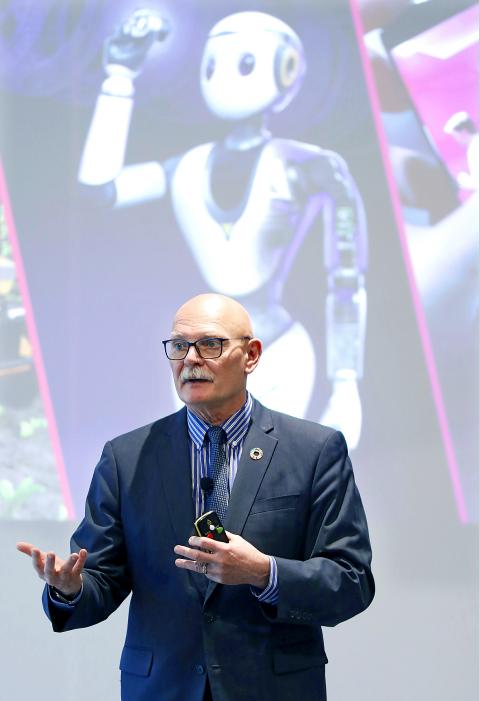
Photo: EPA-EFE
An average conference attendee emits as much as 2,000 pounds (907kg) of carbon dioxide per meeting, according to TerraPass, a sustainability consultancy — about the same as driving from San Francisco to New York City. Some of the environmental impact comes from piles of brochures that might not get recycled, the food that gets wasted and the marketing swag that can end up in landfills. But the vast majority of carbon emissions come from air travel.
“We must get ahead of change and public perception,” Jason Geall, vice president for Northern Europe at American Express Global Business Travel, said in a speech to business travel and meetings executives in London last Monday. “A failure to act now could leave us vulnerable to existential threats, such as flight caps and increased taxation and regulation.”
For now, environmental concerns have not hit events companies. Shares of Relx PLC, which derived about 18 percent of revenue from events in the first half of last year, and Informa PLC, whose events unit contributed about 8 percent, were at or close to all-time highs on Friday. UBS AG analysts led by Adam Berlin forecast 4 percent annual growth in the global exhibitions sector in the coming year, about the same pace as in recent years.
While more organizers are recognizing the need to mitigate the damage their events can cause to the environment, the industry has not settled on an approach for tackling air travel. Some conference holders include carbon offsetting in the cost of the event tickets. Others leave attendees to address the problem themselves.
Take Mobile World Congress (MWC), the annual meeting for the telecommunications industry in Barcelona. This year’s event starts Feb. 24, and last year more than 100,000 people attended. For four of the past five years, Guinness World Records named it “The World’s Largest Carbon Neutral Trade Show.”
MWC lists among its main achievements the creation of a green logo, and the use of recycled post-consumer bottles in the lanyards for attendees’ badges. Guests are also directed to a Web site where they can calculate and offset their emissions from attending the event, a spokeswoman said. The GSMA, the mobile industry lobby group that hosts the conference, calculates and offsets any emissions remaining, including from travel.
Though the events industry has been slow to tackle the problem of carbon dioxide emissions from air travel, images of the Australian wildfires and calls for action from activists like Greta Thunberg have sparked interest in making meetings more green, said Nancy Zavada, president of environmental consultancy MeetGreen in Portland, Oregon.
Demand for her services, which includes helping meeting organizers arrange teleconferencing and carbon offsetting for attendees’ flights, jumped about 20 percent in the last quarter, she said.
“The climate, the storms, the weather, are really starting to wake people up to what’s going on,” she said. “It’s also the Greta effect.”
Zavada also cautions against being too quick to criticize the environmental measures taken at Davos. The WEF does not serve drinks in single-use plastic containers, uses 100 percent renewable energy, and to encourage walking in the Alpine snow, offers shoe grips and maps.
“They’re trying,” Zavada said. “They’re putting some stuff in place. They are just so public, they’re easy to pick on.”

The demise of the coal industry left the US’ Appalachian region in tatters, with lost jobs, spoiled water and countless kilometers of abandoned underground mines. Now entrepreneurs are eyeing the rural region with ambitious visions to rebuild its economy by converting old mines into solar power systems and data centers that could help fuel the increasing power demands of the artificial intelligence (AI) boom. One such project is underway by a non-profit team calling itself Energy DELTA (Discovery, Education, Learning and Technology Accelerator) Lab, which is looking to develop energy sources on about 26,305 hectares of old coal land in
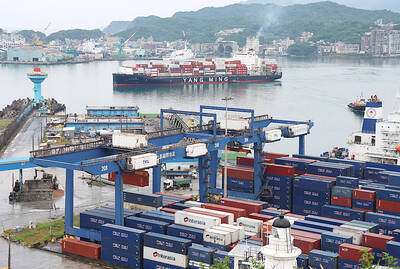
Taiwan’s exports soared 56 percent year-on-year to an all-time high of US$64.05 billion last month, propelled by surging global demand for artificial intelligence (AI), high-performance computing and cloud service infrastructure, the Ministry of Finance said yesterday. Department of Statistics Director-General Beatrice Tsai (蔡美娜) called the figure an unexpected upside surprise, citing a wave of technology orders from overseas customers alongside the usual year-end shopping season for technology products. Growth is likely to remain strong this month, she said, projecting a 40 percent to 45 percent expansion on an annual basis. The outperformance could prompt the Directorate-General of Budget, Accounting and

Netflix on Friday faced fierce criticism over its blockbuster deal to acquire Warner Bros Discovery. The streaming giant is already viewed as a pariah in some Hollywood circles, largely due to its reluctance to release content in theaters and its disruption of traditional industry practices. As Netflix emerged as the likely winning bidder for Warner Bros — the studio behind Casablanca, the Harry Potter movies and Friends — Hollywood’s elite launched an aggressive campaign against the acquisition. Titanic director James Cameron called the buyout a “disaster,” while a group of prominent producers are lobbying US Congress to oppose the deal,

Two Chinese chipmakers are attracting strong retail investor demand, buoyed by industry peer Moore Threads Technology Co’s (摩爾線程) stellar debut. The retail portion of MetaX Integrated Circuits (Shanghai) Co’s (上海沐曦) upcoming initial public offering (IPO) was 2,986 times oversubscribed on Friday, according to a filing. Meanwhile, Beijing Onmicro Electronics Co (北京昂瑞微), which makes radio frequency chips, was 2,899 times oversubscribed on Friday, its filing showed. The bids coincided with Moore Threads’ trading debut, which surged 425 percent on Friday after raising 8 billion yuan (US$1.13 billion) on bets that the company could emerge as a viable local competitor to Nvidia


 RSS
RSS