


One of the most senior figures in the US government has warned British Chancellor of the Exchequer Sajid Javid to delay a “discriminatory” tax on big tech companies, in the latest sign of tensions with US President Donald Trump’s administration ahead of critical trade talks.
US Secretary of the Treasury Steven Mnuchin used a breakfast meeting with the chancellor on Saturday to warn him directly against applying the new tax as part of his forthcoming budget. The confrontation comes as the US mounts a last-ditch attempt to stop Britain using technology from China’s Huawei Technologies Co (華為) in its 5G network.
The US president again pressed British Prime Minister Boris Johnson on Friday night not to give the green light to the use of Huawei technology, despite reassurances from Britain’s security services that they can mitigate any security risks posed by the company.
It is among a mounting number of issues developing with the US in the run-up to trade deal talks later this year. The UK has also sided with European allies over the treatment of Iran, while the US has refused to extradite a woman charged with causing the death of teenage motorcyclist Harry Dunn.
Speaking at Chatham House in London, Mnuchin revealed that he had raised his concerns about the proposed digital services tax, which would mean a 2 percent levy being applied to sales of big tech firms, during a meeting at 11 Downing Street.
“We believe that the [digital services tax] is a discriminatory tax,” he said. “We don’t think it’s appropriate.” He added that such a tax contained “violations to our tax treaties.”
“We’re working through that and I think we have a good outcome of trying to give some room now in 2020 to continue these discussions,” he said.
The UK has become isolated over the issue of a digital services tax after France announced it would drop its plan for a 3 percent levy on the revenues of large technology companies. Javid has so far resisted calls to ditch his version of the tax, although he has said it would be lifted once an international solution to taxing big tech companies was agreed. Going ahead with the levy is likely to provoke retaliation from the US, most likely in the form of tariffs on cars.
Mnuchin also reiterated concerns about the UK’s use of Huawei technology, due to be confirmed this week. He warned that it raised concerns about security and privacy.
“If you look at the role of technology, it is critical that we have infrastructure that is protected,” he said. “And we have important relationships, and I think what’s clear is for the role of government and the role of national security issues and the role of defense, we want to make sure our infrastructures are protected.
“As more and more things are connected to the network and to the grid, these national security issues go beyond the traditional aspects and go into various different aspects. I think the real issue for us is making sure that the networks and infrastructure are properly protected,” he said.
The lobbying from the Trump regime will continue this week when US Secretary of State Mike Pompeo meets the British prime minister and British First Secretary of State Dominic Raab.
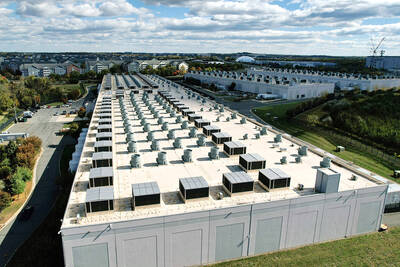
The demise of the coal industry left the US’ Appalachian region in tatters, with lost jobs, spoiled water and countless kilometers of abandoned underground mines. Now entrepreneurs are eyeing the rural region with ambitious visions to rebuild its economy by converting old mines into solar power systems and data centers that could help fuel the increasing power demands of the artificial intelligence (AI) boom. One such project is underway by a non-profit team calling itself Energy DELTA (Discovery, Education, Learning and Technology Accelerator) Lab, which is looking to develop energy sources on about 26,305 hectares of old coal land in

Taiwan’s exports soared 56 percent year-on-year to an all-time high of US$64.05 billion last month, propelled by surging global demand for artificial intelligence (AI), high-performance computing and cloud service infrastructure, the Ministry of Finance said yesterday. Department of Statistics Director-General Beatrice Tsai (蔡美娜) called the figure an unexpected upside surprise, citing a wave of technology orders from overseas customers alongside the usual year-end shopping season for technology products. Growth is likely to remain strong this month, she said, projecting a 40 percent to 45 percent expansion on an annual basis. The outperformance could prompt the Directorate-General of Budget, Accounting and

Netflix on Friday faced fierce criticism over its blockbuster deal to acquire Warner Bros Discovery. The streaming giant is already viewed as a pariah in some Hollywood circles, largely due to its reluctance to release content in theaters and its disruption of traditional industry practices. As Netflix emerged as the likely winning bidder for Warner Bros — the studio behind Casablanca, the Harry Potter movies and Friends — Hollywood’s elite launched an aggressive campaign against the acquisition. Titanic director James Cameron called the buyout a “disaster,” while a group of prominent producers are lobbying US Congress to oppose the deal,

Two Chinese chipmakers are attracting strong retail investor demand, buoyed by industry peer Moore Threads Technology Co’s (摩爾線程) stellar debut. The retail portion of MetaX Integrated Circuits (Shanghai) Co’s (上海沐曦) upcoming initial public offering (IPO) was 2,986 times oversubscribed on Friday, according to a filing. Meanwhile, Beijing Onmicro Electronics Co (北京昂瑞微), which makes radio frequency chips, was 2,899 times oversubscribed on Friday, its filing showed. The bids coincided with Moore Threads’ trading debut, which surged 425 percent on Friday after raising 8 billion yuan (US$1.13 billion) on bets that the company could emerge as a viable local competitor to Nvidia


 RSS
RSS