


France and a major automaker said on Saturday that they are moving to get citizens out of a locked-down Chinese city where a deadly outbreak of a new virus originated and has spread worldwide.
French automaker PSA Group says it will evacuate its employees and their families from Wuhan in central China, quarantine them in another major Chinese city and then bring them back to France.
The Foreign Ministry said French officials were studying “eventual options” for all its nationals to leave if they wish.
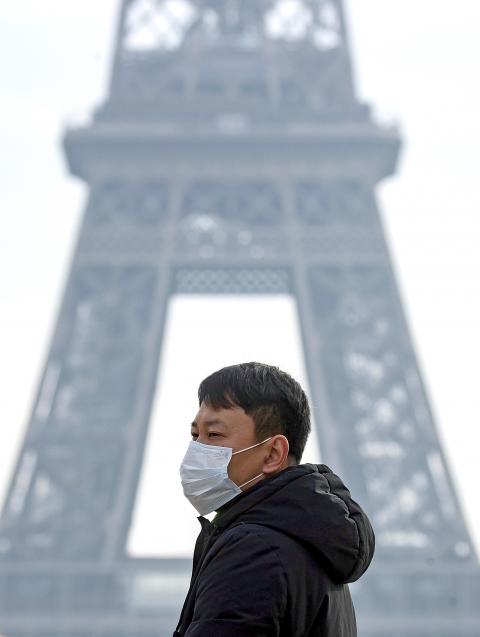
Photo: EPA-EFE
It comes a day after France announced that three cases of the new virus are being treated in two French hospitals — the first confirmed in Europe. All the patients are Chinese who had recently returned from China and are doing well, officials said.
PSA Group did not say how many employees would be part of an evacuation.
In a series of tweets, the automaker said transportation, housing and other organizational considerations are being worked out. PSA, which sells its Peugeot and Citroen cars in China, has a joint venture with Dongfeng Motor Corp (DFM, 東風汽車) in Wuhan.
PSA said it was working closely with Chinese authorities and the French Consulate.
The French Foreign Ministry’s statement made no mention of PSA’s plans.
The automaker did not say how long the quarantine period would last.
However, French medical experts have said the incubation period for the virus appears to be 14 days.
PSA also said it is working with Chinese partner DFM and authorities to take care of Chinese employees. It did not elaborate.
French authorities have cautioned against panic at home, but were concerned about the country’s citizens in Wuhan and those arriving in France, which has direct flights to China. Starting yesterday, medical teams were deployed at France’s airports, notably Paris’ Charles de Gaulle, to help passengers arriving from Chinese cities with questions or medical needs, French health chief Jerome Salomon said.
The new virus accelerated its spread in China with 56 deaths so far, and the US consulate in the epicenter of the outbreak, the central city of Wuhan, announced yesterday it would evacuate its personnel and some private citizens aboard a charter flight.
A notice from the US embassy in Beijing said there would be limited capacity to transport US citizens on tomorrow’s flight from Wuhan that will proceed directly to San Francisco. It said that in the event there are not enough seats, priority will be given to individuals “at greater risk from coronavirus.”

The domestic unit of the Chinese-owned, Dutch-headquartered chipmaker Nexperia BV will soon be able to produce semiconductors locally within China, according to two company sources. Nexperia is at the center of a global tug-of-war over critical semiconductor technology, with a Dutch court in February ordering a probe into alleged mismanagement at the company. The geopolitical tussle has disrupted supply chains, with some carmakers reportedly forced to cut production due to chip shortages. Local production would allow Nexperia’s domestic arm, Nexperia Semiconductors (China) Ltd (安世半導體中國), to bypass restrictions in place since October on the supply of silicon wafers — etched with tiny components to

Singapore-based ride-hailing and delivery giant Grab Holdings Ltd has applied for regulatory approval to acquire the Taiwan operations of Germany-based Delivery Hero SE's Foodpanda in a deal valued at about US$600 million. Grab submitted the filing to the Fair Trade Commission on Friday last week, with the transaction subject to regulatory review and approval, the company said in a statement yesterday. Its independent governance structure would help foster a healthy and competitive market in Taiwan if the deal is approved, Grab said. Grab, which is listed on the NASDAQ, said in the filing that US-based Uber Technologies Inc holds about 13 percent of
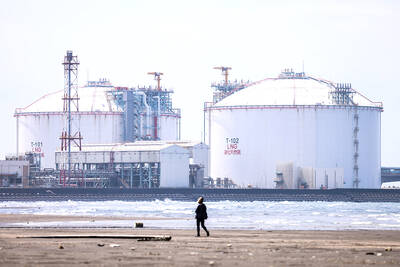
Taiwan is open to joining a global liquefied natural gas (LNG) program if one is created, but on the condition that countries provide delivery even in a scenario where there is a conflict with China, an energy department official said yesterday. While Taiwan’s priority is to have enough LNG at home, the nation is open to exploring potential strategic reserves in other countries such as Japan or South Korea, Energy Administration Deputy Director-General Chen Chung-hsien (陳崇憲) said. While the LNG market does not have a global reserve for emergencies like that of oil, the concept has been raised a few times —

Taiwan Semiconductor Manufacturing Co (TSMC, 台積電) yesterday received government approval to deploy its advanced 3-nanometer (3nm) process at its second fab currently under construction in Japan, the Ministry of Economic Affairs said in a news release. The ministry green-lit the plan for the facility in Kumamoto, which is scheduled to start installing equipment and come online in 2028 with a monthly production capacity of 15,000 12-inch wafers, the ministry said. The Department of Investment Review in June 2024 authorized a US$5.26 billion investment for the facility, slated to manufacture 6- to 12nm chips, significantly less advanced than 3nm process. At a meeting with


 RSS
RSS