


Oil on Friday declined for the second week as signs that supplies remain plentiful offset optimism over the signing of a US-China trade agreement.
Futures in New York were little changed, but ended the week 0.9 percent lower.
Refiners have turned a crude surplus into a product surplus with US gasoline and distillate stocks expanding by more than 40 million barrels over the past three weeks.
The build overshadowed Beijing’s commitment to spending US$52.4 billion in additional purchases of US energy in the next two years as part the “phase one” trade deal between the world’s biggest economies.
“There is a positive vibe after the trade deal, but the fact is we are so oversupplied it’s going to be difficult to get the market up past US$60,” Mizuho Securities USA LLC futures director Bob Yawger said in New York.
Before the landmark US-China accord was signed, prices reached a six-week low on Wednesday after US government data showed that petroleum inventories in the country expanded to the highest levels since September last year.
Supplies at the critical commercial storage hub in Cushing, Oklahoma, rose for the first time in 10 weeks.
US crude production continues to set new records, hitting 13 million barrels per day earlier this month.
Oil drilling rose for the first time in four weeks, led by the Permian Basin, indicating that oil supplies are poised for more gains in the near term.
West Texas Intermediate futures for delivery next month settled up US$0.02 at US$58.54 per barrel on the New York Mercantile Exchange.
Brent for March settlement rose US$0.23 cents to US$64.85 on the ICE Futures Europe exchange in London after climbing 1 percent on Thursday. That put its premium over West Texas Intermediate for the same month at US$6.27 per barrel.
The market might have to contend with another week of inventory builds as fog on the US Gulf Coast has intermittently suspended marine traffic and slowed exports, Lipow Oil Associates LLC president Andy Lipow said in Houston, Texas.
The International Energy Agency on Thursday said that global markets have a “solid base” of inventories and climbing supplies from outside the OPEC cartel, even as elevated tensions in the Middle East endanger production from Iraq and elsewhere.
In other energy trading, wholesale gasoline fell US$0.01 to US$1.64 per gallon and heating oil declined US$0.01 to US$1.86 per gallon, while natural gas fell US$0.07 to US$2 per 1,000 cubic feet.
Additional reporting by AP
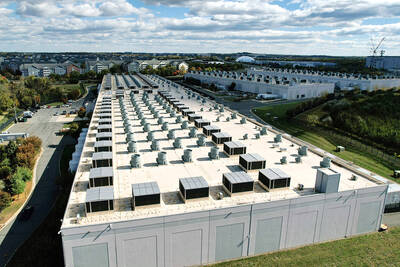
The demise of the coal industry left the US’ Appalachian region in tatters, with lost jobs, spoiled water and countless kilometers of abandoned underground mines. Now entrepreneurs are eyeing the rural region with ambitious visions to rebuild its economy by converting old mines into solar power systems and data centers that could help fuel the increasing power demands of the artificial intelligence (AI) boom. One such project is underway by a non-profit team calling itself Energy DELTA (Discovery, Education, Learning and Technology Accelerator) Lab, which is looking to develop energy sources on about 26,305 hectares of old coal land in

Taiwan’s exports soared 56 percent year-on-year to an all-time high of US$64.05 billion last month, propelled by surging global demand for artificial intelligence (AI), high-performance computing and cloud service infrastructure, the Ministry of Finance said yesterday. Department of Statistics Director-General Beatrice Tsai (蔡美娜) called the figure an unexpected upside surprise, citing a wave of technology orders from overseas customers alongside the usual year-end shopping season for technology products. Growth is likely to remain strong this month, she said, projecting a 40 percent to 45 percent expansion on an annual basis. The outperformance could prompt the Directorate-General of Budget, Accounting and

Netflix on Friday faced fierce criticism over its blockbuster deal to acquire Warner Bros Discovery. The streaming giant is already viewed as a pariah in some Hollywood circles, largely due to its reluctance to release content in theaters and its disruption of traditional industry practices. As Netflix emerged as the likely winning bidder for Warner Bros — the studio behind Casablanca, the Harry Potter movies and Friends — Hollywood’s elite launched an aggressive campaign against the acquisition. Titanic director James Cameron called the buyout a “disaster,” while a group of prominent producers are lobbying US Congress to oppose the deal,

Two Chinese chipmakers are attracting strong retail investor demand, buoyed by industry peer Moore Threads Technology Co’s (摩爾線程) stellar debut. The retail portion of MetaX Integrated Circuits (Shanghai) Co’s (上海沐曦) upcoming initial public offering (IPO) was 2,986 times oversubscribed on Friday, according to a filing. Meanwhile, Beijing Onmicro Electronics Co (北京昂瑞微), which makes radio frequency chips, was 2,899 times oversubscribed on Friday, its filing showed. The bids coincided with Moore Threads’ trading debut, which surged 425 percent on Friday after raising 8 billion yuan (US$1.13 billion) on bets that the company could emerge as a viable local competitor to Nvidia


 RSS
RSS