


Asian equities on Friday rose as investors, still buoyed by a China-US trade deal, turned their focus to earnings season and the global outlook, while they were also cheered by data indicating that China’s economy appears to be stabilizing.
Apart from last week’s blip caused by the US assassination of a top Iranian general, markets have enjoyed a strong start to the new decade, building on a rally late last year.
The gains have been fanned by the “phase one” trade agreement, as well as signs of improvement in worldwide economies, lower interest rates, government stimulus and easing Brexit concerns.
With the prospect of a healthy batch of company reports, there are hopes for further advances.
“It’s very hard to be bearish here,” Federated Investors Management senior equity strategist Linda Duessel told Bloomberg TV.
“We could have really good earnings surprises to the upside” as more profit reports roll in, she said.
All three main indices on Wall Street on Thursday ended at record highs, boosted by the US Senate’s approval of a new North American free-trade deal, while Google parent Alphabet Inc joined Apple Inc and Microsoft Corp to become a trillion-dollar firm for the first time.
The positive energy funneled through to Asia, where most markets ended broadly up.
In Taipei, the TAIEX on Friday closed up 23.36 points, or 0.2 percent, at 12,090.29, rising 0.5 percent from a close of 12,024.65 a week earlier. Turnover totaled NT$131.27 billion (US$4.38 billion).
In Hong Kong, the Hang Seng on Friday gained 173.38 points, or 0.6 percent, to 29,056.42, surging 1.5 percent from a close of 28,638.20 on Jan. 10.
Tokyo’s Nikkei 225 on Friday rose 108.13 points, or 0.5 percent, at 24,041.26, a jump of 0.8 percent from 23,850.57 a week earlier.
The Shanghai Composite on Friday edged up 1.41 points, or 0.1 percent, to 3,075.50, but slid 0.5 percent from 3,092.2 on Jan. 10.
Seoul’s KOSPI on Friday rose 2.52 points, or 0.1 percent, to 2,250.57, surging 2 percent from 2,206.39 a week earlier.
Sydney added 0.3 percent, with Mumbai, Bangkok, Wellington and Manila also well up.
Beijing added to the mood, releasing data showing that the world’s No. 2 economy expanded 6.1 percent last year.
While that was the slowest pace in three decades and well down from 6.6 percent in 2018, it was in line with expectations and the government’s target.
The 6 percent growth for the October-to-December quarter was the same as the previous quarter, while traders were also cheered by figures showing a better-than-forecast rise in retail sales, industrial output and investment.
The slowdown in growth in China has been a major headache for investors over the past few years, as the country’s leaders struggle with the US trade war, slowing global demand and a worrying debt mountain.
Still, while there is hope that this year could see healthy advances for equities, some doubt remains.
Progress on the next round of US-China talks “will continue to hog the limelight in 2020,” said AxiTrader chief Asia market strategist Stephen Innes, who added that “trade discussions between the US and the EU remain open-ended, while the commencement of bilateral EU and the UK trade discussions could get thorny.”
“But perhaps the real elephant in the room, the US [presidential] election in November, will also increasingly preoccupy investors as we move through the year,” he said.
Additional reporting by staff writer
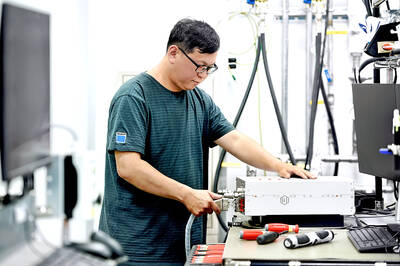
SEMICONDUCTORS: The German laser and plasma generator company will expand its local services as its specialized offerings support Taiwan’s semiconductor industries Trumpf SE + Co KG, a global leader in supplying laser technology and plasma generators used in chip production, is expanding its investments in Taiwan in an effort to deeply integrate into the global semiconductor supply chain in the pursuit of growth. The company, headquartered in Ditzingen, Germany, has invested significantly in a newly inaugurated regional technical center for plasma generators in Taoyuan, its latest expansion in Taiwan after being engaged in various industries for more than 25 years. The center, the first of its kind Trumpf built outside Germany, aims to serve customers from Taiwan, Japan, Southeast Asia and South Korea,

Gasoline and diesel prices at domestic fuel stations are to fall NT$0.2 per liter this week, down for a second consecutive week, CPC Corp, Taiwan (台灣中油) and Formosa Petrochemical Corp (台塑石化) announced yesterday. Effective today, gasoline prices at CPC and Formosa stations are to drop to NT$26.4, NT$27.9 and NT$29.9 per liter for 92, 95 and 98-octane unleaded gasoline respectively, the companies said in separate statements. The price of premium diesel is to fall to NT$24.8 per liter at CPC stations and NT$24.6 at Formosa pumps, they said. The price adjustments came even as international crude oil prices rose last week, as traders
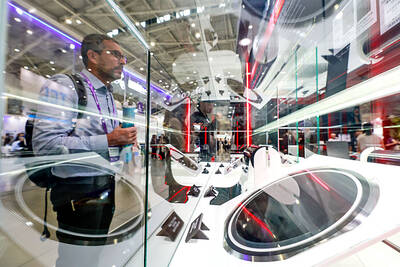
SIZE MATTERS: TSMC started phasing out 8-inch wafer production last year, while Samsung is more aggressively retiring 8-inch capacity, TrendForce said Chipmakers are expected to raise prices of 8-inch wafers by up to 20 percent this year on concern over supply constraints as major contract chipmakers Taiwan Semiconductor Manufacturing Co (TSMC, 台積電) and Samsung Electronics Co gradually retire less advanced wafer capacity, TrendForce Corp (集邦科技) said yesterday. It is the first significant across-the-board price hike since a global semiconductor correction in 2023, the Taipei-based market researcher said in a report. Global 8-inch wafer capacity slid 0.3 percent year-on-year last year, although 8-inch wafer prices still hovered at relatively stable levels throughout the year, TrendForce said. The downward trend is expected to continue this year,
POWERING UP: PSUs for AI servers made up about 50% of Delta’s total server PSU revenue during the first three quarters of last year, the company said Power supply and electronic components maker Delta Electronics Inc (台達電) reported record-high revenue of NT$161.61 billion (US$5.11 billion) for last quarter and said it remains positive about this quarter. Last quarter’s figure was up 7.6 percent from the previous quarter and 41.51 percent higher than a year earlier, and largely in line with Yuanta Securities Investment Consulting Co’s (元大投顧) forecast of NT$160 billion. Delta’s annual revenue last year rose 31.76 percent year-on-year to NT$554.89 billion, also a record high for the company. Its strong performance reflected continued demand for high-performance power solutions and advanced liquid-cooling products used in artificial intelligence (AI) data centers,


 RSS
RSS