


Hyundai Motor Co on Monday announced it would mass-produce flying cars for Uber Technologies Inc’s aerial rideshare network set to deploy in 2023.
The South Korean manufacturer said it would produce the four-passenger electric “vertical take-off and landing vehicles” at “automotive scale,” without offering details.
The deal announced at the CES in Las Vegas could help Uber, which is working with other aircraft manufacturers, to achieve its goal of deploying air taxi service in a handful of cities by 2023.
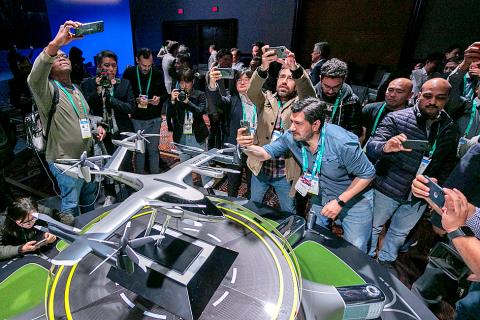
Photo: AFP
Hyundai urban air mobility division head Jaiwon Shin said he expects the large-scale manufacturing to keep costs affordable for the aerial systems.
“We know how to mass-produce high quality vehicles,” Shin, NASA’s former associate administrator for the Aeronautics Research Mission Directorate, told a news conference at CES.
He said he expected the partnership to allow for the short-range air taxis to be “affordable for everyone.”
Uber Elevate head Eric Allison appeared at the CES event with Hyundai to discuss the partnership.
“By taking transportation out of the two dimensional grid on the ground and moving it into the sky, we can offer significant time savings to our riders,” Allison said.
He said that because of its other app-based transport options, “only Uber can seamlessly connect riders from cars, trains and even bikes to aircraft.”
Uber has announced it had selected Melbourne to join Dallas and Los Angeles in becoming the first cities to offer Uber Air flights, with the goal of beginning demonstrator flights this year and commercial operations in 2023.
While Uber has held talks with the US Federal Aviation Administration, the effort is likely to face heavy scrutiny from the regulator over logistics for takeoff and landing, noise and safety concerns.
Hyundai is using CES to show the S-A1 model aircraft with a cruising speed up to 290kph.
The aircraft utilizes “distributed electric propulsion,” designed with multiple rotors that can keep it in the air if one of them fails.
The smaller rotors also help reduce noise, which the companies said is important to cities.
The Hyundai vehicle is to be piloted initially, but over time is to become autonomous, the company said.
Additional reporting by Bloomberg

The demise of the coal industry left the US’ Appalachian region in tatters, with lost jobs, spoiled water and countless kilometers of abandoned underground mines. Now entrepreneurs are eyeing the rural region with ambitious visions to rebuild its economy by converting old mines into solar power systems and data centers that could help fuel the increasing power demands of the artificial intelligence (AI) boom. One such project is underway by a non-profit team calling itself Energy DELTA (Discovery, Education, Learning and Technology Accelerator) Lab, which is looking to develop energy sources on about 26,305 hectares of old coal land in

Taiwan’s exports soared 56 percent year-on-year to an all-time high of US$64.05 billion last month, propelled by surging global demand for artificial intelligence (AI), high-performance computing and cloud service infrastructure, the Ministry of Finance said yesterday. Department of Statistics Director-General Beatrice Tsai (蔡美娜) called the figure an unexpected upside surprise, citing a wave of technology orders from overseas customers alongside the usual year-end shopping season for technology products. Growth is likely to remain strong this month, she said, projecting a 40 percent to 45 percent expansion on an annual basis. The outperformance could prompt the Directorate-General of Budget, Accounting and

Netflix on Friday faced fierce criticism over its blockbuster deal to acquire Warner Bros Discovery. The streaming giant is already viewed as a pariah in some Hollywood circles, largely due to its reluctance to release content in theaters and its disruption of traditional industry practices. As Netflix emerged as the likely winning bidder for Warner Bros — the studio behind Casablanca, the Harry Potter movies and Friends — Hollywood’s elite launched an aggressive campaign against the acquisition. Titanic director James Cameron called the buyout a “disaster,” while a group of prominent producers are lobbying US Congress to oppose the deal,

Two Chinese chipmakers are attracting strong retail investor demand, buoyed by industry peer Moore Threads Technology Co’s (摩爾線程) stellar debut. The retail portion of MetaX Integrated Circuits (Shanghai) Co’s (上海沐曦) upcoming initial public offering (IPO) was 2,986 times oversubscribed on Friday, according to a filing. Meanwhile, Beijing Onmicro Electronics Co (北京昂瑞微), which makes radio frequency chips, was 2,899 times oversubscribed on Friday, its filing showed. The bids coincided with Moore Threads’ trading debut, which surged 425 percent on Friday after raising 8 billion yuan (US$1.13 billion) on bets that the company could emerge as a viable local competitor to Nvidia


 RSS
RSS