


A Samsung Electronics Co lab yesterday unveiled a digital avatar it described as an artificial intelligence (AI)-powered “artificial human,” claiming it is able to “converse and sympathize” like real people.
The announcement at the opening of the 2020 CES in Las Vegas touted a new kind of AI called NEON, produced by the independent Samsung unit Star Labs.
The technology allows for the creation of customized digital beings that can appear on displays or video games and could be designed to be “TV anchors, spokespeople, or movie actors” or even “companions and friends,” the California-based unit of the South Korean giant said.
“NEONs will be our friends, collaborators and companions, continually learning, evolving and forming memories from their interactions,” Star Labs chief executive Pranav Mistry said.
The NEON creators said the new virtual humans are the product of advances in technologies, including neural networks and computational reality.
According to Star Labs, NEON is inspired “by the rhythmic complexities of nature and extensively trained with how humans look, behave and interact.”
The avatars “create life-like reality that is beyond normal perception to distinguish, with latency of less than a few milliseconds,” it said.
While digital avatars have long been able to be programmed for specific tasks such as role players in games, NEON goes further by enabling interactions that can incorporate human emotion.
Although the artificial humans may borrow features from real people, “each NEON has his or her own unique personality and can show new expressions, movements, and dialogs,” the company said.
The announcement comes amid a proliferation of AI-manipulated computer videos known as “deepfakes,” and growing concerns how they could be used to deceive or manipulate.
Some analysts fear these fakes could be misused during an election campaign to exacerbate political tensions.
Jack Gold, analyst at J. Gold Associates, said Samsung might be ahead of the pack if it can develop avatars that can show emotions and expressions.
“We have to wait and see what this means,” Gold said. “But it has major implications for many fields like customer service, help desk functions, entertainment, and of course could also be used to ‘fake’ a human interacting with a live person for bad or illegal purposes.”
Avi Greengartm, founder and lead analyst of the consultancy Techsponential, said the avatars could be realistic but also “creepy.”
“Leaving aside how impressive the technology is, will NEON be used in ways that people like, just tolerate, or actively hate?” he said.
According to Samsung and Star Labs, NEON offers avatars with lifelike reality “that is beyond normal perception to distinguish.”
The company envisions commercial opportunities to create avatars to be service representatives, financial advisors, healthcare providers or concierges.
“We have always dreamed of such virtual beings in science fictions and movies,” Mistry said. “NEONs will integrate with our world and serve as new links to a better future, a world where ‘humans are humans’ and ‘machines are humane.’”
The laboratory was launched last year by Mistry, who had previously been a senior Samsung vice president and head of innovation at Samsung Mobile.
He was known for developing Sixth Sense, a gesture-based wearable technology system built at the Massachusetts Institute of Technology.
Mistry also worked on projects with Microsoft Corp, Google and NASA.

The demise of the coal industry left the US’ Appalachian region in tatters, with lost jobs, spoiled water and countless kilometers of abandoned underground mines. Now entrepreneurs are eyeing the rural region with ambitious visions to rebuild its economy by converting old mines into solar power systems and data centers that could help fuel the increasing power demands of the artificial intelligence (AI) boom. One such project is underway by a non-profit team calling itself Energy DELTA (Discovery, Education, Learning and Technology Accelerator) Lab, which is looking to develop energy sources on about 26,305 hectares of old coal land in

Taiwan’s exports soared 56 percent year-on-year to an all-time high of US$64.05 billion last month, propelled by surging global demand for artificial intelligence (AI), high-performance computing and cloud service infrastructure, the Ministry of Finance said yesterday. Department of Statistics Director-General Beatrice Tsai (蔡美娜) called the figure an unexpected upside surprise, citing a wave of technology orders from overseas customers alongside the usual year-end shopping season for technology products. Growth is likely to remain strong this month, she said, projecting a 40 percent to 45 percent expansion on an annual basis. The outperformance could prompt the Directorate-General of Budget, Accounting and

Netflix on Friday faced fierce criticism over its blockbuster deal to acquire Warner Bros Discovery. The streaming giant is already viewed as a pariah in some Hollywood circles, largely due to its reluctance to release content in theaters and its disruption of traditional industry practices. As Netflix emerged as the likely winning bidder for Warner Bros — the studio behind Casablanca, the Harry Potter movies and Friends — Hollywood’s elite launched an aggressive campaign against the acquisition. Titanic director James Cameron called the buyout a “disaster,” while a group of prominent producers are lobbying US Congress to oppose the deal,
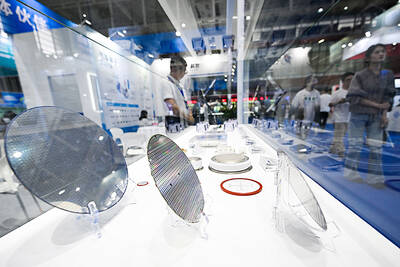
Two Chinese chipmakers are attracting strong retail investor demand, buoyed by industry peer Moore Threads Technology Co’s (摩爾線程) stellar debut. The retail portion of MetaX Integrated Circuits (Shanghai) Co’s (上海沐曦) upcoming initial public offering (IPO) was 2,986 times oversubscribed on Friday, according to a filing. Meanwhile, Beijing Onmicro Electronics Co (北京昂瑞微), which makes radio frequency chips, was 2,899 times oversubscribed on Friday, its filing showed. The bids coincided with Moore Threads’ trading debut, which surged 425 percent on Friday after raising 8 billion yuan (US$1.13 billion) on bets that the company could emerge as a viable local competitor to Nvidia


 RSS
RSS