


Consumer technology spending is getting a boost from wearables, smart devices and streaming media services and should hit record levels in the US this year, organizers of a major tech gathering said on Sunday.
Starting the Consumer Electronics Show (CES) in Las Vegas, organizers said they expect US$422 billion in sales of about 300 kinds of consumer tech products and services in the US market, a gain of 4 percent from last year.
The Consumer Technology Association (CTA), which organizes the annual gathering, said popularity of streaming services and wireless earbuds and the promise of new devices using superfast 5G connectivity and artificial intelligence (AI) is driving consumer interest.
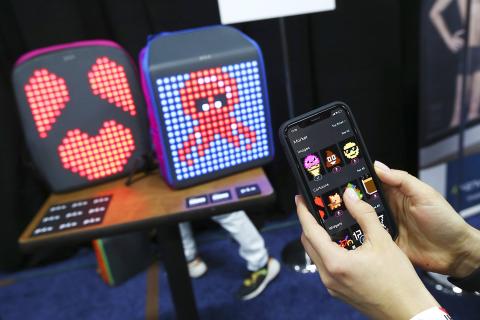
Photo: AP
“More and more consumers are embracing the faster connectivity, advanced intelligence and seemingly infinite content that technology offers today — pushing consumer technology industry revenues toward another record-setting year in 2020,” CTA president and chief executive Gary Shapiro said.
“We’ll see advancements in 5G connectivity and AI play out across the CES 2020 show floor this week — from digital health to self-driving vehicles and smart homes — vital technologies that are changing our lives for the better,” he said.
The show opens today against the backdrop of mounting concerns on how data gathered from connected devices can be exploited by marketers, governments and hackers.
There has also been a wave of attacks from politicians and advocates against dominant tech platforms, as well as intense trade frictions between the world’s economic and technology powers, the US and China.
CTA’s forecast shows strong consumer interest in a number of sectors including digital health — a broad category including smartwatches, fitness trackers and connected health monitoring devices — with sales of about US$10 billion. For streaming — including video, music and gaming — the group expects 11 percent growth in spending to US$81 billion.
CTA said it is seeing consumer interest in new kinds of wireless earbuds, led by those from Apple and Samsung, with expected sales of 67 million units worth US$8.2 billion in revenue.
Smartphone sales are expected to break out of their torpor with a 2 percent increase in sales, helped by new 5G handsets.
However, 5G handset growth is likely to be slow at first, and it would be this year before the faster technology accounts for two-thirds of US handset sales, according to Lesley Rohrbaugh, director of market research at the association.
However, Rohrbaugh said that new chip technology is making possible more kinds of devices, such as those for the home, infused with artificial intelligence using object detection and voice recognition.
“Voice is going into everything. And it’s not just our mobile devices. It’s not just our speakers, it’s every product and like those smart appliances,” she said.

The demise of the coal industry left the US’ Appalachian region in tatters, with lost jobs, spoiled water and countless kilometers of abandoned underground mines. Now entrepreneurs are eyeing the rural region with ambitious visions to rebuild its economy by converting old mines into solar power systems and data centers that could help fuel the increasing power demands of the artificial intelligence (AI) boom. One such project is underway by a non-profit team calling itself Energy DELTA (Discovery, Education, Learning and Technology Accelerator) Lab, which is looking to develop energy sources on about 26,305 hectares of old coal land in

Taiwan’s exports soared 56 percent year-on-year to an all-time high of US$64.05 billion last month, propelled by surging global demand for artificial intelligence (AI), high-performance computing and cloud service infrastructure, the Ministry of Finance said yesterday. Department of Statistics Director-General Beatrice Tsai (蔡美娜) called the figure an unexpected upside surprise, citing a wave of technology orders from overseas customers alongside the usual year-end shopping season for technology products. Growth is likely to remain strong this month, she said, projecting a 40 percent to 45 percent expansion on an annual basis. The outperformance could prompt the Directorate-General of Budget, Accounting and

Netflix on Friday faced fierce criticism over its blockbuster deal to acquire Warner Bros Discovery. The streaming giant is already viewed as a pariah in some Hollywood circles, largely due to its reluctance to release content in theaters and its disruption of traditional industry practices. As Netflix emerged as the likely winning bidder for Warner Bros — the studio behind Casablanca, the Harry Potter movies and Friends — Hollywood’s elite launched an aggressive campaign against the acquisition. Titanic director James Cameron called the buyout a “disaster,” while a group of prominent producers are lobbying US Congress to oppose the deal,

Two Chinese chipmakers are attracting strong retail investor demand, buoyed by industry peer Moore Threads Technology Co’s (摩爾線程) stellar debut. The retail portion of MetaX Integrated Circuits (Shanghai) Co’s (上海沐曦) upcoming initial public offering (IPO) was 2,986 times oversubscribed on Friday, according to a filing. Meanwhile, Beijing Onmicro Electronics Co (北京昂瑞微), which makes radio frequency chips, was 2,899 times oversubscribed on Friday, its filing showed. The bids coincided with Moore Threads’ trading debut, which surged 425 percent on Friday after raising 8 billion yuan (US$1.13 billion) on bets that the company could emerge as a viable local competitor to Nvidia


 RSS
RSS