


China’s financial regulator said it would implement a series of measures to shore up the nation’s troubled smaller banks and insurers, while continuing a clampdown on shadow financing and property speculation.
The regulator would introduce measures to eliminate bad loans and promote mergers, capital injections and the restructuring of high-risk institutions, the China Banking and Insurance Regulatory Commission (CBIRC) said in a statement on Friday.
Other steps include setting up a resolution fund and bridge banks, while introducing new investors and allowing market-oriented exits, it said.
Many of China’s 3,000 small banks are coping with a mountain of bad loans, prompting the government to crack down on risky funding practices. Small, troubled banks pose a risk to the Chinese economy, which is already growing at its weakest pace since the early 1990s.
The watchdog would gradually lower the risks of shadow financing by reducing noncompliant investments in nonstandard assets, while insurance institutions would clean up multilayered investment and leveraged transactions between related parties, the CBIRC said.
The CBIRC would also increase risk management in areas such as real estate, make sure that housing deals are not for speculation and prevent capital from flowing illegally into property markets.
Moreover, it would continue to resolve the hidden debt risk of local government bonds.
Meanwhile, China’s central bank pledged more financial support for small and micro businesses while saying that it plans to stick to a prudent monetary policy stance this year.
The People’s Bank of China would improve the incentive mechanism for lending to such companies, it said in a statement following a two-day work conference in Beijing.
Authorities would make it easier for them to gain access to financing through targeted reserve cuts, relending and rediscounting, among other policy tools, it said.
Separately, the Chinese State Administration of Foreign Exchange said it would diversify policy tools to counter the impact from external shocks on the country’s trade and investment, international balance of payment and cross-border capital flows.
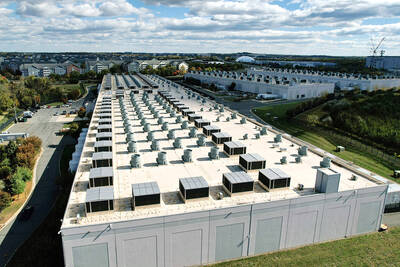
The demise of the coal industry left the US’ Appalachian region in tatters, with lost jobs, spoiled water and countless kilometers of abandoned underground mines. Now entrepreneurs are eyeing the rural region with ambitious visions to rebuild its economy by converting old mines into solar power systems and data centers that could help fuel the increasing power demands of the artificial intelligence (AI) boom. One such project is underway by a non-profit team calling itself Energy DELTA (Discovery, Education, Learning and Technology Accelerator) Lab, which is looking to develop energy sources on about 26,305 hectares of old coal land in

Taiwan’s exports soared 56 percent year-on-year to an all-time high of US$64.05 billion last month, propelled by surging global demand for artificial intelligence (AI), high-performance computing and cloud service infrastructure, the Ministry of Finance said yesterday. Department of Statistics Director-General Beatrice Tsai (蔡美娜) called the figure an unexpected upside surprise, citing a wave of technology orders from overseas customers alongside the usual year-end shopping season for technology products. Growth is likely to remain strong this month, she said, projecting a 40 percent to 45 percent expansion on an annual basis. The outperformance could prompt the Directorate-General of Budget, Accounting and

Netflix on Friday faced fierce criticism over its blockbuster deal to acquire Warner Bros Discovery. The streaming giant is already viewed as a pariah in some Hollywood circles, largely due to its reluctance to release content in theaters and its disruption of traditional industry practices. As Netflix emerged as the likely winning bidder for Warner Bros — the studio behind Casablanca, the Harry Potter movies and Friends — Hollywood’s elite launched an aggressive campaign against the acquisition. Titanic director James Cameron called the buyout a “disaster,” while a group of prominent producers are lobbying US Congress to oppose the deal,

Two Chinese chipmakers are attracting strong retail investor demand, buoyed by industry peer Moore Threads Technology Co’s (摩爾線程) stellar debut. The retail portion of MetaX Integrated Circuits (Shanghai) Co’s (上海沐曦) upcoming initial public offering (IPO) was 2,986 times oversubscribed on Friday, according to a filing. Meanwhile, Beijing Onmicro Electronics Co (北京昂瑞微), which makes radio frequency chips, was 2,899 times oversubscribed on Friday, its filing showed. The bids coincided with Moore Threads’ trading debut, which surged 425 percent on Friday after raising 8 billion yuan (US$1.13 billion) on bets that the company could emerge as a viable local competitor to Nvidia


 RSS
RSS