


The screens will be bigger and bolder, the cars will be smarter and some of the technology will be up-close and personal — even intimate.
This year’s CES, running from Tuesday to Friday in Las Vegas, is to be crammed with the latest in connected devices, from light bulbs to underwear, along with the newest technology for autos, health and wellness, smart homes, retail and more.
One of the world’s biggest trade shows, the gathering features 4,500 exhibitors, an estimated 175,000 attendees and 1,000 speakers in exhibit areas equivalent to more than 50 football fields.
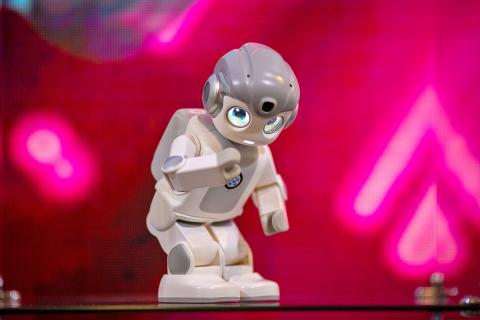
Photo: AFP
Small start-ups and large tech firms from dozens of countries will be angling for a slice of the more than trillion-dollar global consumer electronics marketplace.
The show, organized by the Consumer Technology Association, is to see a large presence from tech giants such as Google and Amazon.com Inc vying for leadership in providing the “brains” or digital assistants for many smart products.
With improvements in artificial intelligence (AI), digital voice assistants are becoming smarter and more like humans, opening up new possibilities, Futuresource Consulting Ltd’s Simon Forrest said.
“We can see devices that can now sound happy if your favorite football team has won and ... dejected if your mother is at the door,” Forrest said.
While the long-sought goal of “emotional intelligence” in computing is still far from reality, advances are allowing more computing power to be packed into smaller spaces, including smart glasses, in-ear “hearables” and other devices, he said.
“We can imagine the voice assistant in the ear, which can do a lot more than it does today,” Forrest said. “Maybe the restaurant across the street can read you their menu, or you can get turn-by-turn directions in your car.”
Manufacturers including South Korea’s LG Electronics Co are expected to unveil new TVs with the latest ultra-high-definition standard known as 8K, even if little or no content is now available in the format.
Moor Insights & Strategy analyst Patrick Moorhead said that he expects to see “higher-resolution, lower-price 8K televisions,” extending a trend.
Innovation around the small screen might lead to more folding smartphones and other adaptations.
“Imagine an iPad device you can fold and carry around with you — I think we will see a lot more of those,” Moorhead said.
Fully self-driving vehicles might not be ready to go mainstream, but that is not stopping innovation.
“There’s a deepening understanding that the companies have a big hill to climb” before deploying fully autonomous cars, Gartner Inc analyst Michael Ramsey said.
Accenture PLC analyst Juergen Reers said that CES is increasingly important for the transportation sector, because “most of the innovation is happening in software and services” rather than in vehicles themselves.
The industry is changing because “consumers are looking at mobility as a service, rather than simply buying a vehicle,” Reers said.
China-based Futurus Technology Ltd (未來黑科技) has said that it would launch what it claims is the first “mixed-reality interactive windshield” to give motorists real-time information about a vehicle’s status, performance and surroundings.
Others are to use 5G technology and AI to help cars detect pedestrians, bicycles and other vehicles.
California’s Xperi Corp is to unveil an in-cabin system using iris identification, facial recognition and other biometrics to unlock vehicles and detect driver fatigue.
Amazon is revving up its auto efforts with a booth showcasing its cloud-computing Amazon Web Services Inc division aimed at “intelligent, personalized products and services.”
Fisker Inc’s Ocean electric car is to be unveiled, in one of the latest challenges to segment leader Tesla Inc.
In the smart home space, more devices are to connect to digital assistants like Amazon Alexa and Google Assistant, or their rivals.
These would include smart screen command centers and smart mirrors, as well as kitchen gadgets and appliances.
Avi Greengart of the consultancy Techsponential said that he expects more smart home devices like security-focused video doorbells, but added that the integrated smart home is not yet here.
“It isn’t exactly clear people want to live in the Jetsons’ home,” he said, referring to the cartoon series about a futuristic family.
Wearables are reaching more of the human body in the quest for improved health and connectivity.
German-based Robert Bosch GmbH is to be showcase smart glasses designed to help motorists with heads-up navigation assistance, with other smart eyewear to be revealed.
“Hearables” represent another emerging category, including advanced earbuds, translators and AI-boosted hearing aids.
Ear-worn devices are among the fastest-growing wearables, capturing 47 percent of the segment in the second quarter of last year, market intelligence firm International Data Corp said.
Textile computing firm Myant Inc is to show smart clothing — starting with connected underwear — with sensors that monitor a wearer’s heart and breathing rates, temperature, movement, posture and sleep.
“It is time for technology to morph around people as opposed to the other way around,” Myant founder Tony Chahine said.
Other CES exhibitors are to display robots for health and security, artificial intelligence for food, airborne devices including a “flying gondola” and technology aimed at improving the retail experience.
Sex tech is to be officially part of the show, a year after a flap over the disqualification of one innovation award winner.
A sexual wellness marketplace promises products that show organizers said “must be innovative and include new or emerging tech to qualify.”
Additional reporting by Rob Lever
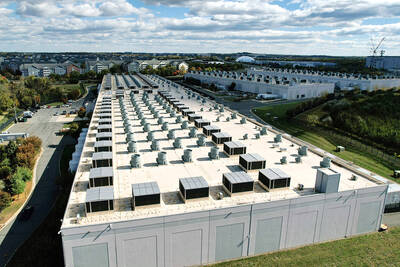
The demise of the coal industry left the US’ Appalachian region in tatters, with lost jobs, spoiled water and countless kilometers of abandoned underground mines. Now entrepreneurs are eyeing the rural region with ambitious visions to rebuild its economy by converting old mines into solar power systems and data centers that could help fuel the increasing power demands of the artificial intelligence (AI) boom. One such project is underway by a non-profit team calling itself Energy DELTA (Discovery, Education, Learning and Technology Accelerator) Lab, which is looking to develop energy sources on about 26,305 hectares of old coal land in

Taiwan’s exports soared 56 percent year-on-year to an all-time high of US$64.05 billion last month, propelled by surging global demand for artificial intelligence (AI), high-performance computing and cloud service infrastructure, the Ministry of Finance said yesterday. Department of Statistics Director-General Beatrice Tsai (蔡美娜) called the figure an unexpected upside surprise, citing a wave of technology orders from overseas customers alongside the usual year-end shopping season for technology products. Growth is likely to remain strong this month, she said, projecting a 40 percent to 45 percent expansion on an annual basis. The outperformance could prompt the Directorate-General of Budget, Accounting and
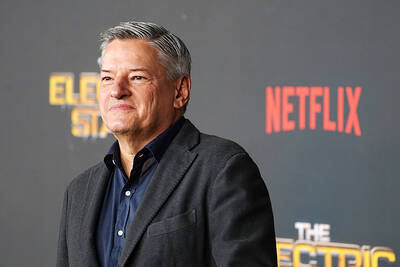
Netflix on Friday faced fierce criticism over its blockbuster deal to acquire Warner Bros Discovery. The streaming giant is already viewed as a pariah in some Hollywood circles, largely due to its reluctance to release content in theaters and its disruption of traditional industry practices. As Netflix emerged as the likely winning bidder for Warner Bros — the studio behind Casablanca, the Harry Potter movies and Friends — Hollywood’s elite launched an aggressive campaign against the acquisition. Titanic director James Cameron called the buyout a “disaster,” while a group of prominent producers are lobbying US Congress to oppose the deal,
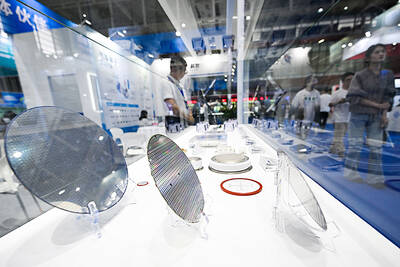
Two Chinese chipmakers are attracting strong retail investor demand, buoyed by industry peer Moore Threads Technology Co’s (摩爾線程) stellar debut. The retail portion of MetaX Integrated Circuits (Shanghai) Co’s (上海沐曦) upcoming initial public offering (IPO) was 2,986 times oversubscribed on Friday, according to a filing. Meanwhile, Beijing Onmicro Electronics Co (北京昂瑞微), which makes radio frequency chips, was 2,899 times oversubscribed on Friday, its filing showed. The bids coincided with Moore Threads’ trading debut, which surged 425 percent on Friday after raising 8 billion yuan (US$1.13 billion) on bets that the company could emerge as a viable local competitor to Nvidia


 RSS
RSS