


One of the largest coal-fired power plants in the western US is to close two of its four units in the next few days as the Montana facility edges toward an eventual total shutdown.
Colstrip Units 1 and 2 — built in the 1970s when massive strip mines were being developed across Montana and Wyoming — will close by Sunday or as soon as they run out of coal to burn, Talen Energy spokeswoman Taryne Williams said on Thursday.
The plant employs about 300 people and is the main driver of the economy for the surrounding town of Colstrip, which has about 2,300 people.
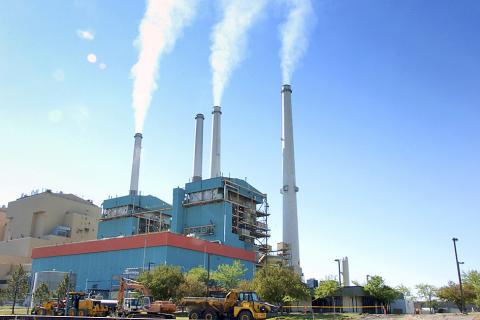
Photo: AP
However, it has been unable to compete with surging investments into sources of renewable energy and cheap natural gas, as the coal plant’s operating costs have risen with the need for better pollution controls.
Some employees for now will be reassigned to decommissioning work that will last through the middle of this year, Williams said.
There are “no hard and fast numbers or timelines” as the company considers how many workers will be needed for the remaining two units, she said.
The closure of units 1 and 2 was long anticipated as demand for US coal collapsed in recent years and came despite vows by elected officials in Montana to find ways to keep it open.
The two closing units are operated by Pennsylvania-based Talen, which co-owns them with Puget Sound Energy of Washington State.
US Senator Duane Ankney, who represents Colstrip in the Montana Legislature, said the impending closure was a “prime example” of how out-of-state interests were hurting the coal industry to the detriment of Montana.
“Coal does so much more than power our homes. Coal funds our public schools, infrastructure, parks and libraries,” Ankney said in a statement.
A representative of the International Brotherhood of Electrical Workers Local 1638, which represents most of the plant’s union employees, could not be reached immediately for comment.
Williams said Talen was “committed to doing what is right by our employees”and will help affected workers to transition to new jobs.
The doors to the two units are to be welded shut tomorrow, Ankney said.
However, there are no plans to dismantle them, because of their proximity to the two remaining units, Williams said.
The large volume of ash generated by burning coal at Colstrip has contaminated groundwater with toxic materials and is expected to cost hundreds of millions of dollars to clean up. Plans for that cleanup are pending with the Montana Department of Environmental Quality.
Six utilities own shares of Colstrip’s remaining two units, which were built in the 1980s. Most of the owners are making preparations for operations to cease as early as 2025.
However, one of the owners, Northwestern Energy, plans for Colstrip to keep running past 2040 and last month announced that it wants to acquire part of Puget Sound Energy’s interest in Colstrip Unit 4 for US$1.
That would boost South Dakota-based NorthWestern’s ownership interest in the power plant to 55 percent even as many other utilities across the US have been getting out of the coal power market in recent years.
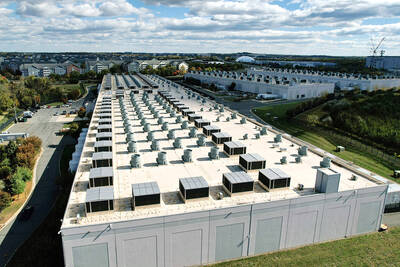
The demise of the coal industry left the US’ Appalachian region in tatters, with lost jobs, spoiled water and countless kilometers of abandoned underground mines. Now entrepreneurs are eyeing the rural region with ambitious visions to rebuild its economy by converting old mines into solar power systems and data centers that could help fuel the increasing power demands of the artificial intelligence (AI) boom. One such project is underway by a non-profit team calling itself Energy DELTA (Discovery, Education, Learning and Technology Accelerator) Lab, which is looking to develop energy sources on about 26,305 hectares of old coal land in

Taiwan’s exports soared 56 percent year-on-year to an all-time high of US$64.05 billion last month, propelled by surging global demand for artificial intelligence (AI), high-performance computing and cloud service infrastructure, the Ministry of Finance said yesterday. Department of Statistics Director-General Beatrice Tsai (蔡美娜) called the figure an unexpected upside surprise, citing a wave of technology orders from overseas customers alongside the usual year-end shopping season for technology products. Growth is likely to remain strong this month, she said, projecting a 40 percent to 45 percent expansion on an annual basis. The outperformance could prompt the Directorate-General of Budget, Accounting and

Netflix on Friday faced fierce criticism over its blockbuster deal to acquire Warner Bros Discovery. The streaming giant is already viewed as a pariah in some Hollywood circles, largely due to its reluctance to release content in theaters and its disruption of traditional industry practices. As Netflix emerged as the likely winning bidder for Warner Bros — the studio behind Casablanca, the Harry Potter movies and Friends — Hollywood’s elite launched an aggressive campaign against the acquisition. Titanic director James Cameron called the buyout a “disaster,” while a group of prominent producers are lobbying US Congress to oppose the deal,

Two Chinese chipmakers are attracting strong retail investor demand, buoyed by industry peer Moore Threads Technology Co’s (摩爾線程) stellar debut. The retail portion of MetaX Integrated Circuits (Shanghai) Co’s (上海沐曦) upcoming initial public offering (IPO) was 2,986 times oversubscribed on Friday, according to a filing. Meanwhile, Beijing Onmicro Electronics Co (北京昂瑞微), which makes radio frequency chips, was 2,899 times oversubscribed on Friday, its filing showed. The bids coincided with Moore Threads’ trading debut, which surged 425 percent on Friday after raising 8 billion yuan (US$1.13 billion) on bets that the company could emerge as a viable local competitor to Nvidia


 RSS
RSS