


Ride-hailing giant Uber Technologies Inc and delivery company Postmates Inc have filed a lawsuit against the state of California, claiming a new law that would treat gig-economy freelancers as employees is unconstitutional.
The legislation, known as Assembly Bill 5 and was due to go into effect yesterday, would mean that — under certain conditions — independent contractors are classified as employees and granted the minimum salary and health insurance benefits that entail.
This would include drivers for Uber and Postmates.
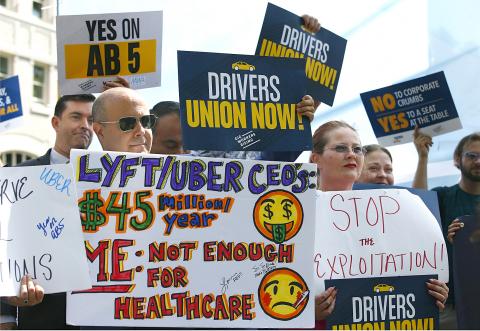
Photo: AP
“Plaintiffs bring this lawsuit to protect their constitutional rights and defend their fundamental liberty to pursue their chosen work as independent service providers and technology companies in the on-demand economy,” the lawsuit filed on Monday said.
Uber warned earlier that it would oppose any change of status for its drivers, which would cost the company extra in social security costs.
In the suit, Uber and its co-plaintiffs argue that the law targets independent service providers, while exempting direct salespeople, travel agents, construction truck drivers and commercial fishers.
“There is no rhyme or reason to these nonsensical exemptions,” it said.
Uber and its US rival, Lyft Inc, have each put aside US$30 million to organize a referendum, allowed under Californian law, to replace the legislation with a compromise on social rights that has been put before the state governor.
Drivers are divided between those who want the same security as employees and those who want the flexibility of being able to choose the hours they work.
The gig economy has given drivers “opportunities to earn money when and where they want, with unprecedented independence and flexibility,” the lawsuit said.
California is one of Uber’s key markets, with about 9 percent of its sales on ride and delivery platforms made in the state, CNBC said, citing Uber chief executive officer Dara Khosrowshahi.
The new law came as the ride-hailing company is also facing legal clampdowns on its operations elsewhere.
A German court early last month ruled that Uber — which relies heavily on the use of vehicles from local car rental companies in the country — must have a rental car license of its own to operate.
In November, London’s transport authority refused to renew the company’s operating license because of safety and security concerns.
That came as a big blow to Uber, which has about 3.5 million customers and about 50,000 drivers in the British capital.
It has said it will appeal the decision.

The demise of the coal industry left the US’ Appalachian region in tatters, with lost jobs, spoiled water and countless kilometers of abandoned underground mines. Now entrepreneurs are eyeing the rural region with ambitious visions to rebuild its economy by converting old mines into solar power systems and data centers that could help fuel the increasing power demands of the artificial intelligence (AI) boom. One such project is underway by a non-profit team calling itself Energy DELTA (Discovery, Education, Learning and Technology Accelerator) Lab, which is looking to develop energy sources on about 26,305 hectares of old coal land in

Taiwan’s exports soared 56 percent year-on-year to an all-time high of US$64.05 billion last month, propelled by surging global demand for artificial intelligence (AI), high-performance computing and cloud service infrastructure, the Ministry of Finance said yesterday. Department of Statistics Director-General Beatrice Tsai (蔡美娜) called the figure an unexpected upside surprise, citing a wave of technology orders from overseas customers alongside the usual year-end shopping season for technology products. Growth is likely to remain strong this month, she said, projecting a 40 percent to 45 percent expansion on an annual basis. The outperformance could prompt the Directorate-General of Budget, Accounting and

Netflix on Friday faced fierce criticism over its blockbuster deal to acquire Warner Bros Discovery. The streaming giant is already viewed as a pariah in some Hollywood circles, largely due to its reluctance to release content in theaters and its disruption of traditional industry practices. As Netflix emerged as the likely winning bidder for Warner Bros — the studio behind Casablanca, the Harry Potter movies and Friends — Hollywood’s elite launched an aggressive campaign against the acquisition. Titanic director James Cameron called the buyout a “disaster,” while a group of prominent producers are lobbying US Congress to oppose the deal,

Two Chinese chipmakers are attracting strong retail investor demand, buoyed by industry peer Moore Threads Technology Co’s (摩爾線程) stellar debut. The retail portion of MetaX Integrated Circuits (Shanghai) Co’s (上海沐曦) upcoming initial public offering (IPO) was 2,986 times oversubscribed on Friday, according to a filing. Meanwhile, Beijing Onmicro Electronics Co (北京昂瑞微), which makes radio frequency chips, was 2,899 times oversubscribed on Friday, its filing showed. The bids coincided with Moore Threads’ trading debut, which surged 425 percent on Friday after raising 8 billion yuan (US$1.13 billion) on bets that the company could emerge as a viable local competitor to Nvidia


 RSS
RSS