


World stocks on Tuesday closed out a notably profitable year, with Wall Street recording its best annual performances since 2013, boosted by hopes for a US-China trade deal.
New York rallied into the close, turning positive for the day and leaving the broad-based S&P 500 and tech-heavy NASDAQ Composite up 29 percent and 35 percent respectively for last year, the best showings in six years.
Key European markets showed increases of 25 percent or more for last year, partly thanks to late surges on receding recession fears and easing China-US trade tensions.
However, Brexit-hit London trailed its peers with a 12 percent annual rise, less than half the percentage increase managed by Paris, Frankfurt and Milan.
Earlier on Tuesday as US markets were about to open, US President Donald Trump tweeted that a partial trade deal with China would be signed in Washington on Jan. 15, ending some of the uncertainty about efforts to cement the deal announced early last month.
Prudential Financial Inc market strategist Quincy Krosby told reporters that the US-China detente could help decide the direction of the global economy next year.
“Much of the enthusiasm in the market is based on the idea that global growth is going to begin to accelerate, albeit slowly,” she said. “The question will be: Do we actually see positive growth, especially in China?”
Demand in China is crucial to chances for growth in global trade, while a China trade agreement could see US corporations begin investing again after a year when corporate capital spending stagnated worryingly, Krosby said.
Asian stock markets closed mainly lower on Tuesday, with Hong Kong’s Hang Seng Index ending a half-day of trading almost 0.5 percent down, although it rallied more than 7 percent last month. Tokyo was shut for a public holiday.
“While market volumes are predictably light, investors continue to strike a year-end cautionary tone as December optimism is gradually giving way to 2020’s uncertainty,” AxiTrader Ltd chief Asia market strategist Stephen Innes said in a client note.
Asian investors were also watching for significant policy announcements early in the New Year.
In a New Year’s speech yesterday, North Korean leader Kim Jong-un struck a decisively militaristic tone, warning of a new strategic weapon and “shocking” action.
Analysts said all eyes were on nuclear-armed Pyongyang’s threat of a “new way” after its end-of-year deadline for sanctions relief from the US expired.
An address by Chinese President Xi Jinping (習近平) would be followed closely.
Elsewhere on Tuesday, oil prices slid, despite reports that Iran had seized a vessel suspected of smuggling fuel near the Strait of Hormuz — a chokepoint for one-third of the world’s seaborne oil.
Over the year, the price of Brent North Sea crude jumped by almost one-quarter and the New York benchmark contract West Texas Intermediate soared more than one-third in value, helped by tighter supply.
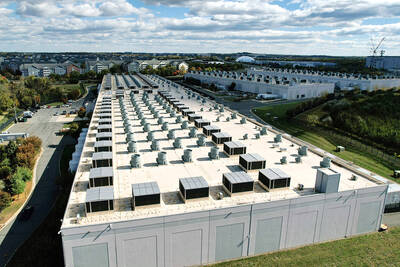
The demise of the coal industry left the US’ Appalachian region in tatters, with lost jobs, spoiled water and countless kilometers of abandoned underground mines. Now entrepreneurs are eyeing the rural region with ambitious visions to rebuild its economy by converting old mines into solar power systems and data centers that could help fuel the increasing power demands of the artificial intelligence (AI) boom. One such project is underway by a non-profit team calling itself Energy DELTA (Discovery, Education, Learning and Technology Accelerator) Lab, which is looking to develop energy sources on about 26,305 hectares of old coal land in

Taiwan’s exports soared 56 percent year-on-year to an all-time high of US$64.05 billion last month, propelled by surging global demand for artificial intelligence (AI), high-performance computing and cloud service infrastructure, the Ministry of Finance said yesterday. Department of Statistics Director-General Beatrice Tsai (蔡美娜) called the figure an unexpected upside surprise, citing a wave of technology orders from overseas customers alongside the usual year-end shopping season for technology products. Growth is likely to remain strong this month, she said, projecting a 40 percent to 45 percent expansion on an annual basis. The outperformance could prompt the Directorate-General of Budget, Accounting and

Netflix on Friday faced fierce criticism over its blockbuster deal to acquire Warner Bros Discovery. The streaming giant is already viewed as a pariah in some Hollywood circles, largely due to its reluctance to release content in theaters and its disruption of traditional industry practices. As Netflix emerged as the likely winning bidder for Warner Bros — the studio behind Casablanca, the Harry Potter movies and Friends — Hollywood’s elite launched an aggressive campaign against the acquisition. Titanic director James Cameron called the buyout a “disaster,” while a group of prominent producers are lobbying US Congress to oppose the deal,

Two Chinese chipmakers are attracting strong retail investor demand, buoyed by industry peer Moore Threads Technology Co’s (摩爾線程) stellar debut. The retail portion of MetaX Integrated Circuits (Shanghai) Co’s (上海沐曦) upcoming initial public offering (IPO) was 2,986 times oversubscribed on Friday, according to a filing. Meanwhile, Beijing Onmicro Electronics Co (北京昂瑞微), which makes radio frequency chips, was 2,899 times oversubscribed on Friday, its filing showed. The bids coincided with Moore Threads’ trading debut, which surged 425 percent on Friday after raising 8 billion yuan (US$1.13 billion) on bets that the company could emerge as a viable local competitor to Nvidia


 RSS
RSS