


Lime Asset Management Co, the firm at the center of a scandal that sparked unprecedented withdrawals from South Korean hedge funds, now faces an investigation into its investment in a troubled US fund.
A senior official at the Financial Supervisory Service (FSS) said that South Korea’s top financial watchdog would ask prosecutors to probe Lime’s investment in funds run by International Investment Group LLC (IIG).
The US Securities and Exchange Commission (SEC) last month revoked IIG’s registration, accusing the New York-based investment adviser of hiding losses and selling at least US$60 million in fake loan assets to clients.
BIGGEST HEDGE FUND
Lime Asset, South Korea’s largest hedge fund with about US$3.7 billion under management, halted redemptions from some of its funds in October as it couldn’t return cash as fast as clients wanted. The withdrawals came amid a probe into the company’s investments.
The Seoul Southern District Court on Nov. 15 issued an arrest warrant for former Lime chief investment officer Lee Jong-pil on concerns over flight risk and possible destruction of evidence, but he did not show up for his hearing, the court said in a text message.
The FSS official said the regulator has temporarily suspended its probe of Lee, who has been fired by Lime.
Calls to Lime chief executive officer Won Jong-jun by Bloomberg went unanswered.
The funds frozen by Lime were invested in illiquid assets, such as private loans, convertible bonds and collateralized loan obligations repackaging trade-finance assets.
The FSS official said some Lime funds were invested in assets managed by IIG. The US firm specializes in trade finance lending to small and medium-sized companies in emerging markets, according to the SEC complaint.
RISK NOTIFICATION
The South Korean regulator looks to determine whether Lime was aware that IIG was in trouble and neglected to notify its clients of the related risk.
Total assets under management of local hedge funds in South Korea rebounded to 34.9 trillion won (US$30 billion) as of Nov. 30, according to data from NH Investment & Securities.
That marked a reversal of the record 700 billion won withdrawal over two months in the wake of Lime’s difficulties.
Still, the industry is likely to continue struggling amid strengthened regulations on local brokerage sales of hedge funds to retail investors and a hike in minimum investments by hedge funds in the aftermath of the incident, NH said.

The demise of the coal industry left the US’ Appalachian region in tatters, with lost jobs, spoiled water and countless kilometers of abandoned underground mines. Now entrepreneurs are eyeing the rural region with ambitious visions to rebuild its economy by converting old mines into solar power systems and data centers that could help fuel the increasing power demands of the artificial intelligence (AI) boom. One such project is underway by a non-profit team calling itself Energy DELTA (Discovery, Education, Learning and Technology Accelerator) Lab, which is looking to develop energy sources on about 26,305 hectares of old coal land in

Taiwan’s exports soared 56 percent year-on-year to an all-time high of US$64.05 billion last month, propelled by surging global demand for artificial intelligence (AI), high-performance computing and cloud service infrastructure, the Ministry of Finance said yesterday. Department of Statistics Director-General Beatrice Tsai (蔡美娜) called the figure an unexpected upside surprise, citing a wave of technology orders from overseas customers alongside the usual year-end shopping season for technology products. Growth is likely to remain strong this month, she said, projecting a 40 percent to 45 percent expansion on an annual basis. The outperformance could prompt the Directorate-General of Budget, Accounting and
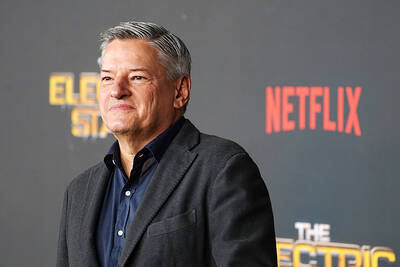
Netflix on Friday faced fierce criticism over its blockbuster deal to acquire Warner Bros Discovery. The streaming giant is already viewed as a pariah in some Hollywood circles, largely due to its reluctance to release content in theaters and its disruption of traditional industry practices. As Netflix emerged as the likely winning bidder for Warner Bros — the studio behind Casablanca, the Harry Potter movies and Friends — Hollywood’s elite launched an aggressive campaign against the acquisition. Titanic director James Cameron called the buyout a “disaster,” while a group of prominent producers are lobbying US Congress to oppose the deal,

Two Chinese chipmakers are attracting strong retail investor demand, buoyed by industry peer Moore Threads Technology Co’s (摩爾線程) stellar debut. The retail portion of MetaX Integrated Circuits (Shanghai) Co’s (上海沐曦) upcoming initial public offering (IPO) was 2,986 times oversubscribed on Friday, according to a filing. Meanwhile, Beijing Onmicro Electronics Co (北京昂瑞微), which makes radio frequency chips, was 2,899 times oversubscribed on Friday, its filing showed. The bids coincided with Moore Threads’ trading debut, which surged 425 percent on Friday after raising 8 billion yuan (US$1.13 billion) on bets that the company could emerge as a viable local competitor to Nvidia


 RSS
RSS