


Boeing Co on Monday pushed out its embattled chief executive officer, Dennis Muilenburg, as it attempts to pivot from a protracted crisis surrounding the grounding of its top-selling 737 MAX after two deadly crashes.
More than nine months after the 737 MAX was grounded and a week after halting production of the aircraft, Boeing named board chairman David Calhoun as chief executive and president, saying that the company needed to “restore confidence” and “repair relationships with regulators, customers and all other stakeholders.”
Although coming during the sleepy days ahead of the Christmas holiday, the move was not entirely unexpected after Boeing stripped Muilenburg of his chairman title in October, installing board member Calhoun in that post.
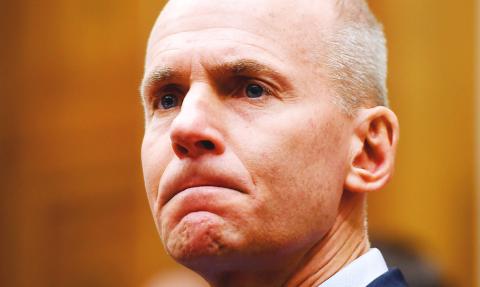
Photo: AFP
Still, while Boeing watchers had seen Muilenburg’s days as numbered, some expected him to stay on until the 737 MAX was returned to service, but the timing of that landmark event remains unclear and depends on the US Federal Aviation Administration (FAA), which has made it clear it is not in a hurry.
The agency does not comment on personnel decisions, an FAA spokesman said.
“The FAA continues to follow a thorough process for returning the Boeing 737 MAX to passenger service,” the spokesman said. “Our first priority is safety, and we have set no time frame for when the work will be completed.”
Muilenburg repeatedly offered predictions on the 737 MAX’s return to service that proved overly optimistic.
His prospects further dimmed last week when its Starliner unmanned spacecraft came up short in a NASA mission to reach the International Space Station.
Boeing shares rallied on the announcement of the leadership shake-up, which came after calls in the US Congress for Muilenburg to go.
The stock price jumped 2.9 percent to finish at US$337.55.
However, Scott Hamilton of Leeham News, an aviation Web site, said that Calhoun had roundly praised Muilenburg’s performance as CEO in a television interview last month.
The executive had been “part of the board policy-making that led to the cost-cutting some say had deleterious impact on the development of the MAX,” Hamilton wrote.
“Calhoun has been on the board 10 years,” he said. “Is Calhoun, an insider, the right person to pull Boeing out of its dive?”
US Senator Richard Blumenthal called for a “complete management house cleaning” at Boeing and new leadership “who will take safety seriously.”
Calhoun previously served as vice chairman of General Electric Co, where he had a long career after starting with the company soon after graduating from Virginia Tech.
He serves as senior managing director of investment banking firm Blackstone Group LP.
Following the announcement, Calhoun reached out to lawmakers, airline CEOs, suppliers, regulators and other key stakeholders, a Boeing spokesman said.
Muilenburg is to leave the company immediately, but Calhoun would not take the CEO post until Jan. 13, while he exits existing commitments, Boeing said in a news release.
During that period, Boeing chief financial officer Greg Smith is to serve as interim CEO. Meanwhile, board member Lawrence Kellner is to become non-executive chairman of the board, effective immediately.

The demise of the coal industry left the US’ Appalachian region in tatters, with lost jobs, spoiled water and countless kilometers of abandoned underground mines. Now entrepreneurs are eyeing the rural region with ambitious visions to rebuild its economy by converting old mines into solar power systems and data centers that could help fuel the increasing power demands of the artificial intelligence (AI) boom. One such project is underway by a non-profit team calling itself Energy DELTA (Discovery, Education, Learning and Technology Accelerator) Lab, which is looking to develop energy sources on about 26,305 hectares of old coal land in

Taiwan’s exports soared 56 percent year-on-year to an all-time high of US$64.05 billion last month, propelled by surging global demand for artificial intelligence (AI), high-performance computing and cloud service infrastructure, the Ministry of Finance said yesterday. Department of Statistics Director-General Beatrice Tsai (蔡美娜) called the figure an unexpected upside surprise, citing a wave of technology orders from overseas customers alongside the usual year-end shopping season for technology products. Growth is likely to remain strong this month, she said, projecting a 40 percent to 45 percent expansion on an annual basis. The outperformance could prompt the Directorate-General of Budget, Accounting and

Netflix on Friday faced fierce criticism over its blockbuster deal to acquire Warner Bros Discovery. The streaming giant is already viewed as a pariah in some Hollywood circles, largely due to its reluctance to release content in theaters and its disruption of traditional industry practices. As Netflix emerged as the likely winning bidder for Warner Bros — the studio behind Casablanca, the Harry Potter movies and Friends — Hollywood’s elite launched an aggressive campaign against the acquisition. Titanic director James Cameron called the buyout a “disaster,” while a group of prominent producers are lobbying US Congress to oppose the deal,

Two Chinese chipmakers are attracting strong retail investor demand, buoyed by industry peer Moore Threads Technology Co’s (摩爾線程) stellar debut. The retail portion of MetaX Integrated Circuits (Shanghai) Co’s (上海沐曦) upcoming initial public offering (IPO) was 2,986 times oversubscribed on Friday, according to a filing. Meanwhile, Beijing Onmicro Electronics Co (北京昂瑞微), which makes radio frequency chips, was 2,899 times oversubscribed on Friday, its filing showed. The bids coincided with Moore Threads’ trading debut, which surged 425 percent on Friday after raising 8 billion yuan (US$1.13 billion) on bets that the company could emerge as a viable local competitor to Nvidia


 RSS
RSS