


As Boeing Co prepares to shutter much of a huge factory near Seattle that builds the grounded 737 MAX jet, the economic hit is reverberating across the US in places such as Wichita, Kansas; Stamford, Connecticut; and Cincinnati, Ohio.
Those cities are home to some of 900 companies worldwide that supply parts for the troubled plane, which analysts say is the largest manufactured product exported from the US.
Boeing does not plan to lay off any of the 12,000 workers at its factory in Renton, Washington.
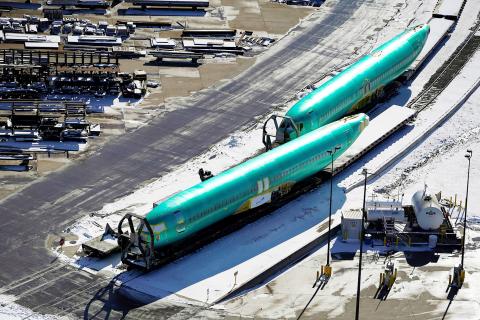
Photo: Reuters
However, smaller parts companies, such as Wichita-based Spirit AeroSystems Holdings Inc, might not have that luxury. They could be forced to cut employees and some might even get pushed out of business.
With 13,500 workers, Spirit is the largest employer in Kansas’ biggest city. It gets half of its revenue from making fuselages for the 737.
Even though MAX production had slowed earlier in the year, Spirit and other suppliers continued to crank out parts, putting many of them in storage. As of Friday last week, Spirit had 90 fuselages on a ramp adjacent to nearby McConnell Air Force Base.
CFM International SA, a joint venture between General Electric Co and France’s Safran SA, which makes the MAX engines, also faces uncertainty.
The Cincinnati-based firm on Tuesday said that it is working with customers and other suppliers “to mitigate the impact of the temporary shutdown of the 737 MAX production.”
The company, which has more than 80 manufacturing sites worldwide with about 50,000 workers, said it can move people and manufacturing across multiple engine programs. That might hold off any layoffs.
CFM produces other engines for commercial and military aircraft.
Stamford-based Hexcel Corp, which makes composite materials used on the 737 MAX frame and engines was already reporting lower sales after Boeing slowed the rate of MAX production.
On Tuesday, the company tried to sound hopeful, saying it was confident in the airplane’s long-term success and looked forward “to its return to flight and gradual ramp-up in production during 2020.”
The 737 MAX is such a big product that by itself, the production hiatus would shrink US GDP by about 0.5 percent in the first quarter of next year, JP Morgan Chase & Co economist Michael Feroli said.
That could cut the US economy’s growth rate by about a quarter to 1.5 percent.
Joseph Brusuelas, chief economist for RSM, a tax advisory and consulting firm, predicted layoffs by suppliers and wrote in a note that some might have trouble staying in business.
“It cannot be overstated just how important the domestic and global supply chains associated with Boeing are to the small and medium-sized firms,” Brusuelas wrote.

The demise of the coal industry left the US’ Appalachian region in tatters, with lost jobs, spoiled water and countless kilometers of abandoned underground mines. Now entrepreneurs are eyeing the rural region with ambitious visions to rebuild its economy by converting old mines into solar power systems and data centers that could help fuel the increasing power demands of the artificial intelligence (AI) boom. One such project is underway by a non-profit team calling itself Energy DELTA (Discovery, Education, Learning and Technology Accelerator) Lab, which is looking to develop energy sources on about 26,305 hectares of old coal land in

Taiwan’s exports soared 56 percent year-on-year to an all-time high of US$64.05 billion last month, propelled by surging global demand for artificial intelligence (AI), high-performance computing and cloud service infrastructure, the Ministry of Finance said yesterday. Department of Statistics Director-General Beatrice Tsai (蔡美娜) called the figure an unexpected upside surprise, citing a wave of technology orders from overseas customers alongside the usual year-end shopping season for technology products. Growth is likely to remain strong this month, she said, projecting a 40 percent to 45 percent expansion on an annual basis. The outperformance could prompt the Directorate-General of Budget, Accounting and

Netflix on Friday faced fierce criticism over its blockbuster deal to acquire Warner Bros Discovery. The streaming giant is already viewed as a pariah in some Hollywood circles, largely due to its reluctance to release content in theaters and its disruption of traditional industry practices. As Netflix emerged as the likely winning bidder for Warner Bros — the studio behind Casablanca, the Harry Potter movies and Friends — Hollywood’s elite launched an aggressive campaign against the acquisition. Titanic director James Cameron called the buyout a “disaster,” while a group of prominent producers are lobbying US Congress to oppose the deal,

Two Chinese chipmakers are attracting strong retail investor demand, buoyed by industry peer Moore Threads Technology Co’s (摩爾線程) stellar debut. The retail portion of MetaX Integrated Circuits (Shanghai) Co’s (上海沐曦) upcoming initial public offering (IPO) was 2,986 times oversubscribed on Friday, according to a filing. Meanwhile, Beijing Onmicro Electronics Co (北京昂瑞微), which makes radio frequency chips, was 2,899 times oversubscribed on Friday, its filing showed. The bids coincided with Moore Threads’ trading debut, which surged 425 percent on Friday after raising 8 billion yuan (US$1.13 billion) on bets that the company could emerge as a viable local competitor to Nvidia


 RSS
RSS