


An adviser to China’s central bank urged authorities to take measures to prevent “systemic risks” from the failure of local government borrowing platforms, and warned of a “chain reaction” should defaults be allowed to damage market confidence.
Ma Jun (馬駿) , an external adviser to the People’s Bank of China (PBOC) monetary policy committee, said in an interview with Securities Times published yesterday that the government could allow so-called local-government financing vehicles (LGFV) with strong fundamentals to take over weaker counterparts, including those in other provinces.
Stronger LGFVs could also seek to go public or acquire listed firms to boost their financing abilities, he said.
The authorities should take steps as soon as possible, due to the risk of “compound” effects among LGFVs, Ma said.
A local government investment arm in Inner Mongolia narrowly escaped a bond default this month, ending yet another scare that could have shaken confidence in Beijing’s support for such borrowers.
Ma’s comments come as market participants are debating whether the Chinese leadership is easing up on its multiyear deleveraging drive amid a slowing economy.
Last week’s Central Economic Work Conference, a key meeting to plan next year’s policy moves, seemed to downplay the urgency to clean up the financial system.
However, Ma said that government intervention is still needed to prevent “systemic financial risks” and local governments should also take on some responsibility to come up with measures to address hidden debts.
Ma’s remarks showed that regulators have realized the “severity” of the woes plaguing weaker, heavily indebted LGFVs, Shenwan Hongyuan Securities (申萬宏源證券) analyst Meng Xiangjuan (孟祥娟) said.
“The proposal of letting LGFVs consolidate across regions is fairly new,” Meng said, adding that there have already been cases of intraregion restructuring of local financing platforms in some provinces.
Regional governments in China have long used LGFVs to raise funds via off-balance-sheet debt. Without formal state backing, Beijing’s shifting attitude over the years has dictated their fortunes: After years of lax oversight, Beijing placed restrictions on debt issuance by LGFVs in 2014 to cut financial risk, only to ease those later as the economy started slowing.
Hohhot Economic and Technological Development Zone Investment Development Group, an LGFV from the less developed Inner Mongolia, caused brief panic in markets earlier this month after missing an early bond repayment.
The company secured an extended deadline from investors a few days later.
The incident nonetheless rekindled concerns about the fate of LGFVs, after onshore corporate bond defaults in China rose to a record high this year as a sharp economic slowdown constrains Beijing’s ability to bail out failing borrowers.
A similar incident last year briefly jolted China’s bond market as well. Xinjiang Production Construction 6th Shi State-owned Assets Management Co, a cotton trader owned by the local government, missed interest and principal on a 500 million yuan (US$71.5 million at the current exchange rate) note, before making good on the delayed repayment a few days later.
LGFVs have 8.5 trillion yuan of notes outstanding onshore and US$69.8 billion in offshore markets, data compiled by Bloomberg showed.
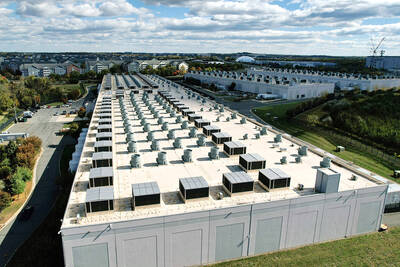
The demise of the coal industry left the US’ Appalachian region in tatters, with lost jobs, spoiled water and countless kilometers of abandoned underground mines. Now entrepreneurs are eyeing the rural region with ambitious visions to rebuild its economy by converting old mines into solar power systems and data centers that could help fuel the increasing power demands of the artificial intelligence (AI) boom. One such project is underway by a non-profit team calling itself Energy DELTA (Discovery, Education, Learning and Technology Accelerator) Lab, which is looking to develop energy sources on about 26,305 hectares of old coal land in

Taiwan’s exports soared 56 percent year-on-year to an all-time high of US$64.05 billion last month, propelled by surging global demand for artificial intelligence (AI), high-performance computing and cloud service infrastructure, the Ministry of Finance said yesterday. Department of Statistics Director-General Beatrice Tsai (蔡美娜) called the figure an unexpected upside surprise, citing a wave of technology orders from overseas customers alongside the usual year-end shopping season for technology products. Growth is likely to remain strong this month, she said, projecting a 40 percent to 45 percent expansion on an annual basis. The outperformance could prompt the Directorate-General of Budget, Accounting and

Netflix on Friday faced fierce criticism over its blockbuster deal to acquire Warner Bros Discovery. The streaming giant is already viewed as a pariah in some Hollywood circles, largely due to its reluctance to release content in theaters and its disruption of traditional industry practices. As Netflix emerged as the likely winning bidder for Warner Bros — the studio behind Casablanca, the Harry Potter movies and Friends — Hollywood’s elite launched an aggressive campaign against the acquisition. Titanic director James Cameron called the buyout a “disaster,” while a group of prominent producers are lobbying US Congress to oppose the deal,

Two Chinese chipmakers are attracting strong retail investor demand, buoyed by industry peer Moore Threads Technology Co’s (摩爾線程) stellar debut. The retail portion of MetaX Integrated Circuits (Shanghai) Co’s (上海沐曦) upcoming initial public offering (IPO) was 2,986 times oversubscribed on Friday, according to a filing. Meanwhile, Beijing Onmicro Electronics Co (北京昂瑞微), which makes radio frequency chips, was 2,899 times oversubscribed on Friday, its filing showed. The bids coincided with Moore Threads’ trading debut, which surged 425 percent on Friday after raising 8 billion yuan (US$1.13 billion) on bets that the company could emerge as a viable local competitor to Nvidia


 RSS
RSS