


Ryanair Holdings PLC chief executive officer Michael O’Leary is an unlikely spokesman for how aviation can avoid killing the planet. The budget travel evangelist has delighted in disparaging “eco-warriors” and casting doubt on climate science.
However, as chairman of the European airline association, A4E, he is now front and center of the effort to persuade governments not to impose new climate taxes on the industry. It is not going well.
This week, European Commission President Ursula von der Leyen unveiled a plan to make the continent carbon neutral by 2050. Her Green Deal is still thin on detail, but it is already prompted plenty of criticism — from the green groups who say it does not go far enough to the big polluters who fear it will harm their competitiveness, such as coal-dependent Poland and the airlines.
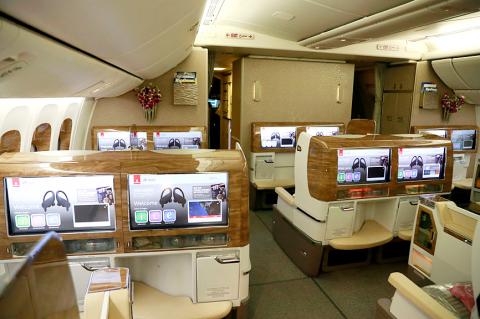
Photo: Reuters
One aim of the Green Deal is to make the price of transport “reflect the impact it has on the environment.” Accordingly, Europe is to review aviation’s tax exemptions — kerosene is not taxed — and consider cutting the free allowances allocated to airlines under Europe’s emissions trading system.
The airlines think they are being unfairly maligned. They contribute about 2 percent of global emissions, a fraction of what cars and trucks produce.
However, unlike road transport, the aviation industry does not have a convincing plan to decarbonize. Europe’s airlines are spending 170 billion euros (US$189 billion) on new fuel-efficient aircraft, but these will still spew out carbon. Synthetic fuels are expensive and battery limitations mean emission-free commercial flights are years away.
Aviation is typical of the trade-offs people we have to make to get to net-zero emissions. So far we have only done the easy stuff that does not force people to give up much or pay more for cheap products and services.
The airlines are lobbying for better air traffic management in Europe’s crowded skies, which would cut the amount of fuel used.
However, there is only a certain amount of carbon we can keep emitting before things go from bad to catastrophic.
The question of who will have to cut back most on their polluting raises issues around economic growth and fairness: The top 10 percent of most frequent fliers took more than half of all flights from England last year, while almost half the population do not fly at all.
Airlines do not even agree among themselves about whether to punish the business lounge elite or the weekend city breakers.
The International Air Transport Association (IATA) this week boasted that more than 4.5 billion passengers would take a flight this year as tickets become ever cheaper. The average return fare, adjusted for inflation and taxes, is almost two-thirds lower than it was 20 years ago.
“Flying is freedom,” IATA director-general Alexandre de Juniac said.
However, even flying fanatics are no longer convinced that its growth should be unconstrained. Over-tourism in the Mediterranean has brought this to wider attention. When the environmental impact of a business is not priced in, there can be such a thing as too much freedom.
Ryanair makes the reasonable point that aviation taxes are a levy on the poor. Making flights more expensive would hurt those for whom 20 euros in new taxes, say, is the difference between flying and staying home. It is fine to encourage people to take a train, but rail fares are often higher, and decent services are concentrated in richer European countries.
A similar debate is raging in the auto industry, where the cost of electric batteries could make small vehicles — often bought by the young and elderly — uneconomical.
Hence the budget airline Wizz Air Holdings PLC struck a nerve with a video that calls for the business-class cabins of its big legacy rivals to be banned.
“We think you’re doing great ... harm to our planet... Are all those empty seats worth the damage they cause?” the narrator asks in the video.
Wizz is, of course, talking its own book; it does not offer business class. However, in a carbon-constrained world, abolishing business and first class is not so outlandish.
Because of their ability to sell out flights and cram passengers on-board, Wizz and Ryanair are Europe’s two most efficient airlines when measured on carbon dioxide per passenger-kilometer traveled.
Naturally, the older carriers do not see it that way.
Ryanair’s promotion of tickets that cost less than 10 euros is “economically, ecologically and politically irresponsible,” according to the Deutsche Lufthansa AG chief executive officer Carsten Spohr said.
KLM Royal Dutch Airlines is even encouraging consumers not to fly if they do not have to.
The airlines still hope to find a way out of the impasse. EasyJet PLC is to offset the carbon produced by all its flights, for example by paying to plant trees. That would cost the airline £25 million (US$33.31 million) a year, equivalent to about £0.26 per passenger or £3 per ton (907kg) of carbon produced.
However, such measures have not always delivered the promised benefits and have been likened to the old Catholic practice of selling indulgences.
While the price of European carbon permits has risen above 20 euros a ton, that is probably too low to really affect ticket prices or encourage the use of expensive synthetic fuels.
This year, Ryanair paid 115 million euros for emission allowances, or less than 1 euro per passenger.
The Green Deal is billed as a “growth strategy,” but nobody should pretend this will not involve hard decisions. The noisy complaints are an industry realizing its license to expand and pollute is being revoked.
Chris Bryant is a Bloomberg Opinion columnist covering industrial companies. He previously worked for the Financial Times.
This column does not necessarily reflect the opinion of the editorial board or Bloomberg LP and its owners.
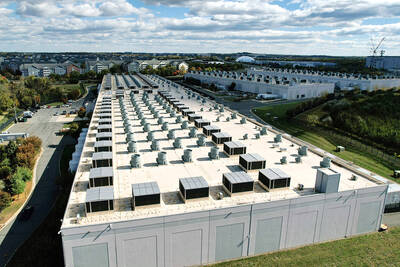
The demise of the coal industry left the US’ Appalachian region in tatters, with lost jobs, spoiled water and countless kilometers of abandoned underground mines. Now entrepreneurs are eyeing the rural region with ambitious visions to rebuild its economy by converting old mines into solar power systems and data centers that could help fuel the increasing power demands of the artificial intelligence (AI) boom. One such project is underway by a non-profit team calling itself Energy DELTA (Discovery, Education, Learning and Technology Accelerator) Lab, which is looking to develop energy sources on about 26,305 hectares of old coal land in
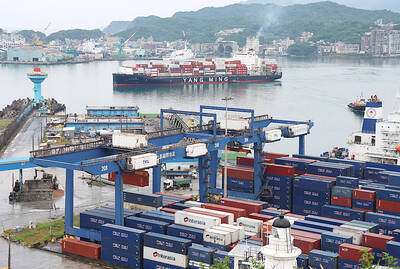
Taiwan’s exports soared 56 percent year-on-year to an all-time high of US$64.05 billion last month, propelled by surging global demand for artificial intelligence (AI), high-performance computing and cloud service infrastructure, the Ministry of Finance said yesterday. Department of Statistics Director-General Beatrice Tsai (蔡美娜) called the figure an unexpected upside surprise, citing a wave of technology orders from overseas customers alongside the usual year-end shopping season for technology products. Growth is likely to remain strong this month, she said, projecting a 40 percent to 45 percent expansion on an annual basis. The outperformance could prompt the Directorate-General of Budget, Accounting and

Netflix on Friday faced fierce criticism over its blockbuster deal to acquire Warner Bros Discovery. The streaming giant is already viewed as a pariah in some Hollywood circles, largely due to its reluctance to release content in theaters and its disruption of traditional industry practices. As Netflix emerged as the likely winning bidder for Warner Bros — the studio behind Casablanca, the Harry Potter movies and Friends — Hollywood’s elite launched an aggressive campaign against the acquisition. Titanic director James Cameron called the buyout a “disaster,” while a group of prominent producers are lobbying US Congress to oppose the deal,

Two Chinese chipmakers are attracting strong retail investor demand, buoyed by industry peer Moore Threads Technology Co’s (摩爾線程) stellar debut. The retail portion of MetaX Integrated Circuits (Shanghai) Co’s (上海沐曦) upcoming initial public offering (IPO) was 2,986 times oversubscribed on Friday, according to a filing. Meanwhile, Beijing Onmicro Electronics Co (北京昂瑞微), which makes radio frequency chips, was 2,899 times oversubscribed on Friday, its filing showed. The bids coincided with Moore Threads’ trading debut, which surged 425 percent on Friday after raising 8 billion yuan (US$1.13 billion) on bets that the company could emerge as a viable local competitor to Nvidia


 RSS
RSS