


The billionaire behind six-month-old Vietnamese auto start-up VinFast plans a feat even Toyota Motor Corp and Hyundai Motor Co could not pull off during their early days: Sell a car in the US.
Pham Nhat Vuong, the Southeast Asian country’s richest man and now in charge of the new automaker, is so intent on exporting electric vehicles to the lucrative US market in 2021 that he is plowing as much as US$2 billion of his own fortune to reach that goal.
His cash would account for half the capital investment of VinFast, which earlier this year began delivering cars to Vietnamese consumers with BMW AG-licensed engines and aims to expand into electric vehicles (EVs).
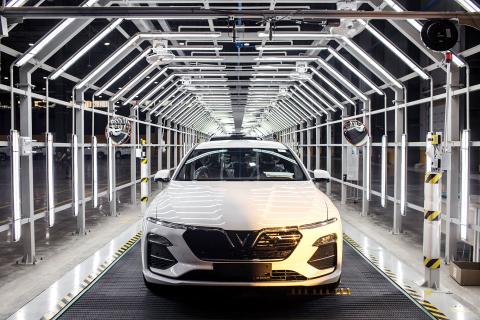
Photo: Bloomberg
“Our ultimate goal is to create an international brand,” the 51-year-old tycoon said in an interview at the Hanoi headquarters of the automaker’s parent, Vingroup JSC, which Vuong founded and holds the title of chairman. “It will be a very difficult road and we will have to put in a lot of effort. But there’s only one road ahead.”
The homegrown vehicles made under Vuong’s sprawling real-estate-to-hospitals conglomerate faces an uphill battle to succeed overseas: Automakers such as India’s Tata Motors Ltd and Malaysia’s Proton Holdings Bhd struggled to win over consumers away from their home turf. Even in Vietnam, VinFast Trading and Production LLC has formidable competition from established foreign players such as Toyota, Ford Motor Co and Hyundai.
VinFast follows a long list of Chinese automakers that have also had ambitions to sell vehicles in the US going back more than a decade.
Although the plans have yet come to fruition, Guangzhou Automobile Group Co (廣州汽車集團), Zotye Automobile Co (眾泰汽車) and others have set up local sales units, and research and development operations to show just how serious they are.
Some Chinese brands have also exhibited at US auto shows in the past few years.
The tycoon, whose net worth is US$9.1 billion, according to the Bloomberg Billionaires Index, is undaunted.
Vingroup sold some shares last year and Vuong plans to sell as much as 10 percent of his own shares to raise funds for the ambitious project. He owns 49 percent of VinFast, while the parent, Vingroup, holds 51 percent.
The automaker would not be profitable for as many as five years, Vuong said, adding the local market is “too small” and overseas sales are key to becoming profitable.
Vuong directly owns 26 percent of Vingroup, according to Bloomberg data. Vietnam Investment Group JSC, in which Vuong has about a 92 percent stake, holds 31.6 percent of Vingroup.
VinFast would have to overcome an even more daunting task of winning over demanding consumers in the US and other developed markets, where emissions and crash standards are stringent.
Adding to these challenges is successfully manufacturing and selling electric vehicles. Many Chinese start-ups, backed by billions of US dollars in funding, bet on the prospects for EVs in the world’s biggest auto market, but few are making money.
BAIC BluePark New Energy Technology Co (北汽藍谷新能源科技), China’s biggest maker of pure electric vehicles, forecasts a loss for this year. Unprofitable NIO Inc (蔚來汽車), which is traded in New York, has struggled to assuage concerns that it is running short on cash amid sputtering EV demand.
VinFast’s first EV would not roll off its assembly line until late next year, but Vuong said he plans to export those vehicles to the US, Europe and Russia in 2021.
VinFast must clear several high hurdles to compete outside Vietnam, said Michael Dunne, chief executive officer of automotive consultant ZoZo Go LLC, which specializes in the Asian market.
“It will be some time before the company is ready to compete in the US — still the world’s toughest market,” he said. “You need a solid brand name.”
Many people prefer a second-hand Honda Motor Co or Toyota over a new vehicle with an unfamiliar brand name, Dunne said.
The Vietnamese automaker will need to produce at least 100,000 vehicles a year to be cost competitive, develop a global brand and establish a parts-and-services network, he said.
Still, VinFast has an opportunity to crack smaller Southeast Asian markets, Dunne added.
VinFast, which operates a 335-hectare factory in the northern port city of Haiphong, Vietnam, is selling its first line of vehicles — a hatchback, sedan and sports utility vehicle (SUV) — at below cost. The hatchback retails for the equivalent of US$17,000, while the four-cylinder sedan goes for US$47,400 and its SUV is offered at US$60,400.
The company targets production of as many as 500,000 vehicles a year by 2025. It also makes electric scooters.
In the next few years, Vingroup will have to spend “many trillions of dong per year” to cover losses for VinFast, estimated at as much as 18 trillion dong (US$777 million) annually, Vuong said.
Those losses include financing and depreciation, and as much as 7 trillion dong each year to absorb the hit of selling vehicles below cost, he added.
Vingroup would divest stakes in other units to fund VinFast, while other subsidiaries have been ordered to reduce costs, Vuong said, without providing details.
VinFast would also seek additional loans, in addition to about US$1.95 billion of international loans it has already raised.
Vuong also plans to list VinFast on a Vietnamese exchange and possibly overseas, he said, without elaborating.
“We have the desire to build a Vietnamese brand that has a world-class reputation,” he said.
“Our biggest challenge is that Vietnamese products do not have an international brand. To many international friends, Vietnam is still a poor, backward country,” Vuong said. “We will have to find a way to market and prove our products represent a dynamic and developing Vietnam that has reached the highest standards of the world.”
With assistance from Ville Heiskanen

The demise of the coal industry left the US’ Appalachian region in tatters, with lost jobs, spoiled water and countless kilometers of abandoned underground mines. Now entrepreneurs are eyeing the rural region with ambitious visions to rebuild its economy by converting old mines into solar power systems and data centers that could help fuel the increasing power demands of the artificial intelligence (AI) boom. One such project is underway by a non-profit team calling itself Energy DELTA (Discovery, Education, Learning and Technology Accelerator) Lab, which is looking to develop energy sources on about 26,305 hectares of old coal land in

Taiwan’s exports soared 56 percent year-on-year to an all-time high of US$64.05 billion last month, propelled by surging global demand for artificial intelligence (AI), high-performance computing and cloud service infrastructure, the Ministry of Finance said yesterday. Department of Statistics Director-General Beatrice Tsai (蔡美娜) called the figure an unexpected upside surprise, citing a wave of technology orders from overseas customers alongside the usual year-end shopping season for technology products. Growth is likely to remain strong this month, she said, projecting a 40 percent to 45 percent expansion on an annual basis. The outperformance could prompt the Directorate-General of Budget, Accounting and

Netflix on Friday faced fierce criticism over its blockbuster deal to acquire Warner Bros Discovery. The streaming giant is already viewed as a pariah in some Hollywood circles, largely due to its reluctance to release content in theaters and its disruption of traditional industry practices. As Netflix emerged as the likely winning bidder for Warner Bros — the studio behind Casablanca, the Harry Potter movies and Friends — Hollywood’s elite launched an aggressive campaign against the acquisition. Titanic director James Cameron called the buyout a “disaster,” while a group of prominent producers are lobbying US Congress to oppose the deal,
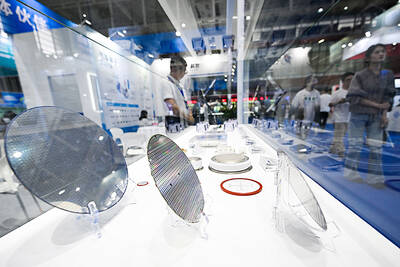
Two Chinese chipmakers are attracting strong retail investor demand, buoyed by industry peer Moore Threads Technology Co’s (摩爾線程) stellar debut. The retail portion of MetaX Integrated Circuits (Shanghai) Co’s (上海沐曦) upcoming initial public offering (IPO) was 2,986 times oversubscribed on Friday, according to a filing. Meanwhile, Beijing Onmicro Electronics Co (北京昂瑞微), which makes radio frequency chips, was 2,899 times oversubscribed on Friday, its filing showed. The bids coincided with Moore Threads’ trading debut, which surged 425 percent on Friday after raising 8 billion yuan (US$1.13 billion) on bets that the company could emerge as a viable local competitor to Nvidia


 RSS
RSS