


US President Donald Trump has signed off on a phase-one trade deal with China, averting the introduction tomorrow of a new wave of US tariffs on about US$160 billion of consumer goods from the Asian nation, people familiar with the matter said.
The deal presented to Trump by trade advisers on Thursday included a promise by the Chinese to buy more US agricultural goods, the people said.
Officials also discussed possible reductions of existing duties on Chinese products, they said.
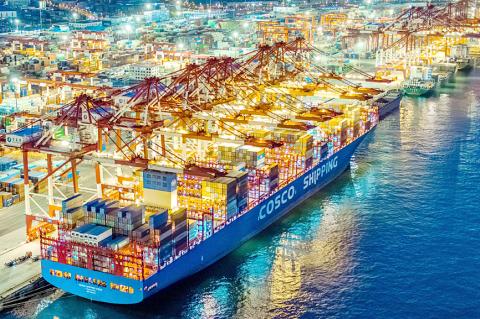
Photo: AFP
An announcement was expected yesterday in Washington, people familiar with the plans said.
Trump on Thursday tweeted that the US and China are “VERY close” to signing a “BIG” trade deal.
“They want it, and so do we!” he tweeted five minutes after equity markets opened in New York, sending stocks to new records.
However, Trump had changed his mind on deals with China before.
Negotiators have been working on the terms of the phase-one deal for months after Trump announced in October that the two nations had reached an agreement that could be put on paper within weeks.
The US has added a 25 percent duty on about US$250 billion of Chinese products and a 15 percent levy on another US$110 billion of its imports over the course of a roughly 20-month trade war.
Discussions now are focused on reducing those rates by as much as half, as part of the interim agreement Trump announced almost nine weeks ago.
In addition to a significant increase in Chinese agricultural purchases in exchange for tariff relief, officials have also said a phase-one pact would include Chinese commitments to do more to stop intellectual-property theft and an agreement by both sides not to manipulate their currencies.
Put off for later discussions are knotty issues such as longstanding US complaints over the vast web of subsidies ranging from cheap electricity to low-cost loans that China has used to build its industrial might.
The new duties, which were scheduled to take effect at 12:01am tomorrow Washington time unless the administration says otherwise, would hit consumer goods from China, including smartphones and toys.
Even amid the positive signs on trade, Chinese Minister of Foreign Affairs Wang Yi (王毅) yesterday highlighted the other confrontations between the two sides.
Wang said that US actions had “severely damaged the hard-earned basis for mutual trust” and left the relationship in their “most complex” state since the two sides established ties four decades ago.
Before today, Trump’s advisers had sent conflicting signals and stressed that he hadn’t made up his mind on the next steps.
The decisions facing Trump over a trade deal highlight one dilemma he confronts going into next year’s presidential election: Whether to bet on an escalation of hostilities with China and the tariffs he is so fond of, or to follow the advice of more market-oriented advisers and business leaders who argue a pause in the escalation would help a slowing US economy bounce back in an election year.
“The outcome of US-China trade talks will be a key determinant of the trajectory for 2020 growth. At one extreme, a deal that takes tariffs back to May 2019 levels, and provides certainty that the truce will hold, could deliver a 0.6 percent boost to global GDP. At the other, a breakdown in talks would mean the trade drag extends into the year ahead,” Bloomberg chief economist Tom Orlik said.
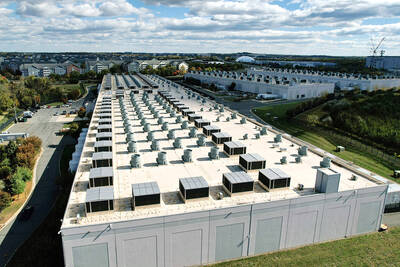
The demise of the coal industry left the US’ Appalachian region in tatters, with lost jobs, spoiled water and countless kilometers of abandoned underground mines. Now entrepreneurs are eyeing the rural region with ambitious visions to rebuild its economy by converting old mines into solar power systems and data centers that could help fuel the increasing power demands of the artificial intelligence (AI) boom. One such project is underway by a non-profit team calling itself Energy DELTA (Discovery, Education, Learning and Technology Accelerator) Lab, which is looking to develop energy sources on about 26,305 hectares of old coal land in

Taiwan’s exports soared 56 percent year-on-year to an all-time high of US$64.05 billion last month, propelled by surging global demand for artificial intelligence (AI), high-performance computing and cloud service infrastructure, the Ministry of Finance said yesterday. Department of Statistics Director-General Beatrice Tsai (蔡美娜) called the figure an unexpected upside surprise, citing a wave of technology orders from overseas customers alongside the usual year-end shopping season for technology products. Growth is likely to remain strong this month, she said, projecting a 40 percent to 45 percent expansion on an annual basis. The outperformance could prompt the Directorate-General of Budget, Accounting and

Netflix on Friday faced fierce criticism over its blockbuster deal to acquire Warner Bros Discovery. The streaming giant is already viewed as a pariah in some Hollywood circles, largely due to its reluctance to release content in theaters and its disruption of traditional industry practices. As Netflix emerged as the likely winning bidder for Warner Bros — the studio behind Casablanca, the Harry Potter movies and Friends — Hollywood’s elite launched an aggressive campaign against the acquisition. Titanic director James Cameron called the buyout a “disaster,” while a group of prominent producers are lobbying US Congress to oppose the deal,

Two Chinese chipmakers are attracting strong retail investor demand, buoyed by industry peer Moore Threads Technology Co’s (摩爾線程) stellar debut. The retail portion of MetaX Integrated Circuits (Shanghai) Co’s (上海沐曦) upcoming initial public offering (IPO) was 2,986 times oversubscribed on Friday, according to a filing. Meanwhile, Beijing Onmicro Electronics Co (北京昂瑞微), which makes radio frequency chips, was 2,899 times oversubscribed on Friday, its filing showed. The bids coincided with Moore Threads’ trading debut, which surged 425 percent on Friday after raising 8 billion yuan (US$1.13 billion) on bets that the company could emerge as a viable local competitor to Nvidia


 RSS
RSS