


France on Wednesday said it would push ahead with its law to tax tech giants that has sparked a row with the US, saying that an international accord was the only way to solve the dispute.
French Minister of Finance Bruno Le Maire met US Secretary of the Treasury Steven Mnuchin on the sidelines of the meeting of G7 finance ministers in Chantilly outside Paris.
“We don’t always agree on all issues, but we do agree on many and it’s always important to listen to each other,” Le Maire tweeted.
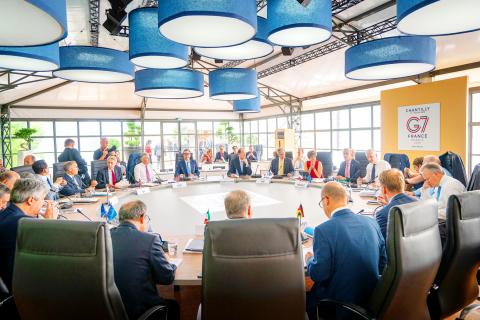
Photo: Bloomberg
The French parliament earlier this month passed a new law that would tax digital giants on revenue accrued inside the country, even if their European headquarters are elsewhere, in a move that would affect huge US groups Google, Apple Inc, Facebook Inc and Amazon.com Inc.
The move has infuriated US President Donald Trump and Washington has announced an unprecedented probe against France that could trigger the imposition of tariffs.
In comments to France Inter radio, Le Maire said France would not back down on its plans to impose the 3 percent tax on revenue.
He said he would make it clear that the French parliament had approved the tax and this could only be withdrawn if there was an international agreement.
“The possibility of US sanctions against France exists,” Le Maire said. “There is a legal instrument for that and clearly there is the political will.”
Even before the final vote by French lawmakers, the US announced it was opening a so-called Section 301 probe into the measure.
A Section 301 investigation was used by the Trump administration to justify its tariffs on China.
However, Le Maire said: “France will not back down on the introduction of its national tax. It was decided upon, it was voted upon, it will be applied from 2019.”
The minister had late Tuesday expressed confidence that the G7 could find a consensus for an international accord, which would be overseen by the Organisation for Economic Co-operation and Development.
“This would be the best way to solve this problem,” Le Maire said.
France became the first major economy to pass such tax legislation last week, when parliament gave its final approval.
Britain unveiled legislation last week and Spain’s new government is expected to introduce its own version.
However, smaller EU states such as Ireland and Luxembourg — low-tax countries which host the European headquarters of the digital giants — have prevented a consensus in the EU.
German Minister of Finance Olaf Scholz said he hoped that next year there could be international rules in place that “we can introduce everywhere, including in the EU and Germany.”
Plans by Facebook to launch a virtual currency called Libra have also stoked concerns among regulators in numerous countries about regulation and market oversight of cryptocurrencies.
Le Maire said the conditions were not yet in place to launch Libra, a virtual currency to be backed with a basket of real-world currencies that Facebook says would facilitate online financial transactions.
After the first day of meetings, a French official said there was a “shared consensus” at the G7 about the need for action on Libra.
“Concerns [were] expressed by all the participants about the current situation and the need to act quickly,” the official added.
Scholz said the ministers and central bankers present had “serious concerns” about the implications.
“We are talking about currency stability, security, data protection and democratic control,” he added.

GROWING OWINGS: While Luxembourg and China swapped the top three spots, the US continued to be the largest exposure for Taiwan for the 41st consecutive quarter The US remained the largest debtor nation to Taiwan’s banking sector for the 41st consecutive quarter at the end of September, after local banks’ exposure to the US market rose more than 2 percent from three months earlier, the central bank said. Exposure to the US increased to US$198.896 billion, up US$4.026 billion, or 2.07 percent, from US$194.87 billion in the previous quarter, data released by the central bank showed on Friday. Of the increase, about US$1.4 billion came from banks’ investments in securitized products and interbank loans in the US, while another US$2.6 billion stemmed from trust assets, including mutual funds,
AI TALENT: No financial details were released about the deal, in which top Groq executives, including its CEO, would join Nvidia to help advance the technology Nvidia Corp has agreed to a licensing deal with artificial intelligence (AI) start-up Groq, furthering its investments in companies connected to the AI boom and gaining the right to add a new type of technology to its products. The world’s largest publicly traded company has paid for the right to use Groq’s technology and is to integrate its chip design into future products. Some of the start-up’s executives are leaving to join Nvidia to help with that effort, the companies said. Groq would continue as an independent company with a new chief executive, it said on Wednesday in a post on its Web

JOINT EFFORTS: MediaTek would partner with Denso to develop custom chips to support the car-part specialist company’s driver-assist systems in an expanding market MediaTek Inc (聯發科), the world’s largest mobile phone chip designer, yesterday said it is working closely with Japan’s Denso Corp to build a custom automotive system-on-chip (SoC) solution tailored for advanced driver-assistance systems and cockpit systems, adding another customer to its new application-specific IC (ASIC) business. This effort merges Denso’s automotive-grade safety expertise and deep vehicle integration with MediaTek’s technologies cultivated through the development of Media- Tek’s Dimensity AX, leveraging efficient, high-performance SoCs and artificial intelligence (AI) capabilities to offer a scalable, production-ready platform for next-generation driver assistance, the company said in a statement yesterday. “Through this collaboration, we are bringing two

Even as the US is embarked on a bitter rivalry with China over the deployment of artificial intelligence (AI), Chinese technology is quietly making inroads into the US market. Despite considerable geopolitical tensions, Chinese open-source AI models are winning over a growing number of programmers and companies in the US. These are different from the closed generative AI models that have become household names — ChatGPT-maker OpenAI or Google’s Gemini — whose inner workings are fiercely protected. In contrast, “open” models offered by many Chinese rivals, from Alibaba (阿里巴巴) to DeepSeek (深度求索), allow programmers to customize parts of the software to suit their


 RSS
RSS