


Russian President Vladimir Putin yesterday said he agreed with Saudi Crown Prince Mohammed Bin Salman to extend an OPEC+ deal at current production levels for the rest of this year and potentially into early next year.
The comments, made at the G20 summit in Osaka, Japan, all but make the outcome of the OPEC meeting tomorrow and on Tuesday in Vienna a foregone conclusion, and further reinforce Putin’s role as the ultimate policymaker within the group.
Saudi Arabia and Russia in 2016 ended years of animosity to join forces to manage the global oil market in an effort to prop up prices. The current version of the deal by the group known as OPEC+ calls for production cuts of 1.2 million barrels a day, which were due to expire at the end of this month.
“We have agreed: We will continue our agreements,” Putin said in Osaka.
“In any event, we will support the continuation of agreements — both Russia and Saudi Arabia in the volumes previously agreed,” he told reporters.
Putin said the extension could last six to nine months, marking the first time a senior leader from the group has indicated the curbs could be needed into next year.
That reflects a somber outlook for oil supply and demand next year due to a combination of a slowing global economy and rising US shale output.
On Friday, West Texas Intermediate for August delivery fell US$0.96 to US$58.47 a barrel at the close of New York Mercantile Exchange trading, up 1.8 percent for the week.
Brent for September settlement on Friday lost US$0.93 to US$64.74 on London’s ICE Futures Europe Exchange, up 0.4 percent for the week.
The August contract, which expired on Friday, was unchanged.
For Moscow, extending the curbs by nine months has an extra incentive, as Russian companies struggle to raise production over the winter months. By extending the deal into next year, Russia could be in a better position to pump more during the spring of next year.
The deal removed 1.2 million barrels a day of OPEC+ production, helping to send oil prices higher.
However, the group has reduced output by far more than it agreed, due to the effects of US sanctions on Iranian and Venezuelan output.
What is more, Saudi Arabia unilaterally lowered production below its official OPEC+ target, pumping 9.7 million barrels a day last month, compared with a ceiling of 10.3 million.
The verbal agreement between Putin and Prince Salman at the G20 further highlights the importance of the gathering as a key policymaking forum for oil and OPEC watchers.
Last year, Putin and Prince Mohammed used the summit in Buenos Aires to give their political backing to extend the OPEC+ deal into the first half of this year.

GROWING OWINGS: While Luxembourg and China swapped the top three spots, the US continued to be the largest exposure for Taiwan for the 41st consecutive quarter The US remained the largest debtor nation to Taiwan’s banking sector for the 41st consecutive quarter at the end of September, after local banks’ exposure to the US market rose more than 2 percent from three months earlier, the central bank said. Exposure to the US increased to US$198.896 billion, up US$4.026 billion, or 2.07 percent, from US$194.87 billion in the previous quarter, data released by the central bank showed on Friday. Of the increase, about US$1.4 billion came from banks’ investments in securitized products and interbank loans in the US, while another US$2.6 billion stemmed from trust assets, including mutual funds,
AI TALENT: No financial details were released about the deal, in which top Groq executives, including its CEO, would join Nvidia to help advance the technology Nvidia Corp has agreed to a licensing deal with artificial intelligence (AI) start-up Groq, furthering its investments in companies connected to the AI boom and gaining the right to add a new type of technology to its products. The world’s largest publicly traded company has paid for the right to use Groq’s technology and is to integrate its chip design into future products. Some of the start-up’s executives are leaving to join Nvidia to help with that effort, the companies said. Groq would continue as an independent company with a new chief executive, it said on Wednesday in a post on its Web
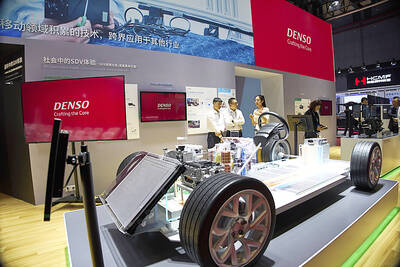
JOINT EFFORTS: MediaTek would partner with Denso to develop custom chips to support the car-part specialist company’s driver-assist systems in an expanding market MediaTek Inc (聯發科), the world’s largest mobile phone chip designer, yesterday said it is working closely with Japan’s Denso Corp to build a custom automotive system-on-chip (SoC) solution tailored for advanced driver-assistance systems and cockpit systems, adding another customer to its new application-specific IC (ASIC) business. This effort merges Denso’s automotive-grade safety expertise and deep vehicle integration with MediaTek’s technologies cultivated through the development of Media- Tek’s Dimensity AX, leveraging efficient, high-performance SoCs and artificial intelligence (AI) capabilities to offer a scalable, production-ready platform for next-generation driver assistance, the company said in a statement yesterday. “Through this collaboration, we are bringing two

Even as the US is embarked on a bitter rivalry with China over the deployment of artificial intelligence (AI), Chinese technology is quietly making inroads into the US market. Despite considerable geopolitical tensions, Chinese open-source AI models are winning over a growing number of programmers and companies in the US. These are different from the closed generative AI models that have become household names — ChatGPT-maker OpenAI or Google’s Gemini — whose inner workings are fiercely protected. In contrast, “open” models offered by many Chinese rivals, from Alibaba (阿里巴巴) to DeepSeek (深度求索), allow programmers to customize parts of the software to suit their


 RSS
RSS