


The risks to the global economy are rising as major industrial nations sharpen threats of a trade war, IMF managing director Christine Lagarde said.
“The clouds on the horizon that we have signaled about six months ago are getting darker by the day — and, I was going to say, by the weekend,” Lagarde told a news conference in Berlin on Monday.
Her remarks follow a chaotic two-day meeting of the G7 in which US President Donald Trump shocked fellow leaders with his disregard for US allies. After leaving the summit early, Trump tweeted he was pulling US support from a joint statement and he accused the host, Canadian Prime Minister Justin Trudeau, of being weak and dishonest.
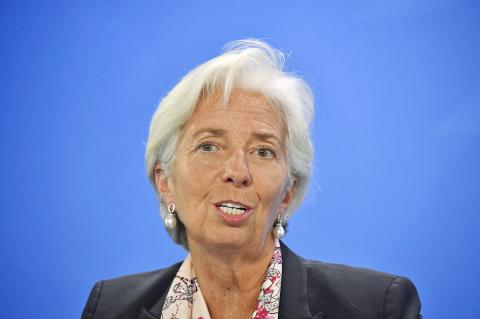
Photo: AFP
Other G7 countries lobbied unsuccessfully at the summit for the US to reverse new tariffs on imported steel and aluminum imports.
Trump turned the tables by challenging world leaders to eliminate all trade barriers, tariffs and subsidies and he threatened to stop trading with them entirely.
Germany and France, who are also part of the G7, criticized Trump for withdrawing his support, and were joined by the UK in reiterating their backing of the communique.
Lagarde’s concerns were echoed by WTO director-general Roberto Azevedo, who said growing trade frictions could cause serious damage to the world economy.
“The rising trade tensions that we see before us, they risk a major economic impact, undermining the strongest sustainable period of trade growth since the financial crisis,” Azevedo said at the Berlin meeting. “We must therefore stop this escalation of tensions. A tit-for-tat process is not going to be helpful. It’s not going to help anyone.”
Lagarde, who attended the summit in Quebec, did not mention Trump by name.
Her warnings about the risks of protectionism have grown more pointed in recent weeks, as the Trump administration has imposed more tariffs and threatened others, including against China.
On Monday, she said the “biggest and darkest cloud” over the global economy is the risk of a deterioration of confidence “by attempts to challenge the way in which trade has been conducted, in which relationships have been handled and the way in which multilateral organizations have been operating.”
The IMF projects the global economy will grow 3.9 percent this year and next year, the fastest pace since 2011.
Beyond that horizon, the IMF is more pessimistic, predicting that growth will weaken as central banks raise interest rates, US fiscal stimulus fades and China’s gradual slowdown continues.
Asked about the US’s backsliding into protectionist trade policies, Lagarde recalled comments from US Supreme Court Justice Ruth Bader Ginsburg.
“She was asked, after more than 50 years of marriage, what was the secret of her marriage? And she said this: It helps being a little bit deaf on occasions,” Lagarde said.
The IMF, which has 189 member countries, was conceived during World War II to oversee the international monetary system and promote open-market policies that drive growth. The US is the fund’s biggest shareholder.


The domestic unit of the Chinese-owned, Dutch-headquartered chipmaker Nexperia BV will soon be able to produce semiconductors locally within China, according to two company sources. Nexperia is at the center of a global tug-of-war over critical semiconductor technology, with a Dutch court in February ordering a probe into alleged mismanagement at the company. The geopolitical tussle has disrupted supply chains, with some carmakers reportedly forced to cut production due to chip shortages. Local production would allow Nexperia’s domestic arm, Nexperia Semiconductors (China) Ltd (安世半導體中國), to bypass restrictions in place since October on the supply of silicon wafers — etched with tiny components to
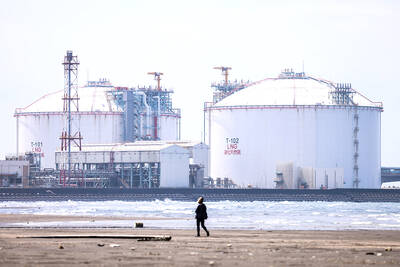
Taiwan is open to joining a global liquefied natural gas (LNG) program if one is created, but on the condition that countries provide delivery even in a scenario where there is a conflict with China, an energy department official said yesterday. While Taiwan’s priority is to have enough LNG at home, the nation is open to exploring potential strategic reserves in other countries such as Japan or South Korea, Energy Administration Deputy Director-General Chen Chung-hsien (陳崇憲) said. While the LNG market does not have a global reserve for emergencies like that of oil, the concept has been raised a few times —

Taiwan Semiconductor Manufacturing Co (TSMC, 台積電) yesterday received government approval to deploy its advanced 3-nanometer (3nm) process at its second fab currently under construction in Japan, the Ministry of Economic Affairs said in a news release. The ministry green-lit the plan for the facility in Kumamoto, which is scheduled to start installing equipment and come online in 2028 with a monthly production capacity of 15,000 12-inch wafers, the ministry said. The Department of Investment Review in June 2024 authorized a US$5.26 billion investment for the facility, slated to manufacture 6- to 12nm chips, significantly less advanced than 3nm process. At a meeting with
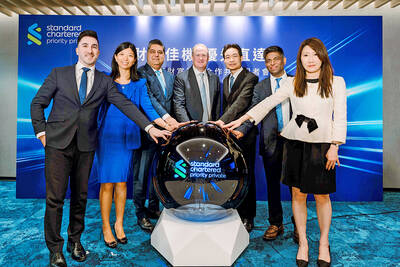
Standard Chartered Taiwan on March 26 announced that it has partnered with international fintech firm FinIQ to build an “Automated Structured Products Pricing Platform.” The bank is also introducing products from global issuers including Goldman Sachs Group Inc, Barclays PLC and BNP Paribas SA. The new platform enables an end-to-end process whereby it finds the most competitive pricing across multiple issuers in a matter of minutes, followed by automated documentation and transaction execution, which significantly shortens time-to-market and delivers a superior wealth management experience. Standard Chartered Bank Taiwan CEO Anthony Yu (游天立) said: “Standard Chartered is increasingly leveraging its wealth management


 RSS
RSS