


Largan Precision Co (大立光), which supplies camera lenses for Apple Inc’s iPhones, yesterday reported that net income last quarter fell 18 percent annually to NT$4.02 billion (US$137.39 million), as aggregate sales in the first quarter dropped 18 percent annually to NT$8.88 billion.
Largan’s earnings per share were NT$29.96 in the first quarter, making the January-to-March period the firm’s poorest showing of the past seven quarters.
Gross margin fell from 70.94 percent for the same period a year earlier to 63.33 percent, its lowest of the past eight quarters, while operating margin dropped from 61.87 percent to 52.82 percent.
Largan chief executive officer Adam Lin (林恩平) attributed last quarter’s poor performance not only to its weaker top-line numbers, but also to a dip in the production yield rate as the company took on new customer designs.
“There is always a learning curve for new designs,” Lin said during a teleconference.
Looking ahead to this month and May, Lin said that the company is not expecting sales to decline further from last month, which came to NT$3.14 billion, 13 percent lower compared with the previous year.
“Monthly sales could improve moderately beginning this month if yield rates improve,” Lin said.
In addition, Largan plans to continue efforts to secure orders from South Korean smartphone vendors for its all-plastic 3D sensing solutions, Lin said.
Handset cameras with plastic lenses are to remain the company’s focus this year, Lin said, adding that while current hybrid glass-and-plastic solutions do not provide any advantage for smartphones, they might be better suited for automotive applications.
The company expects this year to mostly ship handset camera lenses with six layers, while its seven-layer solution — which is widely regarded as a competitive edge over rivals worldwide — is to enter mass production next year, he said.
While Lin declined to comment on whether the company’s customers were forced to divert orders to other suppliers due to its poor yield rates in the past quarter, Largan’s performance echoes the findings of a recent report by Taipei-based KGI SecuritiesCo (凱基證券) analyst Kuo Ming-chi (郭明錤).
According to Kuo, some of Largan’s customers moved their orders to China-based Sunny Optical Technology Group Co (舜宇光學) during the first quarter because the Taiwanese company struggled to meet field curvature specifications for high-end Chinese smartphones.
As Largan’s yield rate improves, Kuo expects the company to regain some of its customers as some major brands prepare to launch this year’s flagship smartphones.
With two to three times the production capacity of Sunny Optical Technology Group, Largan still holds a significant advantage in terms of business scale, Kuo said, adding that the Taiwanese company would likely make headway in the market for lower-tiered lenses with four or five plastic layers.
Largan shares yesterday rose 2.17 percent to NT$3,300 in Taipei trading, but the share price has dropped 17.91 percent this year, compared with the broader market’s 2.94 percent rise over the period.


The domestic unit of the Chinese-owned, Dutch-headquartered chipmaker Nexperia BV will soon be able to produce semiconductors locally within China, according to two company sources. Nexperia is at the center of a global tug-of-war over critical semiconductor technology, with a Dutch court in February ordering a probe into alleged mismanagement at the company. The geopolitical tussle has disrupted supply chains, with some carmakers reportedly forced to cut production due to chip shortages. Local production would allow Nexperia’s domestic arm, Nexperia Semiconductors (China) Ltd (安世半導體中國), to bypass restrictions in place since October on the supply of silicon wafers — etched with tiny components to
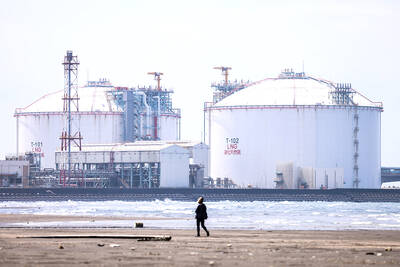
Taiwan is open to joining a global liquefied natural gas (LNG) program if one is created, but on the condition that countries provide delivery even in a scenario where there is a conflict with China, an energy department official said yesterday. While Taiwan’s priority is to have enough LNG at home, the nation is open to exploring potential strategic reserves in other countries such as Japan or South Korea, Energy Administration Deputy Director-General Chen Chung-hsien (陳崇憲) said. While the LNG market does not have a global reserve for emergencies like that of oil, the concept has been raised a few times —

Taiwan Semiconductor Manufacturing Co (TSMC, 台積電) yesterday received government approval to deploy its advanced 3-nanometer (3nm) process at its second fab currently under construction in Japan, the Ministry of Economic Affairs said in a news release. The ministry green-lit the plan for the facility in Kumamoto, which is scheduled to start installing equipment and come online in 2028 with a monthly production capacity of 15,000 12-inch wafers, the ministry said. The Department of Investment Review in June 2024 authorized a US$5.26 billion investment for the facility, slated to manufacture 6- to 12nm chips, significantly less advanced than 3nm process. At a meeting with
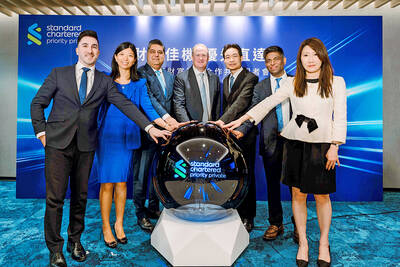
Standard Chartered Taiwan on March 26 announced that it has partnered with international fintech firm FinIQ to build an “Automated Structured Products Pricing Platform.” The bank is also introducing products from global issuers including Goldman Sachs Group Inc, Barclays PLC and BNP Paribas SA. The new platform enables an end-to-end process whereby it finds the most competitive pricing across multiple issuers in a matter of minutes, followed by automated documentation and transaction execution, which significantly shortens time-to-market and delivers a superior wealth management experience. Standard Chartered Bank Taiwan CEO Anthony Yu (游天立) said: “Standard Chartered is increasingly leveraging its wealth management


 RSS
RSS