


Qualcomm Inc said its board will convene to discuss the next steps on Broadcom Ltd’s US$121 billion acquisition offer after a meeting with its hostile suitor on Wednesday, giving no indication of whether the two chipmakers are closer to agreeing on the largest deal in the history of technology.
“We met with representatives of Broadcom for two hours earlier today, and listened carefully to what they had to say,” Qualcomm said in a statement after the meeting in New York. “The Qualcomm board will promptly meet to discuss the meeting and to determine next steps.”
While Qualcomm’s representatives listened, they did not engage with their counterparts, according to a person familiar with Broadcom’s view of how the meeting went.
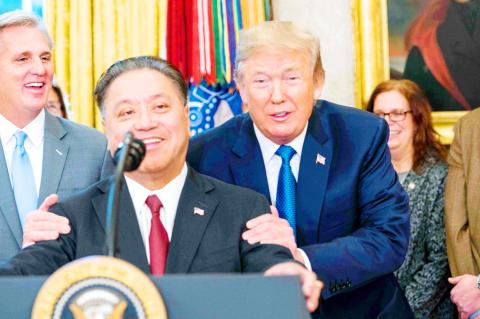
Photo: AFP
Last week, Qualcomm’s board rejected Broadcom’s “best and final” proposal of US$82 a share, which San Diego-based Qualcomm has dismissed as too low. The company had agreed to meet with Broadcom chief executive officer Hock Tan (陳福陽), but warned that he would need to offer more and give better assurances that a transaction would get regulatory approval in a reasonable time frame. Tan replied that the newest bid was as high as he was going to go.
The two sides face a showdown at a March 6 shareholder meeting, where Broadcom is asking Qualcomm investors to elect its board nominees in order to force the deal through.
A failure to win over either Qualcomm’s board or shareholders would be a rare setback for Tan. He has already made Broadcom into one of the largest companies in the US$380 billion semiconductor industry through a string of deals. Taking control of Qualcomm, the biggest maker of chips that power smartphones, would give his company an unprecedented reach in the components that run modern communications systems.
Qualcomm’s board includes chairman Paul Jacobs — the son of the company’s founder — and CEO Steve Mollenkopf, who are both engineers committed to taking market-leading mobile chip technology into new areas such as servers, personal computers and automobiles. Tan has dismissed such expansion plans as unrealistic, arguing that the industry has changed and slowed down.
At the meeting, Tan was not given the chance to appeal to the whole of Qualcomm’s board. The target company was represented by Tom Horton, Jacobs and Mollenkopf from the board, and three others from the leadership team. Only Horton is an independent; the rest are long-serving executives, or, in Jacobs’s case, a former executive, who are committed to Qualcomm’s current strategy and plan to remain a standalone company.
Still, Qualcomm’s contention that the chipmaker’s future is brighter on its own has been a tough sell over the past two years. Challenges to the lucrative technology-licensing business have been at the center of its problems.
Regulators around the world are fining or investigating Qualcomm, supporting elements of Apple Inc.’s claims in a lawsuit alleging Qualcomm abuses its dominant position in mobile chips. Qualcomm has countered that it expects to win in court over time and overturn some of the more than US$4 billion it has been fined.

GROWING OWINGS: While Luxembourg and China swapped the top three spots, the US continued to be the largest exposure for Taiwan for the 41st consecutive quarter The US remained the largest debtor nation to Taiwan’s banking sector for the 41st consecutive quarter at the end of September, after local banks’ exposure to the US market rose more than 2 percent from three months earlier, the central bank said. Exposure to the US increased to US$198.896 billion, up US$4.026 billion, or 2.07 percent, from US$194.87 billion in the previous quarter, data released by the central bank showed on Friday. Of the increase, about US$1.4 billion came from banks’ investments in securitized products and interbank loans in the US, while another US$2.6 billion stemmed from trust assets, including mutual funds,

AI TALENT: No financial details were released about the deal, in which top Groq executives, including its CEO, would join Nvidia to help advance the technology Nvidia Corp has agreed to a licensing deal with artificial intelligence (AI) start-up Groq, furthering its investments in companies connected to the AI boom and gaining the right to add a new type of technology to its products. The world’s largest publicly traded company has paid for the right to use Groq’s technology and is to integrate its chip design into future products. Some of the start-up’s executives are leaving to join Nvidia to help with that effort, the companies said. Groq would continue as an independent company with a new chief executive, it said on Wednesday in a post on its Web

JOINT EFFORTS: MediaTek would partner with Denso to develop custom chips to support the car-part specialist company’s driver-assist systems in an expanding market MediaTek Inc (聯發科), the world’s largest mobile phone chip designer, yesterday said it is working closely with Japan’s Denso Corp to build a custom automotive system-on-chip (SoC) solution tailored for advanced driver-assistance systems and cockpit systems, adding another customer to its new application-specific IC (ASIC) business. This effort merges Denso’s automotive-grade safety expertise and deep vehicle integration with MediaTek’s technologies cultivated through the development of Media- Tek’s Dimensity AX, leveraging efficient, high-performance SoCs and artificial intelligence (AI) capabilities to offer a scalable, production-ready platform for next-generation driver assistance, the company said in a statement yesterday. “Through this collaboration, we are bringing two

Even as the US is embarked on a bitter rivalry with China over the deployment of artificial intelligence (AI), Chinese technology is quietly making inroads into the US market. Despite considerable geopolitical tensions, Chinese open-source AI models are winning over a growing number of programmers and companies in the US. These are different from the closed generative AI models that have become household names — ChatGPT-maker OpenAI or Google’s Gemini — whose inner workings are fiercely protected. In contrast, “open” models offered by many Chinese rivals, from Alibaba (阿里巴巴) to DeepSeek (深度求索), allow programmers to customize parts of the software to suit their


 RSS
RSS