


The Taiwan Futures Exchange (TAIFEX) yesterday said that heavy losses sustained by investors during a bout of volatility last week were the result of a lack of sound risk management and not caused by flaws in its trading mechanism.
Reacting to a steep overnight drop in the Dow Jones Industrial Average, the TAIEX tumbled 4.95 percent, or 542.25 points, to close at 10,404 on Wednesday last week.
During the session, a number of TAIEX options investors caught in the stampede following the market rout were left with especially heavy losses, which they said could have been avoided.
Bearish investors who had sold call options said that prices of their positions had climbed higher, bucking the TAIEX’s decline.
Affected investors also said that negligent market makers had prevented them from settling their positions to minimize losses.
They also questioned the TAIFEX’s decision to exclude the options market from its price stabilization measures.
The TAIEX said that abnormal options price movements during the session were caused by a spike in volatility and were fanned by futures brokerages that had proceeded to force the settlement of positions held by customers in a bid to prevent further losses as their portfolio value tanked.
Most of the affected investors had options positions that were deeply out of the money or had a further-out expiry date, the TAIFEX said, adding that market makers are only obligated to provide more immediate options contracts.
The exchange said that its price stabilization mechanism is designed to guard against market disruptions from sudden occurrences, such as “fat finger” errors, and that it does not regulate continued price actions.
Price stabilization measures implemented by futures authorities in Hong Kong also do not include the options market, it added.
The Chinese National Futures Association (CNFA, 期貨公會) said that when brokerages force settlement of customers’ positions, the action is aimed at containing risk and is carried out automatically once the required conditions are met.
In this case, futures brokerages are not required to anticipate market movements and find the most favorable trades for their customers, the association said, reminding investors that the options market is a zero-sum game.
Investors had complained that positions were settled at the worst possible price points, during the stampede, while others said that brokerages had ignored that they had combination positions — a trading strategy that involves the purchase and sale of call and put options on the same underlying asset.
The TAIFEX estimated that investors had failed to settle a total of NT$120 million (US$4.1 million) from the session alone.
Futures brokerages said that they had taken collateral and arranged repayment plans with most of the affected investors.
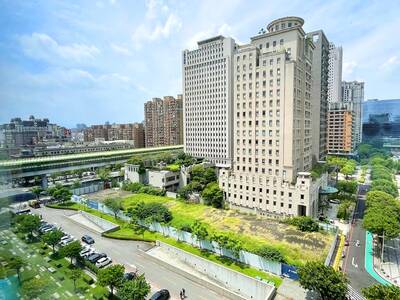
Taichung reported the steepest fall in completed home prices among the six special municipalities in the first quarter of this year, data compiled by Taiwan Realty Co (台灣房屋) showed yesterday. From January through last month, the average transaction price for completed homes in Taichung fell 8 percent from a year earlier to NT$299,000 (US$9,483) per ping (3.3m²), said Taiwan Realty, which compiled the data based on the government’s price registration platform. The decline could be attributed to many home buyers choosing relatively affordable used homes to live in themselves, instead of newly built homes in the city’s prime property market, Taiwan Realty
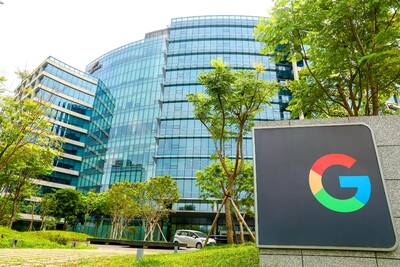
The government yesterday approved applications by Alphabet Inc’s Google to invest NT$27.08 billion (US$859.98 million) in Taiwan, the Ministry of Economic Affairs said in a statement. The Department of Investment Review approved two investments proposed by Google, with much of the funds to be used for data processing and electronic information supply services, as well as inventory procurement businesses in the semiconductor field, the ministry said. It marks the second consecutive year that Google has applied to increase its investment in Taiwan. Google plans to infuse NT$25.34 billion into Charter Investments Ltd (特許投資顧問) through its Singapore-based subsidiary Fructan Holdings Singapore Pte Ltd, and

JET JUICE: The war on Iran’s secondary effects have seen fuel prices skyrocket, knocking flight schedules down to earth in return as airlines struggle with costs Airline passengers should brace for more irritation in the next few months as carriers worldwide cancel flights and ground planes to cope with stratospheric increases in jet-fuel prices. Dutch flag carrier KLM is the latest company to cut its schedule, saying on Thursday that it would scrap 80 return flights at Amsterdam’s Schiphol Airport in the coming month. That puts it in the same league as United Airlines Holdings Inc, Deutsche Lufthansa AG and Cathay Pacific Airways Ltd, which have all pruned itineraries to mitigate costs. Global capacity for next month has been reduced by about 3 percentage points, with all
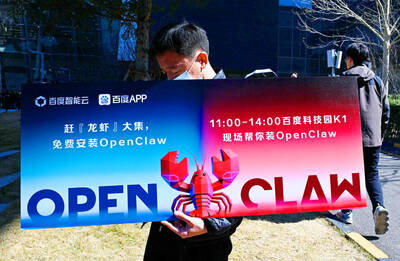
FORESEEABLE CONSEQUENCES: New technology always comes with new innovations by the iniquitous in exploiting users for financial gain or more nefarious ends Artificial intelligence (AI) “agents” say they can save users time and energy by automating tasks, but the growing power of systems such as OpenClaw is putting cybersecurity experts on edge. Powered by a wave of hype, OpenClaw today says it has more than three million users worldwide. The system allows users to create so-called agents, tools based on a large language model (LLM) such as OpenAI’s ChatGPT or Anthropic PBC’s Claude, that can carry out online tasks. “We’ve moved from an AI you could talk with via a chatbot to an agentic AI, which can take action... the threat and the risks are


 RSS
RSS