


Presale housing projects could rise by a double-digit percentage this year from last year due to continued economic improvement, but most of the projects are to be launched in the next six months to avoid the uncertainty related to year-end elections, the General Chamber of Commerce (GCC, 商業總會) said yesterday.
Presale projects offered could increase 21 percent, from NT$745.5 billion last year to NT$900 billion (US$25.19 billion to US$30.42 billion) this year, as healthy economic fundamentals at home and abroad give builders and developers more confidence, said GCC chairman Lai Cheng-yi (賴正鎰), who also heads Shining Construction Group (鄉林集團).
“Small apartments of between 18 ping and 25 ping [59.5m2 and 82.6m2] will be the mainstream products as bigger ones have difficulty finding buyers,” Lai said, adding that apartments smaller than 55 ping account for more than 90 percent of the market.
The central bank has implemented credit control measures on luxury homeowners, limiting mortgages to 60 percent of the evaluation, about 10 percent less than for typical mortgage applications.
Developers plan to launch most presale projects in the first half of this year as campaigning policymakers tend to vent rhetoric unfavorable to real-estate developments.
Taiwan is due to elect new local administrators and councilors by the end of this year.
Urban renewal projects are expected to dominate the Taipei market due to a lack of land, Lai said.
Shining moved staff from Taipei to its headquarters in Taichung last year, when they were unable to locate enough plots of land in the capital, he added.
New Taipei City will remain the most popular area for presale projects due to active transactions in Banciao (板橋), Tamsui (淡水) and Sinjhuang (新莊) districts, Lai said.
Despite an improving economy, price concessions of 10 to 15 percent are necessary to facilitate transactions, he said.
“Many prospective buyers would otherwise stay on the sidelines due to concerns over affordability and price corrections,” Lai added.
A growing number of people view real estate as an investment tool to generate rental yields and thus prefer small apartments, GCC supervisor Hsieh Kun-cheng (謝坤成) said.
The population decline also lends support to building small apartments, he said.
The chamber is pushing to abolish property taxes of up to 45 percent on houses resold within two years of purchase, Lai said.
“The government should think twice about keeping property taxes at unfavorable levels with real estate-related jobs totaling about 3 million,” he said.

ENERGY ISSUES: The TSIA urged the government to increase natural gas and helium reserves to reduce the impact of the Middle East war on semiconductor supply stability Chip testing and packaging service provider ASE Technology Holding Co (日月光投控) yesterday said it planned to invest more than NT$100 billion (US$3.15 billion) in building a new advanced chip testing facility in Kaohsiung to keep up with customer demand driven by the artificial intelligence (AI) boom. That would be included in the company’s capital expenditure budget next year, ASE said. There is also room to raise this year’s capital spending budget from a record-high US$7 billion estimated three months ago, it added. ASE would have six factories under construction this year, another record-breaking number, ASE chief operating officer Tien Wu

The EU and US are nearing an agreement to coordinate on producing and securing critical minerals, part of a push to break reliance on Chinese supplies. The potential deal would create incentives, such as minimum prices, that could advantage non-Chinese suppliers, according to a draft of an “action plan” seen by Bloomberg. The EU and US would also cooperate on standards, investments and joint projects, as well as coordinate on any supply disruptions by countries like China. The two sides are additionally seeking other “like-minded partners” to join a multicountry accord to help create these new critical mineral supply chains, which feed into

For weeks now, the global tech industry has been waiting for a major artificial intelligence (AI) launch from DeepSeek (深度求索), seen as a benchmark for China’s progress in the fast-moving field. More than a year has passed since the start-up put Chinese AI on the map in early last year with a low-cost chatbot that performed at a similar level to US rivals. However, despite reports and rumors about its imminent release, DeepSeek’s next-generation “V4” model is nowhere in sight. Speculation is also swirling over the geopolitical implications of which computer chips were chosen to train and power the new
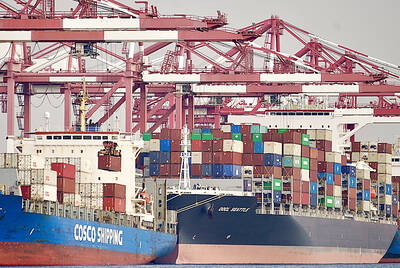
TECH WINNERS: Taiwan and South Korea reported robust trade, which suggests that they have critical advantages in the rapidly expanding AI supply chain, an official said Exports last month surged to a new high, as booming demand tied to artificial intelligence (AI) infrastructure fueled shipments of advanced technology components, underscoring the nation’s pivotal role in the global semiconductor supply chain. Outbound shipments climbed to US$80.18 billion, the highest ever for a single month, rising 61.8 percent from a year earlier and marking the 29th consecutive month of growth, the Ministry of Finance said yesterday. “The surge was driven primarily by global investment in AI infrastructure,” Department of Statistics Director-General Beatrice Tsai (蔡美娜) said. The mass production of next-generation AI computing systems has accelerated procurement across the semiconductor supply


 RSS
RSS