


Taiwan’s technology companies yesterday urged the government to take heed of Broadcom Ltd’s bid to acquire Qualcomm Inc, as the deal could have a significant affect on the sector.
Broadcom in November last year made an unsolicited US$105 billion offer to acquire Qualcomm, launching what would be the largest-ever technology takeover battle.
The deal could affect Taiwan’s semiconductor industry, including chip manufacturing, integrated circuit packaging, as well as information and communications technologies industries, the Allied Association for Science Park Industries said in a statement yesterday.
If combined, the two US companies could control half of the global market share for chips used in consumer electronics, granting them undue influence and bargaining power against suppliers, the association said, adding that this dominance would further pressure the profitability of local technology companies and affect the nation’s growth prospects.
LEVERAGE
The association said that as the deal requires government approval, it should leverage its position to stipulate added conditions to ensure the long-term prospects of local technology companies.
The association also urged the government to help local technology companies tap into opportunities from emerging fields, such as artificial intelligence (AI), the association said.
While Taiwan is well-positioned to supply vital hardware and components, such as flash memory to process data for AI applications, local companies require leadership from the government due to their smaller scale.
The government should take the lead in establishing a platform that would promote vertical collaboration across the supply chain, the association said.
Emerging fields such as AI, 5G networks and automotive electronics require immense investment, so industries must improve collaboration under the government’s guidance and assistance, it said.
ABOLISH LIMITS
The association advised the government to increase wages and research funding for university professors and researchers to cultivate and retain talent.
Association members support the Ministry of Science and Technology’s plans to abolish limits on wages for research assistants and for researchers to be paid up to NT$300,000, it said.
Businesses also need incentives to retain talent, such as improved tax rules on profit-sharing arrangements and dividend income, lest their best staff be poached by Chinese rivals, the association said.
However, Deputy Minister of Science and Technology Hsu Yu-chin (許有進) said that as the two chipmakers are not Taiwanese companies, the government can express its opinion, but has no authority to stop the acquisition.
The government is monitoring the deal and would continue to help in elevating the capabilities of local technology companies to preserve their bargaining power with buyers, Hsu said.

ENERGY ISSUES: The TSIA urged the government to increase natural gas and helium reserves to reduce the impact of the Middle East war on semiconductor supply stability Chip testing and packaging service provider ASE Technology Holding Co (日月光投控) yesterday said it planned to invest more than NT$100 billion (US$3.15 billion) in building a new advanced chip testing facility in Kaohsiung to keep up with customer demand driven by the artificial intelligence (AI) boom. That would be included in the company’s capital expenditure budget next year, ASE said. There is also room to raise this year’s capital spending budget from a record-high US$7 billion estimated three months ago, it added. ASE would have six factories under construction this year, another record-breaking number, ASE chief operating officer Tien Wu

The EU and US are nearing an agreement to coordinate on producing and securing critical minerals, part of a push to break reliance on Chinese supplies. The potential deal would create incentives, such as minimum prices, that could advantage non-Chinese suppliers, according to a draft of an “action plan” seen by Bloomberg. The EU and US would also cooperate on standards, investments and joint projects, as well as coordinate on any supply disruptions by countries like China. The two sides are additionally seeking other “like-minded partners” to join a multicountry accord to help create these new critical mineral supply chains, which feed into

For weeks now, the global tech industry has been waiting for a major artificial intelligence (AI) launch from DeepSeek (深度求索), seen as a benchmark for China’s progress in the fast-moving field. More than a year has passed since the start-up put Chinese AI on the map in early last year with a low-cost chatbot that performed at a similar level to US rivals. However, despite reports and rumors about its imminent release, DeepSeek’s next-generation “V4” model is nowhere in sight. Speculation is also swirling over the geopolitical implications of which computer chips were chosen to train and power the new
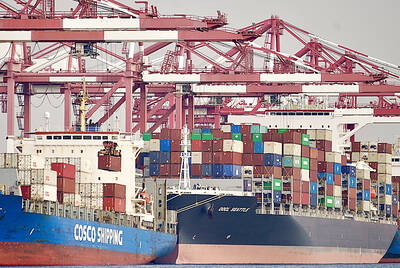
TECH WINNERS: Taiwan and South Korea reported robust trade, which suggests that they have critical advantages in the rapidly expanding AI supply chain, an official said Exports last month surged to a new high, as booming demand tied to artificial intelligence (AI) infrastructure fueled shipments of advanced technology components, underscoring the nation’s pivotal role in the global semiconductor supply chain. Outbound shipments climbed to US$80.18 billion, the highest ever for a single month, rising 61.8 percent from a year earlier and marking the 29th consecutive month of growth, the Ministry of Finance said yesterday. “The surge was driven primarily by global investment in AI infrastructure,” Department of Statistics Director-General Beatrice Tsai (蔡美娜) said. The mass production of next-generation AI computing systems has accelerated procurement across the semiconductor supply


 RSS
RSS